
What are the typical steps involved in a stairlift installation, and how do these impact the overall cost?
A stairlift installation typically involves a home assessment, measuring and designing the rail, selecting the stairlift and features, preparing the staircase, installing and testing the equipment, and explaining its safe operation. Each stage can affect the overall cost: staircase complexity, bespoke rail requirements, electrical work, access conditions, model choice and optional features may all increase the price compared with a standard installation.
A stairlift installation usually consists of a home assessment, staircase measurement, product and feature selection, preparation, rail and equipment installation, safety testing, and a handover explaining how to use the lift. The cost is mainly affected by the type of staircase, whether the rail is standard or bespoke, the stairlift model, any electrical or building work required, and the conditions at the property. A straightforward straight-stairlift installation is generally less involved than a curved or outdoor installation, while a reconditioned stairlift may reduce the equipment cost without removing the need for a safe, professional installation.
1. Initial discussion and home assessment
The process begins by understanding the user’s mobility needs, the people who may operate the stairlift, and the layout of the home. A proper assessment considers the staircase, landings, doorways, available transfer space, power supply and the safest position for getting on and off the lift.
The assessment is important because a stairlift should not be selected on price or appearance alone. The assessor may identify whether a straight, curved, hinged-rail, perch or outdoor model is more suitable. This stage may also reveal requirements such as a parking position beyond the top or bottom of the stairs, a powered swivel seat, or a rail that must avoid a doorway.
For most installations, the assessment is included within the quotation process. It can still influence the final price because a more involved property survey may identify work or equipment that would not be apparent from photographs or a telephone conversation.
2. Measuring the staircase and planning the rail
The installer measures the stair width, rise, going, landings, bends and available clearance. On a straight staircase, the rail may follow a standard configuration. On a staircase with a bend, intermediate landing or change in direction, the rail normally needs to be designed to fit the individual staircase.
A bespoke curved rail is one of the main reasons installation costs vary. Its design must account for safe travel, comfortable entry and exit, clearance from walls and doors, and the position of the lift when parked. The length and shape of the rail, the number of turns and the available space at the top and bottom can all affect the quotation.
Where the staircase has unusual dimensions or restricted access, additional planning may be needed. This does not necessarily mean that installation is impossible, but it can increase design, manufacturing and fitting requirements.
3. Choosing the stairlift and specification
The appropriate stairlift is selected once the assessment has established what the staircase and user require. The specification can include the seat style, weight capacity, controls, upholstery, swivel or powered functions, folding components, travel position and charging arrangement.
Optional features can increase the equipment price and, in some cases, affect installation time. For example, a powered swivel seat or powered footrest may require additional components and testing. A hinged or powered rail can be useful where a doorway or walkway is close to the bottom of the stairs, but its price and fitting requirements differ from those of a fixed rail.
Comfort and ease of use should be considered alongside cost. A lower-priced model may not be the most suitable if the user has difficulty bending, transferring or operating controls. Conversely, unnecessary features add to the price without improving the installation for that particular home.
4. Checking the electrical supply and preparing the site
Most stairlifts use a rechargeable battery system and need a suitable electrical supply for the charging point. The installer checks where the lift will charge and whether the existing socket and wiring are appropriate. If the supply is inconvenient or inadequate, electrical work may be needed before or during installation.
Preparation may also involve moving furniture, protecting flooring and walls, clearing the staircase, or agreeing how existing fixtures will be managed. If a handrail, radiator, door or other obstruction affects the proposed route, it may need to be adjusted or removed. Any building or electrical work outside the standard installation should be identified clearly in the quotation.
Outdoor stairlifts may require additional preparation because the lift is exposed to weather and may need suitable protection, drainage, a weather-resistant charging arrangement or a secure mounting surface. These conditions can make an outdoor installation more complex than an indoor equivalent.
5. Installing the rail and stairlift
On the installation day, the rail is secured to the stairs or another approved supporting structure, rather than relying solely on the wall. The carriage, seat, footrest, controls and safety equipment are then fitted. For a straight stairlift, the rail may be installed from prepared components. A curved rail is normally manufactured to the agreed measurements and fitted to follow the staircase precisely.
The installation time depends on the model, rail design, access to the property and any additional work. A simple straight installation usually involves fewer fitting stages. Curved, outdoor and unusually configured installations require more detailed alignment and adjustment. If the rail has to be manufactured specifically for the staircase, the planning and supply period may also be longer than for an available standard configuration.
6. Testing, commissioning and handover
After fitting, the installer checks the rail fixings, travel path, charging system, seat, belts, sensors, controls, stopping points and safety features. The stairlift should be tested under normal operating conditions, including its approach to the top and bottom of the stairs and any powered or hinged components.
The user is shown how to start, stop, charge and park the stairlift, use the safety belt and operate the controls. They should also understand basic precautions, such as keeping the travel path clear and reporting unusual noises, warning lights or changes in performance. This handover is part of a safe installation and should not be treated as an optional extra.
How each stage affects the overall cost
- Assessment and design: A standard staircase is usually simpler to survey and plan than one with tight turns, limited landings or restricted clearance.
- Rail type: A standard straight rail is generally less costly than a bespoke curved rail. Hinged, drop-nose and extended parking rails can add to the price.
- Stairlift model: New, reconditioned, heavy-duty, perch and outdoor models have different equipment costs and installation requirements.
- Features: Powered swivel seats, powered footrests, folding rails, alternative controls and other convenience features may increase the total.
- Electrical or building work: A new socket, cable routing, removal of an obstruction or repair to the supporting surface may be charged separately if required.
- Property access: Difficult parking, limited access, multiple floors or the need to protect and move household items can affect the time and labour involved.
- Removal or disposal: Taking away an old stairlift or disposing of packaging and redundant equipment may be included or priced as an additional service, so it is worth checking.
- Aftercare: Warranty terms, servicing arrangements and future maintenance do not usually form part of the fitting charge, but they are relevant when comparing the total cost of ownership.
Why an assessment is more reliable than a simple advertised price
An advertised starting price can only describe a particular stairlift and installation scenario. It may not include a bespoke rail, optional features, electrical work, removal of an existing lift or changes required by the layout of the home. A home assessment produces a more realistic quotation by identifying these issues before work begins.
When reviewing a quotation, check whether it states the stairlift model, rail type, included features, fitting work, electrical work, removal arrangements, warranty and any exclusions. Ask whether the price is for a new or reconditioned unit and whether the same installation standards, testing and handover apply. If the user’s needs may change, discuss this at the assessment rather than adding features without considering how they affect daily use.
Planning the installation
Once the specification is agreed, the installer can confirm the expected supply and fitting timescale. A standard stairlift that is available and suitable for the staircase may be arranged more quickly than a curved lift requiring a bespoke rail. Delays can also arise from electrical preparation, building work, restricted access or the need to coordinate removal of an existing stairlift.
The most cost-effective installation is not necessarily the one with the lowest initial price. It is the option that safely suits the staircase, can be operated comfortably, includes the work needed at the property, and avoids paying for features that are not useful. A detailed assessment and an itemised quotation make it easier to compare options and budget accurately.
A home assessment is the most reliable way to establish the likely cost of a stairlift installation. It allows the installer to inspect the staircase, measure the available space and identify any work needed before fitting can begin.
The assessment can show whether the installation needs a standard straight rail or a bespoke curved rail, as well as whether features such as a hinged rail, powered swivel seat or alternative controls would improve safety and ease of use. It also checks the charging point, access to the property and any obstructions that could affect the installation.
When reviewing the quotation, check that it clearly explains:
- the stairlift model and whether it is new or reconditioned;
- the rail design and included features;
- installation, testing and user handover;
- any electrical, building, removal or disposal work; and
- warranty and aftercare arrangements.
This makes it easier to compare like-for-like prices and reduces the risk of unexpected charges when the installation takes place.
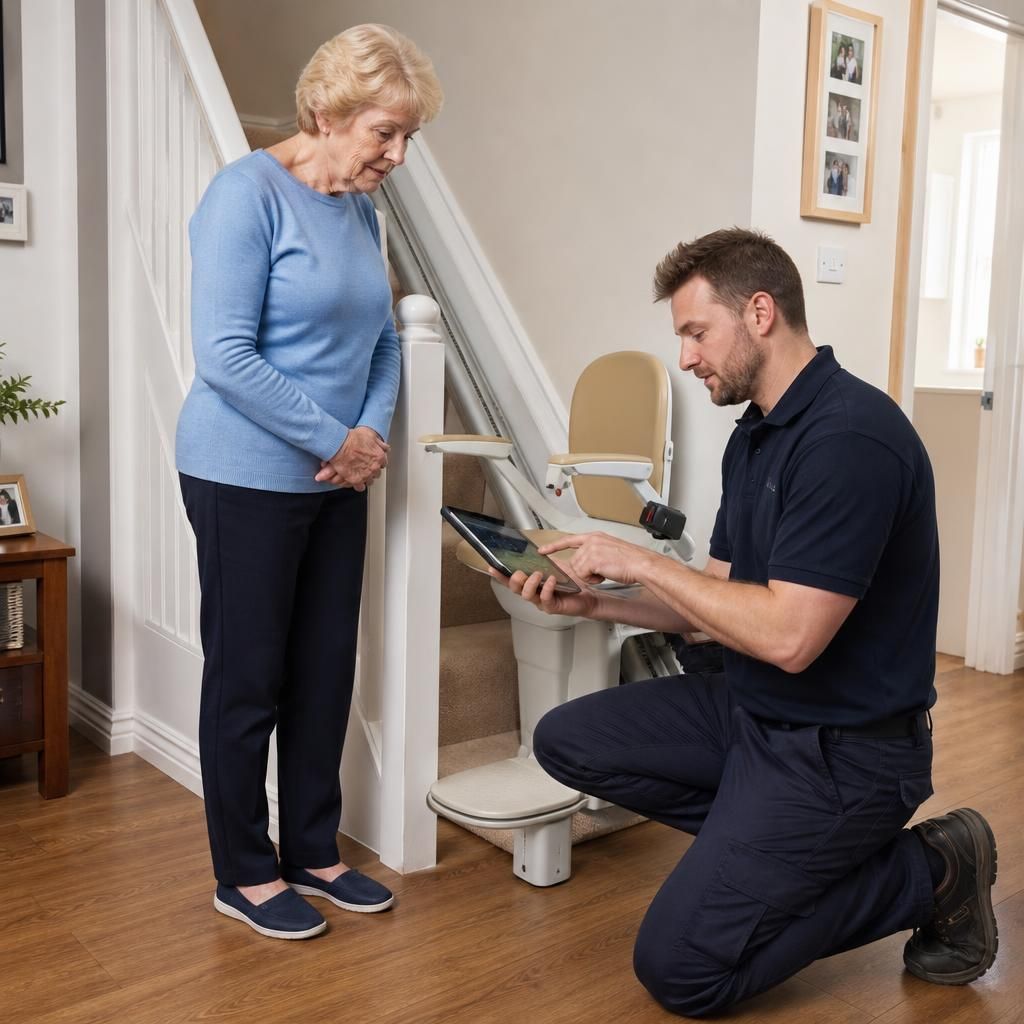
Book Your Stairlift Installation Assessment
Book a stairlift installation assessment with Independent Stairlifts to confirm the most suitable solution for your staircase and receive a clear, tailored quotation.