
How does the choice between new and reconditioned stairlifts impact installation costs?
A reconditioned stairlift usually has a lower upfront cost than a new model, while the installation charge is often similar because both require assessment, fitting and safety testing. The final price depends mainly on the staircase, whether the equipment is suitable and any adaptations or additional features required.
A reconditioned stairlift normally costs less to purchase than a new one, but the installation charge is often similar. This is because both options require a proper assessment, suitable fitting, safety checks and an explanation of how to use the stairlift. The main difference in the overall price usually comes from the equipment itself, the type of staircase and any work needed to make the installation safe and suitable.
What the installation price usually includes
Whether the stairlift is new or reconditioned, a professional installation should account for more than simply attaching the lift to the stairs. The price may include:
- A survey of the staircase, landings, access points and electrical supply
- Checking that the stairlift is suitable for the user’s mobility needs, weight and transfer ability
- Positioning the track, seat and controls safely
- Fitting the rail and charging equipment
- Testing the stairlift, safety sensors and emergency functions
- Demonstrating the controls and explaining day-to-day use
- Removing packaging and completing commissioning checks
These tasks are required for a reconditioned stairlift as well as a new one. A lower equipment price should not mean that the assessment or installation process is shortened.
Why reconditioned stairlifts can reduce the total cost
A reconditioned stairlift has previously been used and has been inspected, serviced and prepared for reinstallation. Depending on the model and its condition, it may offer a lower purchase price while still providing the essential functions needed for safe access between floors.
The saving is generally greatest where the stairlift uses a standard straight rail. Straight stairlift equipment can often be matched to another staircase of the same general configuration, although the rail, seat position and controls must still be assessed carefully. Reconditioned equipment may also be a practical option where the customer needs a basic model without features that are not required.
However, the lower equipment price does not automatically make every reconditioned installation the cheapest option. A stairlift that requires additional work, replacement parts or a different rail may reduce or remove the initial saving. The condition of the batteries, charging unit, upholstery, safety sensors and drive mechanism should all be considered before accepting a quote.
Why new stairlifts may cost more
A new stairlift usually has a higher initial equipment cost because it has not previously been installed and can be selected from the manufacturer’s current range. This can provide a wider choice of seat styles, controls, finishes, powered options and user adjustments. New equipment may also be preferable where the user has specific requirements that are not easily met by available reconditioned stock.
For a straight staircase, a new stairlift can still be relatively straightforward to fit. For a curved staircase, the price is more closely linked to the rail design and the complexity of the route than to whether the stairlift is new or reconditioned. A curved rail is normally made to follow the staircase, including bends, intermediate landings and changes in direction. As a result, the installation cost can remain substantial with either option.
The staircase often has more influence than the stairlift’s age
The most important cost distinction is usually between a straightforward straight installation and a bespoke or technically complex installation. Factors that can affect the price include:
- Whether the staircase is straight, curved, narrow or divided by landings
- The length and layout of the rail required
- Whether the stairlift must stop or park in a particular position
- Available clearance at the top and bottom of the stairs
- The need to preserve access to doorways, hallways or other parts of the home
- Any alterations needed to improve safe transfers or positioning
- Whether additional charging points, controls or electrical work are required
For this reason, a reconditioned stairlift on a complex staircase may cost more to install than a new stairlift on a simple staircase. Comparing only the age of the equipment can give a misleading impression of the final price.
Condition, compatibility and warranty should be checked
Before choosing a reconditioned model, ask what work has been carried out during its preparation. The assessment should establish whether the stairlift is compatible with the staircase and appropriate for the intended user. It is also sensible to clarify whether the price includes replacement batteries or worn components, installation, removal if the arrangement changes, and warranty cover for both parts and labour.
A new stairlift will generally come with current manufacturer support and a new-equipment warranty, subject to its terms. A reconditioned stairlift may have different warranty arrangements, so these should be explained in writing. A shorter or more limited warranty can affect the long-term value even when the initial installation price is lower.
Additional features can narrow the price difference
Optional features can add to the cost of either type of stairlift. Examples include a powered swivel seat, powered footrest, hinged or retractable rail, folding seat or controls positioned for a particular hand. These features may be necessary rather than optional if the user has limited strength, balance or flexibility.
When comparing a new and reconditioned quote, compare equivalent specifications. A basic reconditioned stairlift should not be compared with a new model that includes powered adjustments and enhanced access features. The relevant question is whether each option provides the same level of safety, comfort and independence for the person using it.
Installation quality remains essential
Reconditioned equipment should be installed to the same safety standard as new equipment. The installer should check the rail fixings, seat stability, belt, arm controls, charging system, obstruction sensors and stopping functions. The user should receive a practical demonstration and have the opportunity to operate the stairlift safely before the installation is completed.
Do not select an option solely because it has the lowest headline price. An unsuitable model, unclear warranty or unplanned adaptation can lead to additional expense and inconvenience. A slightly higher initial cost may be justified if it provides a better fit, more appropriate support or fewer foreseeable repairs.
How to compare the two options accurately
- Arrange an assessment of the staircase and the intended user’s requirements.
- Ask for separate details of the equipment cost, installation cost and any adaptations.
- Check whether the quoted stairlift is new or reconditioned and identify its model and specification.
- Confirm what inspection, servicing and replacement parts are included for reconditioned equipment.
- Compare warranty terms, maintenance arrangements and call-out cover.
- Check whether the quoted price includes delivery, commissioning, user training and removal of an existing stairlift where applicable.
- Consider the total cost over the expected period of use, not just the initial purchase price.
In practical terms, a reconditioned stairlift can be a cost-effective choice when a suitable model is available and the staircase is relatively straightforward. A new stairlift may be better when the user needs specific features, a bespoke curved installation or the reassurance of current equipment and comprehensive warranty support. An individual assessment and like-for-like quotation are the most reliable ways to establish how the choice will affect the installation cost in your home.
The choice between a new and reconditioned stairlift usually affects the equipment price more than the installation charge. Both options need a suitable assessment, secure fitting, safety testing and user instruction, so the installation work may be broadly similar when the staircase and specification are the same.
A reconditioned stairlift can reduce the overall cost when it is compatible with the staircase and has been properly inspected and serviced. Before comparing quotations, check that they include:
- Assessment of the staircase and the user’s requirements
- Inspection of the drive system, batteries, sensors, controls and safety belt
- Any replacement parts or adjustments needed before fitting
- Installation, commissioning and a demonstration of safe use
- Clear warranty and aftercare terms
On a curved or technically demanding staircase, the rail design and installation requirements may have more influence on the final price than whether the stairlift is new or reconditioned. A like-for-like quotation is therefore the most reliable way to compare the true cost.
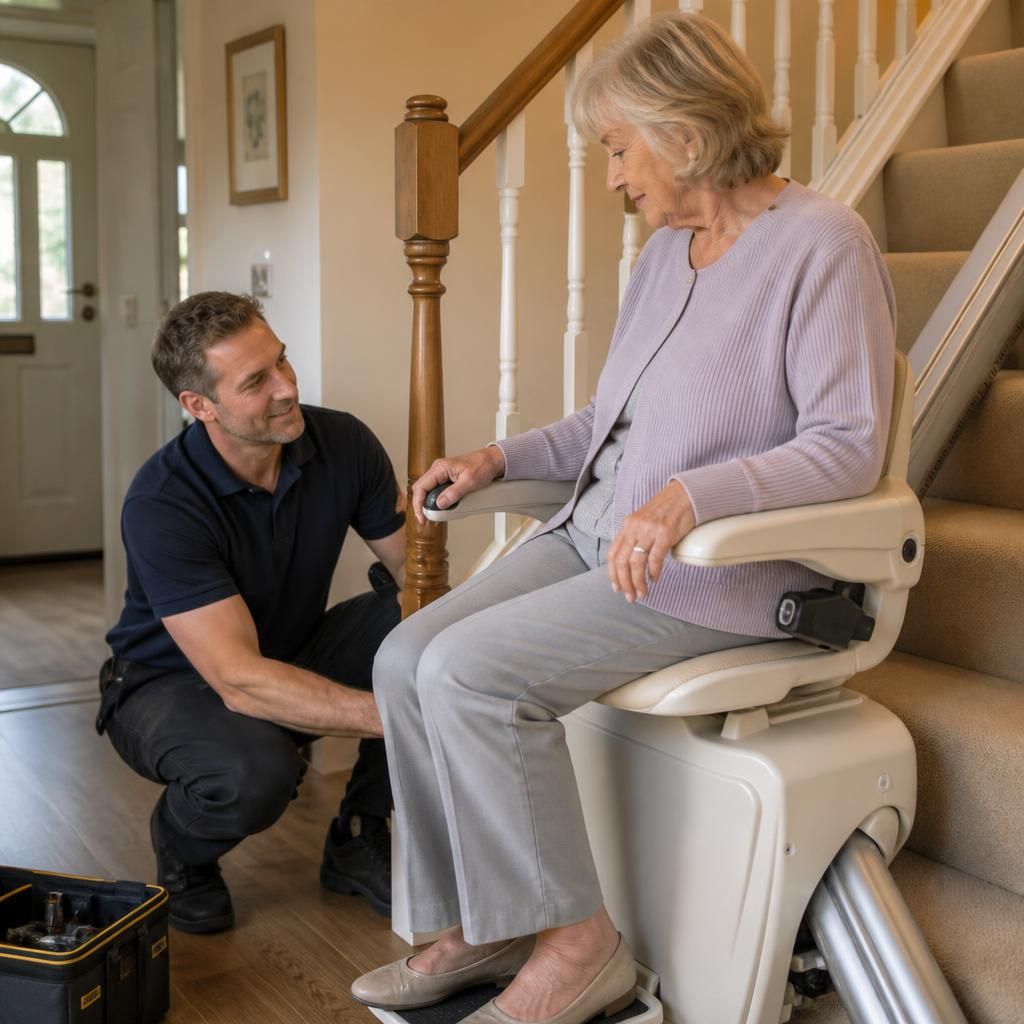
Arrange a like-for-like stairlift assessment
Arrange a like-for-like stairlift assessment to compare new and reconditioned options, including installation, warranty and aftercare costs. We can assess your staircase and recommend the most suitable solution for your requirements.