
How do stairlift installation costs vary between straight and curved staircases?
Straight stairlifts generally cost less to install because they use a standard rail, while curved stairlifts require a bespoke rail shaped to the staircase. The final price depends on the stair layout, installation requirements, chosen features and whether the stairlift is new or reconditioned.
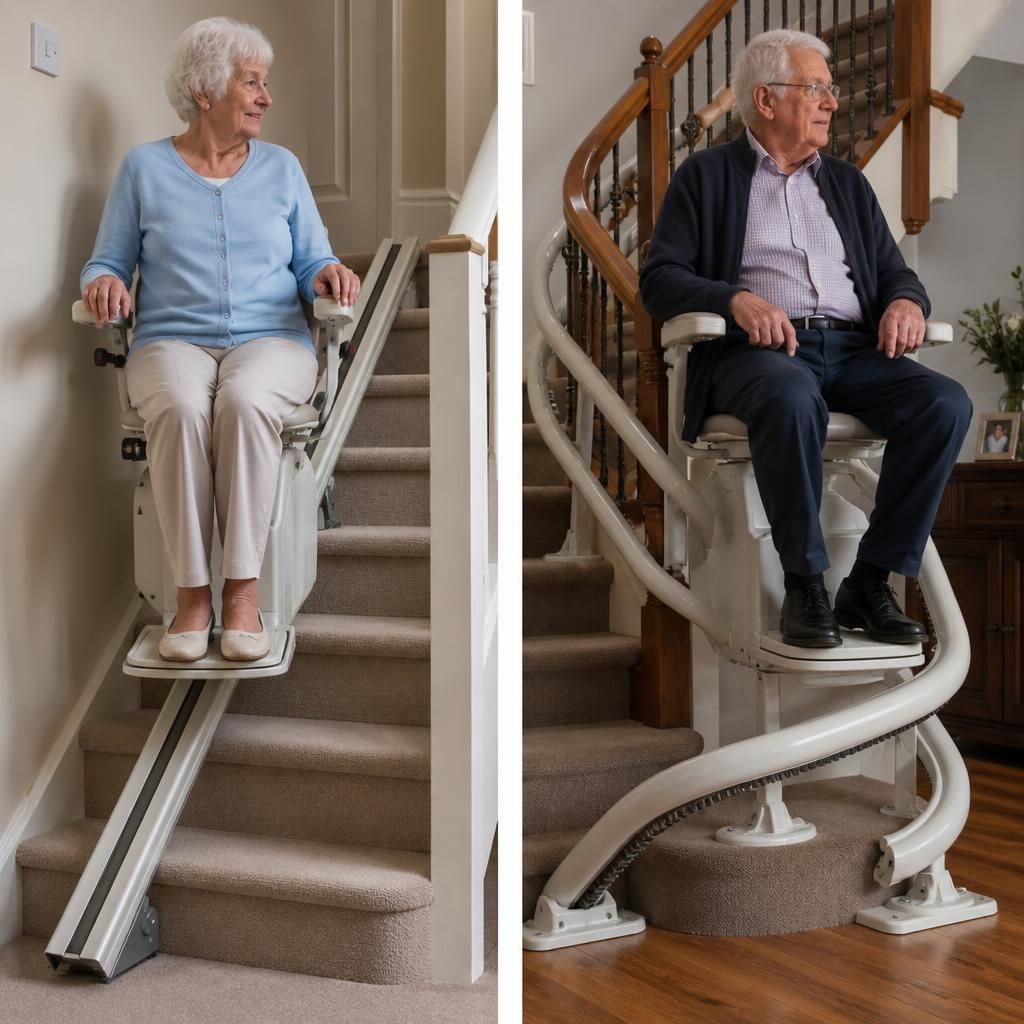
Stairlift installation costs are usually lower for a straight staircase than for a curved staircase. A straight stairlift normally uses a standard rail fitted along one uninterrupted flight, whereas a curved stairlift requires a rail designed and manufactured to follow the exact shape of the stairs. The staircase layout, installation work, equipment specification and whether the stairlift is new or reconditioned all affect the final quotation.
Why straight stairlifts generally cost less
A straight stairlift is fitted to a single flight without changes in direction, intermediate landings or steps that continue around a corner. Standardised rail sections and a relatively straightforward installation process usually reduce both equipment and labour costs. The surveyor still needs to check the stair width, available clearance, fixing points, parking position and the location of the power supply, but the assessment is normally less complex than for a curved installation.
Some straight stairlifts can be installed relatively quickly because the rail is prepared to suit a standard flight. This does not mean every straight staircase has the same price. A narrow staircase, unusual bottom or top step, restricted parking area, or need to route the lift around an obstruction may require additional components or a different rail arrangement.
Why curved stairlifts usually cost more
Curved stairlifts are made to fit the individual staircase. The rail may need to follow one or more bends, travel around a landing, change gradient or serve several floors. It is designed from measurements taken during a home survey and then manufactured for that particular layout. This bespoke process is the main reason curved stairlifts usually have a higher installation cost.
The cost can increase where the staircase includes multiple turns, tight bends, intermediate landings or several levels. A rail that serves more than one flight may also require additional design work and a longer installation. The position of the lift when it is not being used can affect the design too. For example, a parking area may need to be incorporated at the top, bottom or side of the staircase to keep access clear.
Curved installations can also involve more detailed fitting and adjustment. The installer must ensure that the rail follows the stairs accurately, that the carriage travels smoothly through each bend and that the lift parks safely without obstructing doors, corridors or landings. These requirements add to the labour involved, although the exact installation time depends on the individual property.
Key cost differences at a glance
- Rail: a straight stairlift commonly uses a standard or simpler rail, while a curved stairlift normally needs a bespoke rail.
- Design: curved systems require more detailed measurement, planning and manufacture.
- Installation: a straightforward flight usually needs less fitting and adjustment than a staircase with bends or multiple levels.
- Configuration: curved stairlifts may need additional rail sections, charging points, parking arrangements or controls to suit the layout.
- Features: powered swivelling seats, folding rails, powered footrests and upgraded controls can increase the price of either type.
- Condition: a reconditioned stairlift may reduce the equipment cost, although availability and suitability depend on the staircase and the model.
How the staircase survey affects the quotation
A home survey is important because the apparent shape of a staircase does not provide enough information for an accurate price. The surveyor assesses the full route, including the width of the stairs, the position of walls and doors, the space at the top and bottom, electrical access and any obstacles that could affect safe use. For a curved staircase, the survey also provides the measurements needed to design the rail.
The survey should identify whether a standard straight solution is appropriate or whether a curved system is needed. In some homes, a staircase may look broadly straight but include a short turn, a half landing or a change in direction that prevents a standard straight rail from serving the complete route. In other properties, separate solutions may be considered for different flights, but this depends on the layout, transfer points and the user’s mobility. A survey is needed to determine whether that arrangement is practical and safe.
New and reconditioned stairlifts
Choosing a reconditioned stairlift can reduce the initial equipment cost, particularly where a suitable model is already available for a standard straight staircase. The saving is not guaranteed for every installation. A curved rail is made for a particular staircase, so a previously used curved system is only suitable if its rail matches the new location or can be replaced and adapted appropriately. The condition of the carriage, batteries, controls and safety features should also be checked.
A quotation should make clear whether the price includes the stairlift, rail, installation, batteries, warranty, removal of an existing lift and any follow-up adjustments. Comparing the total scope of each quotation is more useful than comparing the equipment price alone.
Features that can change the cost
Both straight and curved stairlifts can be specified with features that improve comfort, access or ease of use. These may include a powered swivel seat, powered or automatic footrest, folding or hinged rail, upgraded upholstery, remote controls and different seat or weight-capacity options. A folding rail may be particularly useful where a door, hallway or walkway is close to the bottom of the stairs, but it can involve additional cost and installation requirements.
The most suitable features depend on how the stairlift will be used. For example, a powered swivel can assist someone who finds it difficult to turn or stand at the top of the stairs, while a folding rail can help preserve access around the foot of the staircase. Selecting only the features that address the user’s needs can help keep the installation within budget without compromising safe operation.
What should be included in the final price?
Before agreeing to an installation, check whether the quotation covers delivery, fitting, electrical work if required, testing, user instruction and removal of packaging or an old stairlift. It should also state any exclusions, such as structural alterations, repairs to damaged walls or steps, or work needed to move furniture. Ask whether VAT has been included and whether any applicable VAT relief can be applied to the purchase and installation.
The lowest initial price is not always the most cost-effective option. A stairlift that follows the staircase properly, parks in a convenient position and includes suitable safety and access features may provide better long-term value than a cheaper system that restricts movement around the stairs. Ongoing considerations include battery replacement, servicing, warranty cover and the availability of support if a fault develops.
In practical terms, a simple straight staircase is generally the more economical installation, while a curved staircase usually costs more because of its bespoke rail and additional design and fitting requirements. The reliable way to establish the cost for a particular home is to arrange a survey and request a written quotation that explains the equipment, installation work, included features and aftercare. This allows the solution to be assessed against both the staircase and the user’s accessibility requirements, rather than relying on a general straight-versus-curved estimate.
The main cost difference between straight and curved stairlift installations is the rail. A straight stairlift usually fits a standard rail along one uninterrupted flight, while a curved stairlift needs a rail measured, designed and manufactured to follow each bend, landing or change in direction.
This bespoke work means that curved installations generally involve more planning, fitting and adjustment. The survey also considers where the stairlift will park, whether doors or walkways need to remain clear, and whether features such as a powered swivel seat or folding rail are required. A written quotation following a home survey is therefore the most reliable way to compare the total cost for your staircase.
Arrange a stairlift survey and receive a tailored quotation
Arrange a home survey to confirm whether a straight or curved stairlift is suitable for your staircase and receive a tailored quotation. The assessment will account for the rail design, installation requirements, useful features and any applicable aftercare.