
How can I determine whether a straight or curved stairlift is most suitable for my staircase?
A straight stairlift is usually suitable for a staircase that runs directly from one floor to another without bends, landings or changes in angle. A curved stairlift is designed for stairs with turns, intermediate landings or multiple sections, so the right choice depends on your staircase layout and the route you need to use safely.
A straight stairlift is generally the most suitable option for a staircase with one continuous flight and no change in direction. A curved stairlift is usually required where the staircase includes a bend, intermediate landing, spiral section or more than one flight that needs to be covered as a continuous route. The layout of the stairs, rather than the age or model of the lift, is the main factor in deciding between the two.
Start by assessing the shape of the staircase
Look at the full route between the floors you need to access. A straight stairlift can normally be installed when the stairs run directly from the bottom to the top without a corner or landing interrupting the rail. The rail follows the staircase in a straight line and is manufactured to suit the length and angle of that flight.
A curved stairlift is designed for staircases that change direction. This may include:
- L-shaped or U-shaped staircases
- Stairs with a half-turn or quarter-turn landing
- Two or more flights connected by a landing
- Spiral or unusually shaped staircases
- Stairs with changes in angle or direction along the route
- Staircases where the lift needs to travel around a landing or finish in a specific position
Even a staircase that appears fairly simple may need a curved rail if the stairlift must continue around a corner or stop at a different point from a standard straight-flight installation.
Understand the difference between the two installation types
A straight stairlift uses a rail that follows one uninterrupted flight. It is generally simpler to survey and install because the rail does not need to be shaped around corners. It can be a practical choice where the staircase is suitable and the user only needs access between two floors along that single flight.
A curved stairlift uses a made-to-measure rail that follows the individual staircase. The rail can be designed around bends, landings and changes in direction, allowing the user to remain seated while travelling along the complete route. This avoids having to transfer to a second lift or walk across a landing between separate flights.
In some homes with more than one straight flight, it may be possible to install separate straight stairlifts. However, this means transferring between lifts, which may not be appropriate for someone with limited balance, strength or confidence. A curved installation may provide a more convenient route, although its suitability and cost depend on the staircase and the required access points.
Consider how the lift will be used
The best option is not determined by the staircase alone. Consider whether the user can safely sit down, stand up and transfer at the top and bottom of the route. The position of the lift when it stops is important, particularly if a doorway, narrow landing or hallway is close to the stairs.
A stairlift may be able to start or finish with the seat turned towards the landing. This can make getting on and off safer, but the available space must be checked carefully. On a curved staircase, the rail can sometimes be designed to continue beyond the top or bottom step, allowing the seat to stop in a more suitable position. This is known as an extended or parking section, but it requires enough clear space and may affect the design and price.
If the user has difficulty bending their knees or needs extra support, the assessment should also consider the seat, armrests, footrest, controls and seat height. These features can be available on both straight and curved stairlifts, but the staircase layout determines which rail type is needed.
Check the available width and surrounding space
Staircase width is relevant to both types of stairlift. The lift must leave sufficient room for safe use and, where possible, allow other household members to use the stairs. A narrow staircase does not automatically rule out a stairlift, but the surveyor will need to check the width of the steps, handrail position, walls, radiators, doorways and any obstructions.
Curved rails can be designed to follow the inside or outside of a bend. The best position depends on the shape of the landing, the direction of travel and where the user needs to get on and off. A rail placed on the inside of a turn may occupy less space in one part of the staircase, while an outside position may provide a better route in another. This cannot be decided reliably from a photograph alone.
Take account of landings and access to other floors
If the staircase has a landing, identify whether the user needs to access only one flight or all connected floors. A straight stairlift may be suitable for an individual flight, with a separate arrangement for another flight. If the aim is to travel from the lowest floor to the highest without leaving the seat, a curved stairlift is more likely to be appropriate.
Also consider whether the landing must remain clear for doors, cupboards, emergency access or other people using the home. The rail may be designed to park away from a doorway or at the top of the stairs, subject to the space available. These practical details are part of determining the right configuration rather than optional additions considered afterwards.
How the choice affects cost
For a suitable single flight, a straight stairlift will commonly involve a simpler rail and installation process than a curved stairlift. A curved stairlift requires a rail designed specifically for the staircase, so its price is usually influenced by the number and complexity of bends, the number of floors served, the parking arrangements and any unusual construction.
The cheapest option is not necessarily the most suitable if it requires the user to transfer between lifts or cannot stop safely at the required point. When comparing quotations, check that each option covers the same route, seat configuration, installation work, warranty and aftercare. A personalised assessment provides a more meaningful cost than choosing solely from a general price range.
What happens during a suitability assessment
- The staircase is inspected, including its width, gradient, turns, landings and available space at the top and bottom.
- The surveyor discusses which floors need to be accessed and whether the user can transfer safely between seats or at a landing.
- Potential obstructions such as doors, radiators, handrails and furniture are considered.
- The most suitable side of the staircase and parking positions are assessed.
- Seat options, controls, safety features and any access requirements are discussed.
- The proposed route is explained, together with any structural, electrical or installation considerations affecting the quotation.
Before the assessment, it can help to note which parts of the staircase are difficult to use, where the user needs to get on and off, and whether anyone else in the household must continue using the stairs. These details help ensure that the recommendation is based on everyday use rather than the staircase shape alone.
In summary, choose a straight stairlift when the required route is one uninterrupted flight. Choose a curved stairlift when the route includes bends, landings or multiple sections, or when transferring between separate lifts would be unsafe or impractical. Where the layout is uncertain, an on-site assessment is the reliable way to confirm the rail type, seating arrangement, installation requirements and total cost for the home.
The staircase layout determines whether a straight or curved stairlift is suitable. A straight stairlift follows one uninterrupted flight, while a curved stairlift is made to follow bends, landings, changes in direction or several connected flights.
An on-site assessment also considers where the user needs to get on and off, the available space, doorways and obstructions, and whether other household members need to keep using the stairs. This confirms the safest route and whether a curved rail or separate straight stairlifts would be more practical.
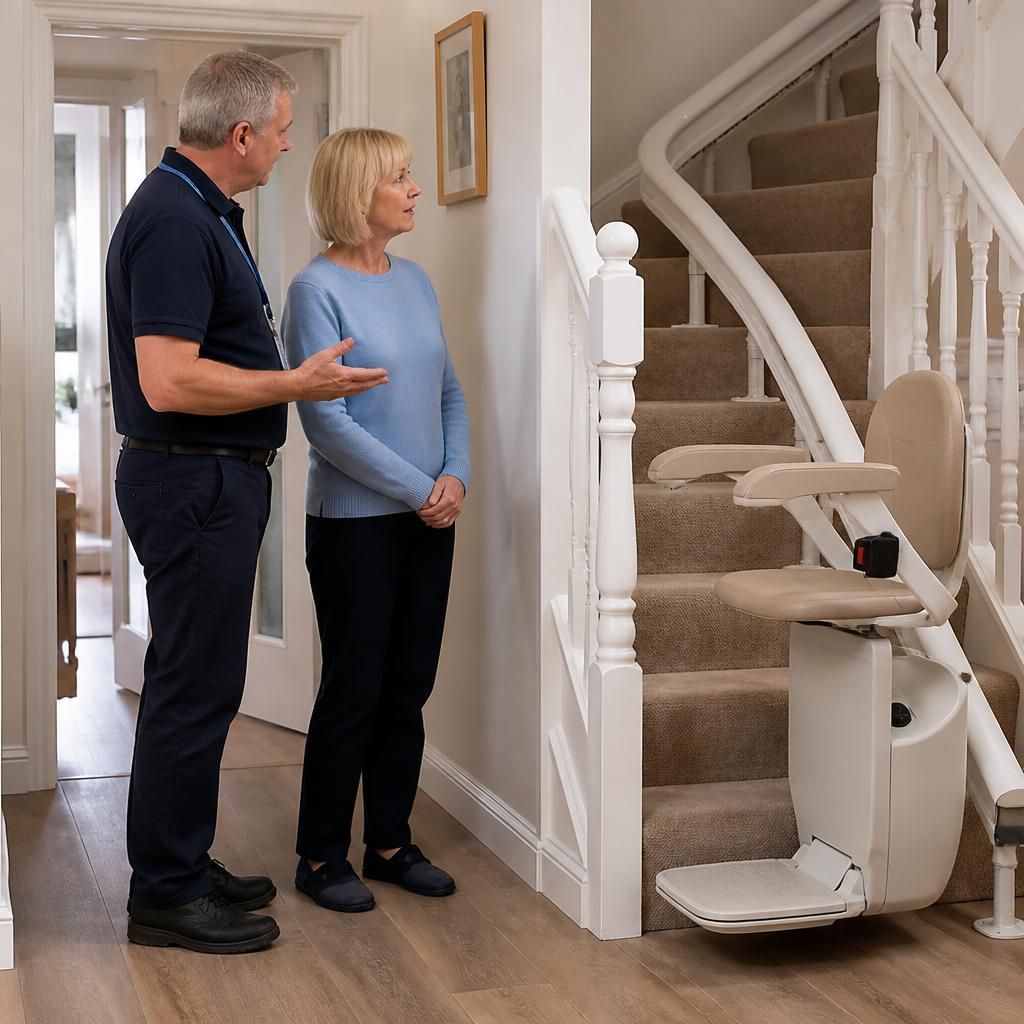
Book your personalised stairlift assessment
Book your personalised stairlift assessment to confirm whether a straight or curved stairlift is suitable for your staircase and access needs. Our assessment will also clarify the safest configuration and installation requirements.