
What specific features should I consider when selecting an outdoor stairlift for my property's unique layout?
When selecting an outdoor stairlift, consider weatherproof construction, a track design suited to the stairs and landings, reliable controls, safe seating and restraints, and charging arrangements that fit your property. A site assessment should also check gradients, bends, access points, exposure to rain or frost, and whether the lift can be parked securely without obstructing paths or doorways.
The most important outdoor stairlift features are weather-resistant construction, a track designed around the exact shape of the stairs, dependable safety controls and a secure charging and parking position. Your property’s gradients, bends, landings, exposure to the weather, access routes and available space should determine the specification rather than choosing a standard model based on the stair count alone.
An outdoor stairlift is exposed to rain, frost, sunlight, wind, dirt and changes in temperature. Look for construction that is specifically rated for external use, with corrosion-resistant materials and protected electrical components. The seat, armrests, controls and footrest should tolerate regular outdoor conditions, while exposed fixings and track components should be suitable for the location. A cover can provide additional protection when the lift is parked, but it should not be treated as a substitute for weather-resistant equipment.
Ask what level of weather protection applies to the complete lift and which parts need to remain sheltered. An installation beside a covered entrance may have different requirements from one on an open garden staircase. Drainage is also important: water should not collect around the track, charging point or lower landing. Where the stairlift will be exposed to coastal air, heavy rainfall or persistent shade, the assessment should consider the increased risk of corrosion, damp and frost.
Choose a track that follows the actual route of the stairs. Outdoor access stairs may be straight, curved, steep, narrow or interrupted by landings. A straight track can be suitable where the staircase has a consistent line, but bends, changes in gradient and intermediate landings may require a bespoke curved rail. The track should provide a smooth, stable journey without reducing safe access for people who still use the stairs.
- Curves and changes of direction: These should be measured accurately so the stairlift follows the staircase without fouling walls, gates, handrails or doorways.
- Landings: The track may need to finish in a position that gives the user enough room to dismount safely and reach the entrance or pathway.
- Steep or uneven steps: The lift and seat must remain stable throughout the journey, with the track installed securely to the structure rather than relying on unsuitable surfaces.
- Narrow passages: A compact folded profile, suitable armrests and a folding footrest can help preserve usable space when the lift is parked.
- Obstructions: Gates, walls, planters, bins, low roofs and opening doors should all be checked before the rail position is finalised.
Parking options are particularly important outside. The stairlift may need to park at the top, bottom or on a landing, depending on where the user needs to get off and where the lift can be kept clear of the weather. A powered or manual swivel seat can help the user turn towards the landing before standing. On a tight staircase, a hinged or removable section of track may be needed to prevent the rail obstructing a doorway or walkway. Any hinge must be positioned and operated safely, with enough clearance to use it without stretching across the stairs.
Safety features should match the user as well as the property. A comfortable seat with supportive arms and an adjustable or appropriately positioned footrest can make mounting and dismounting more controlled. A swivel seat may be valuable where the user cannot safely twist on the stairs. A seat belt or harness should be easy to fasten and release, while remaining secure during travel. Controls should be usable with the person’s grip, reach and dexterity in mind; simple directional controls and a clearly accessible stop function are generally preferable to complicated operation.
Check for sensors that stop the lift if the footrest or carriage encounters an obstruction. Safety edges, obstruction detection and a controlled start and stop can reduce the risk of impact, but they do not remove the need to keep the stairs and track clear. The installer should explain the emergency stop, manual lowering or recovery procedure, and what to do if the lift stops away from a charging point.
Controls on the armrest and a separate remote control can both be useful. A remote allows the lift to be called to the required end of the staircase, which is helpful when more than one person uses the property. It should not, however, be positioned where rain can damage it or where an unintended press could cause a hazard. The controls should be protected from moisture and checked as part of routine maintenance.
Reliable charging is essential for an outdoor installation. The charging points should be located where the lift can park safely and charge consistently, without blocking a door, path or gate. Many stairlifts are designed to charge when parked at designated points, so the user needs to know where those points are and whether the lift must be left in a particular position. If the stairlift is rarely used, the charging arrangement still needs to maintain the battery correctly.
Consider what happens during a power cut or if the lift is needed when it is not fully charged. Battery-backed operation can allow the lift to complete journeys during a mains interruption, but the available travel depends on the model, battery condition and usage. Ask how the batteries are protected from cold and damp, how their condition is checked and how replacement is arranged. Outdoor power supplies should be installed safely and in accordance with the relevant electrical requirements for the property.
The seat and footrest should suit the user’s height, leg position and transfer ability. A folding seat, arms and footrest can reduce the space occupied when the lift is not in use. Where the user has limited knee or hip movement, the assessment should consider seat height, swivel operation and the distance between the seat and the landing. A weather-resistant cushion or seat material may be appropriate, but it should still be comfortable, easy to clean and capable of drying properly.
Security features may be worthwhile where the staircase is accessible to visitors or passes through a shared area. A key switch or user control can help prevent unintended operation. The lift should also be capable of being parked in a position that does not create a trip or collision risk. If the property is unoccupied for periods, ask about isolation, battery care and protection from unauthorised use.
A site assessment should examine more than the line of the stairs. It should include:
- the width, gradient, surface and structural condition of each section of staircase;
- the location of bends, landings, gates, doors and changes in level;
- clearance around the seat, footrest, track and any folding or hinged section;
- where the user will approach, board and leave the stairlift;
- exposure to rain, frost, snow, wind, direct sunlight, mud and coastal conditions;
- the position of electrical supplies, charging points and weather protection;
- drainage and the risk of standing water around the lower and upper landings;
- safe access for servicing and battery replacement; and
- how the lift will affect other household members, visitors and emergency access.
Maintenance requirements should influence the specification. Outdoor stairlifts need regular checks of the track, fixings, batteries, charging contacts, safety sensors, seat belt and weather seals. Leaves, grit and mud should be kept away from moving parts, and the lift should be cleaned using the methods recommended for its materials and electrical components. Do not hose down the motor, controls or charging equipment unless the manufacturer specifically permits it.
When comparing options, ask for the proposed track route, parking position, weather protection, charging method, safety equipment and maintenance arrangements to be explained in relation to your own stairs. A properly surveyed bespoke solution may be more suitable than a lower-cost standard configuration when the property has bends, restricted landings, exposed sections or difficult access. The right features are those that allow the user to board, travel, dismount and leave the staircase safely in all seasons, while keeping the lift protected and the surrounding route usable.
For a property with bends, landings or restricted access, the track design and parking position are often the most important outdoor stairlift features. A bespoke rail can follow changes in direction and gradient, while a suitable parking point allows the user to dismount safely without blocking a doorway, path or gate.
During the survey, check clearance around handrails, walls, gates and opening doors. A folding footrest, swivel seat or hinged track section may help preserve usable space, but each feature must be positioned so it can be operated safely. The rail and charging point should also avoid areas where rainwater, mud or standing water could affect the equipment.
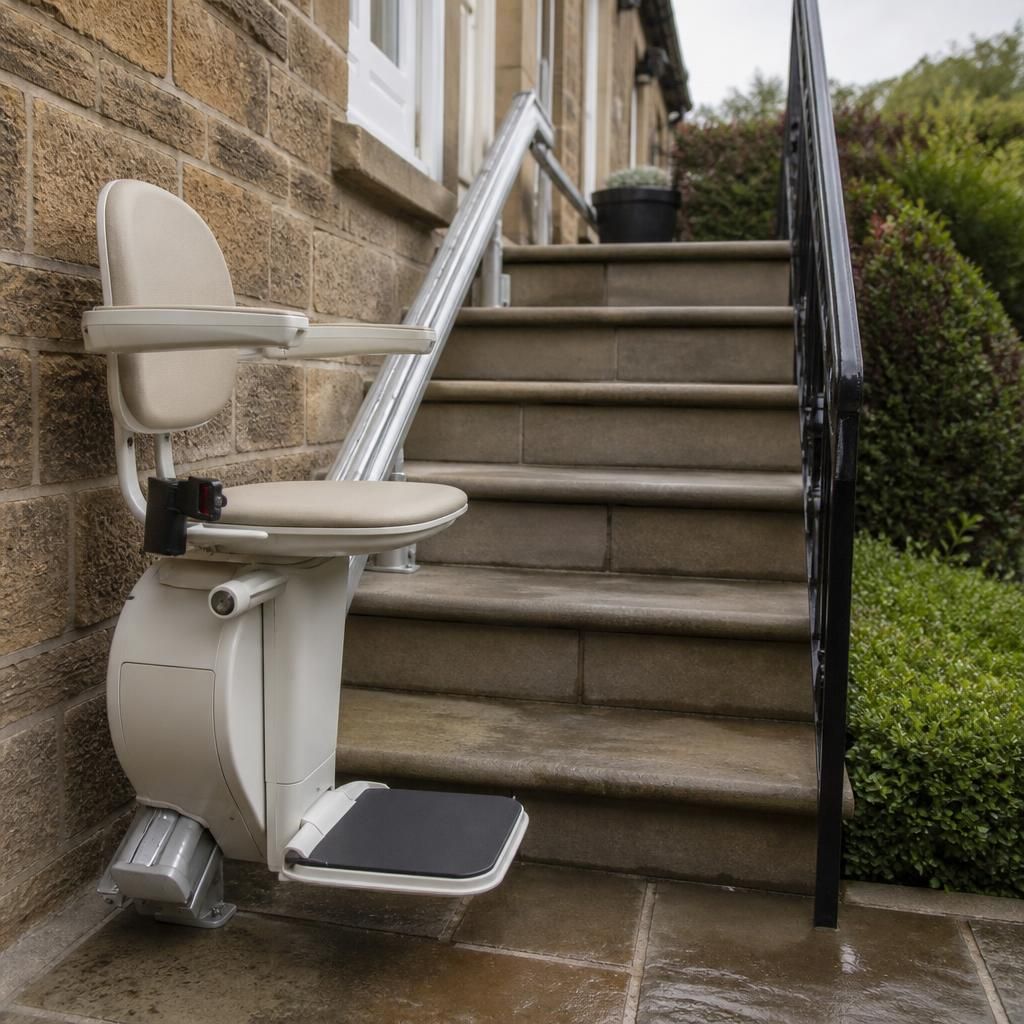
Arrange Your Outdoor Stairlift Assessment
Arrange an outdoor stairlift assessment to review your property’s layout, weather exposure, parking space and charging requirements. Independent Stairlifts can then recommend features and a track design suited to your access needs.