
What are the installation challenges unique to outdoor stairlifts?
Outdoor stairlift installations must account for weather exposure, moisture, temperature changes, uneven or unstable surfaces, and safe electrical protection. An expert assessment is needed to adapt the rail, fixings and controls to the property so the lift remains secure, reliable and suitable throughout the year.
Outdoor stairlift installation is more challenging than indoor fitting because the equipment and its supporting structure are exposed to rain, frost, sunlight, wind, dirt and changing ground conditions. The installer must assess the whole route, not just the staircase, then specify suitable weather-resistant equipment, fixings, electrical protection and drainage arrangements. Uneven steps, fragile surfaces, restricted access and difficult cable routes can also make the installation more bespoke than a typical indoor stairlift.
Weather exposure and moisture
An outdoor stairlift needs protection from conditions that would not normally affect an indoor model. Rain and condensation can reach the rail, carriage, controls, motor and charging points. Frost may affect moving parts, while prolonged sunlight can degrade some plastics, seals and finishes. For this reason, outdoor equipment should be designed and rated for external use, with suitable covers or weather protection where required. Weather-resistant does not mean that every component can be left permanently exposed without maintenance.
The position of the parked stairlift is important. If the seat, controls or charging contacts are left in an exposed location, they may collect water or debris. The installer may recommend a covered parking position, a protective cover or a change to the rail layout. These decisions need to balance protection against the available space, the user’s ability to transfer safely and the need to keep the staircase clear.
Uneven, worn or unstable steps
Outdoor steps are often made from paving slabs, concrete, brick, timber or metal, and their condition can vary considerably along the route. Frost damage, loose slabs, cracked concrete, moss and worn edges can make it difficult to create reliable fixing points. A rail must be securely supported throughout its length, so the installer may need to avoid damaged areas, use different support positions or recommend repairs before fitting.
Where the staircase is built on soil, a retaining wall or an older structure, its ability to carry the combined loads from the stairlift and user must be considered. Fixing into a weak surface can lead to movement, noise or premature failure. In some installations, additional brackets, a supporting frame or local structural work may be necessary. These requirements cannot be confirmed accurately from photographs alone; the condition and construction of the steps need to be inspected in person.
Non-standard layouts and rail design
Outdoor stairs frequently include turns, intermediate landings, narrow sections, changes in gradient or a final approach that is not level. The rail has to follow the route while maintaining safe clearances from walls, gates, paths, handrails and surrounding ground. At the top and bottom, there must be enough room for the user to get on and off safely without obstructing a doorway or walkway.
A straight external flight may still require a carefully positioned rail if the steps are not uniform. Curved or multi-level routes require more detailed measurement because the rail is made to suit the actual staircase. Overhanging branches, boundary walls, garden furniture and gates may also affect the usable route. In some cases, the most practical solution involves changing the parking position or adjusting access around the staircase rather than simply following its exact edge.
Drainage, debris and seasonal conditions
Water must be able to drain away from the steps, rail supports and electrical components. Pools of water can accelerate corrosion, encourage algae growth and make the user’s walking route slippery. Leaves, soil, grit and snow can obstruct the rail or affect the wheels and sensors. The installation assessment should therefore consider nearby gutters, downpipes, planting, irrigation systems and areas where rainwater runs across the staircase.
Good installation does not remove the need to keep the route clear. Regularly removing leaves and other debris, treating slippery growth appropriately and reporting unusual noise or movement can help preserve safe operation. During severe weather, the stairlift may need additional care in line with the manufacturer’s instructions. The user should know where the controls and charging points are located and how to keep them clean and dry.
Electrical supply and protection
Outdoor stairlifts need a suitable power supply positioned so that it is practical for charging but protected from accidental damage and direct weather exposure. The cable route may be complicated by external walls, paved areas, outbuildings or the distance between the staircase and the property’s existing supply. Cables must be secured and protected from water, impact, gardening equipment and other likely sources of damage.
External electrical work requires appropriate protection and testing by a suitably qualified person. The installer will consider earthing, isolation, residual-current protection and the suitability of the existing circuit, as well as how the equipment will be disconnected safely for maintenance. A convenient indoor socket is not automatically suitable for an outdoor installation. Any additional electrical work should be identified before the installation date so that the stairlift can be commissioned safely.
Safe access and clearances
The stairlift must leave enough usable space for the passenger and, where necessary, for other people who need to use the steps. Outdoor routes can be shared with visitors, delivery access, garden paths or emergency exits. The installer will check that the parked lift does not create a trip hazard, block a gate or prevent a door from opening fully.
Handrails, walls and nearby planting can restrict the passenger’s elbows, knees or clothing. Wind may also affect a folding footrest, seat or safety arm when the equipment is being used. The seating position, swivel function, belt, footrest and controls should be assessed against the user’s mobility and the conditions at the top and bottom of the staircase. If the user has difficulty standing or turning, the landing arrangement may be as important as the lift itself.
Corrosion, security and vandalism
Salt-laden air is an additional consideration for homes near the coast, while roads, fertilisers and garden chemicals can also contribute to corrosion. Materials, finishes and fixings should be selected for the environment, and exposed parts need to be kept clean in accordance with the manufacturer’s guidance. The installer should also consider whether the stairlift is visible from a public path or accessible to children, pets or unauthorised users.
Some properties need a secure way to prevent unauthorised operation when the lift is not in use. The location of the charger, remote controls and covers may need to be planned around this requirement. Security measures must not make it difficult for the intended user to reach, operate or charge the stairlift.
How an assessment addresses these challenges
A proper survey normally reviews:
- the construction, condition, width and gradient of every step;
- the proposed rail route, parking positions and transfer areas;
- wall, paving and structural fixing points;
- drainage, exposure to wind and sunlight, and nearby vegetation;
- the electrical supply, cable route and external protection;
- clearances around doors, gates, handrails and shared pathways;
- the user’s transfer ability, controls and preferred direction of travel; and
- access for installation, future servicing and removal of the equipment.
The survey findings determine whether standard outdoor equipment is appropriate or whether a bespoke rail, extra supports, protective housing, surface preparation or electrical work is needed. They also help identify work that should be completed before fitting, such as repairing loose paving, improving drainage or clearing the route.
Outdoor stairlift installation challenges are therefore mainly structural, environmental and practical rather than simply mechanical. Choosing equipment intended for external use is only one part of the solution. Correct measurements, sound fixings, protected electrics, suitable clearances and a maintenance plan are what allow the stairlift to remain safe and dependable through changing UK weather. If the staircase or surrounding ground changes after installation, it should be reassessed rather than adapting the equipment without professional advice.
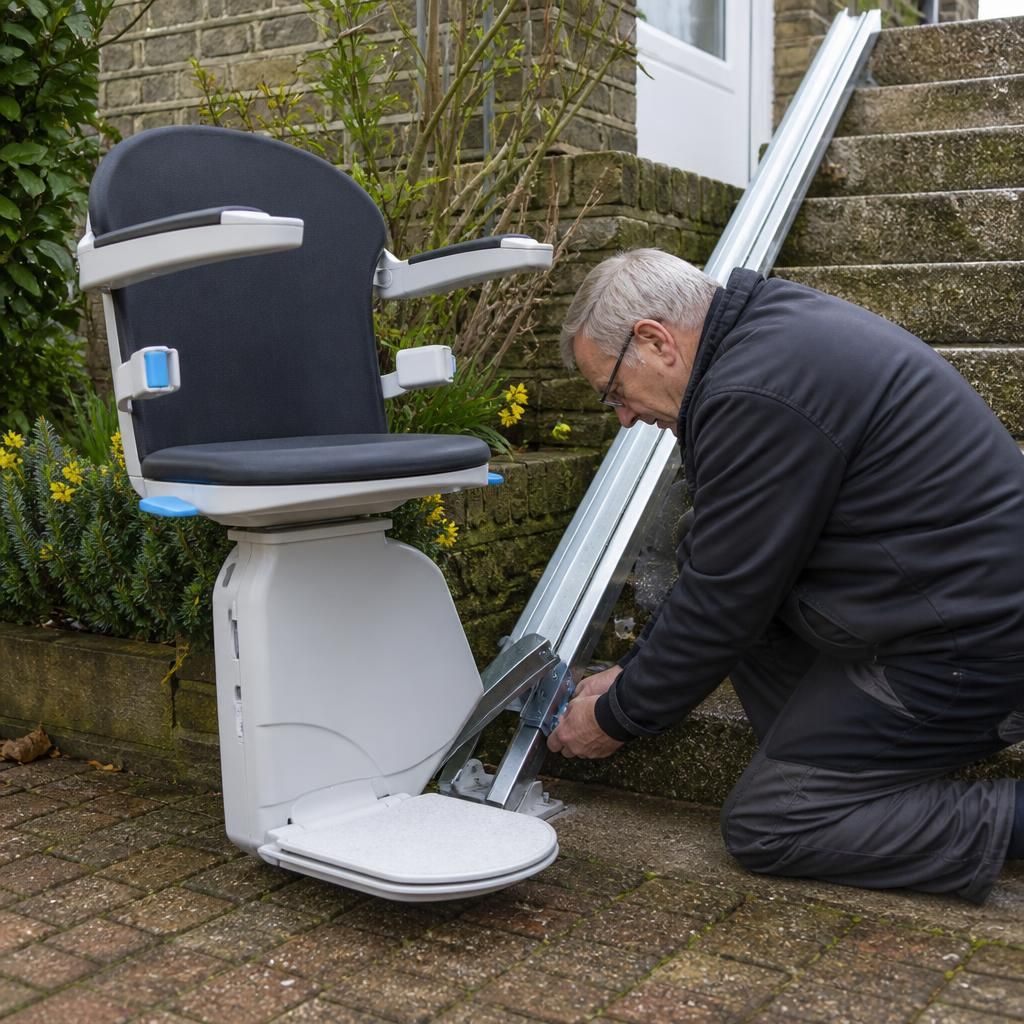
Secure fixing is one of the most important outdoor stairlift installation challenges because external steps may be uneven, cracked, loose or built on surfaces that cannot safely support standard brackets. The installer must inspect the construction and condition of the staircase before deciding where the rail supports can be positioned.
Where paving, concrete or brickwork is damaged, additional supports, a revised rail position or preparatory repairs may be needed. This helps prevent movement and keeps the stairlift stable during use. A professional site assessment is essential, as photographs cannot reliably show the strength, drainage or condition of outdoor fixing points.
Arrange an Outdoor Stairlift Assessment
Arrange an outdoor stairlift assessment so we can inspect your staircase, fixing points, drainage, electrical supply and access requirements before recommending a suitable installation.