
What are the benefits of choosing a bespoke outdoor stairlift solution over a standard model?
A bespoke outdoor stairlift is designed around the exact shape, gradient and access requirements of your garden steps, rather than fitted as a standard solution. This can provide a safer, more comfortable and durable journey, with weather-resistant features and a layout that makes better use of the available space.
A bespoke outdoor stairlift is designed around the precise shape, gradient, surface and access points of your external steps, whereas a standard model is intended to suit a more limited range of layouts. This tailored approach can provide a safer, more comfortable and more dependable way to manage garden steps, particularly where the staircase is steep, uneven, narrow, curved or exposed to difficult weather conditions.
Better suited to the layout of your steps
Outdoor access routes often vary considerably. Steps may change direction, include intermediate landings, follow a curved wall or run alongside a narrow path. A bespoke stairlift can be planned around these features rather than requiring the property to be altered to accommodate a standard rail.
During an assessment, the installation team considers the complete route, including the position of the top and bottom landings, available clearance, gates, doorways, paths and any turning areas. The rail can then be configured to follow the practical line of travel while maintaining appropriate clearance for the user and other people using the steps.
Improved safety on uneven or challenging access routes
A tailored installation can address risks that may be overlooked when a standard model is used on a difficult staircase. These may include changes in gradient, awkward entry and exit points, restricted headroom, slippery surfaces and areas where the user needs to approach the seat from the side.
Where appropriate, the design may incorporate features such as powered swivelling, a suitable seat position, adjustable arms, safety belts and controls that are easy to operate. The aim is to provide a stable transfer on and off the lift and a controlled journey along the full route. The installation should also leave enough room for safe movement around the equipment, although the available space and the stairlift design will determine what is possible.
Greater comfort and easier transfers
A bespoke solution can be specified to reflect the user’s mobility, posture and transfer needs. Seat height, armrest position, footrest arrangement and control location can all affect how easily someone gets on and off the stairlift. This is especially important outdoors, where a wet landing, uneven paving or limited shelter may make transfers more difficult.
The most suitable arrangement depends on the individual. Someone with reduced knee movement may need a different seating and transfer position from someone who has difficulty standing or turning. An assessment allows these practical considerations to be considered alongside the shape of the steps, rather than treating the stairlift as a one-size-fits-all product.
More appropriate protection from the weather
Outdoor stairlifts need protection against rain, moisture, temperature changes, dirt and, in some locations, coastal exposure. A bespoke outdoor specification can take account of how exposed the route is and where the equipment will be stored when it is not in use.
Weather-resistant materials and covers can help protect key components, while suitable positioning can reduce direct exposure where the property layout allows it. This does not make an outdoor stairlift maintenance-free. The lift still needs to be kept clean, checked regularly and protected from standing water, debris and avoidable damage. A tailored design simply makes it easier to match the equipment and its protection to the actual outdoor conditions.
More effective use of limited space
External steps are often positioned beside walls, railings, hedges, driveways or narrow paths. A standard rail may project into a walkway, obstruct a gate or prevent a door from opening fully. A bespoke design can consider these surrounding features and, where the equipment allows, include a rail arrangement that folds, parks or finishes in a more suitable position.
Space-saving planning is particularly important when other people need to use the steps or when the route forms part of an emergency or everyday access path. The installation must balance the user’s needs with clearance for pedestrians, property access and safe operation.
A better fit for unusual stair configurations
Bespoke outdoor stairlifts are useful where the steps are not a simple straight flight. A curved or multi-section route may require a rail made to follow several changes in direction. Even on a straight staircase, the exact rail length, landing position and parking arrangement may need to be adapted to the property.
For very short, irregular or particularly steep steps, the correct solution may not be an outdoor stairlift at all. A platform lift, ramp, handrail improvement or other access arrangement could be more appropriate, depending on the space and the user’s abilities. A professional assessment should identify these limitations before any equipment is recommended.
Potentially better long-term reliability
Reliability depends on the quality of the equipment, installation, use and maintenance, not simply on whether the stairlift is described as bespoke. However, a lift that is correctly matched to the route is less likely to create avoidable problems caused by poor clearances, unsuitable parking positions or excessive exposure.
The assessment should consider drainage, power supply, charging positions, surface condition and access for future servicing. It should also identify whether nearby trees, leaves, grit or salt could affect the rail or moving parts. These details support a more practical installation and make routine checks easier.
Adaptation to changing mobility needs
A tailored design can take current and foreseeable mobility needs into account. For example, the user may need simpler controls, a more supportive seat or a different transfer position in the future. It is not always possible to predict every change, and a bespoke stairlift cannot replace a clinical assessment, but planning around the person’s circumstances can avoid selecting equipment that is difficult to use from the outset.
It is also important to consider who else may use the access route. Controls, parking points and the position of the rail should be practical for carers, family members and visitors without compromising the user’s safety.
When a standard outdoor stairlift may be suitable
A standard model can be appropriate where the steps are straight, have consistent dimensions, offer sufficient clearance and have straightforward entry and exit points. It may provide a simpler installation when the environment is sheltered and the user’s requirements are well served by the available standard adjustments.
The benefit of choosing bespoke does not mean that the most complex option is always necessary. The right choice is the one that safely suits the staircase, the property and the person using it. A site assessment should explain which elements genuinely need tailoring and which can be met with standard components.
What to discuss during an assessment
- The exact route, including bends, landings, surface changes and access to doors or gates.
- How the user will approach, transfer onto and leave the stairlift at each end.
- Clearance for other people, walking aids, wheelchairs and everyday access.
- Exposure to rain, frost, dirt, salt air and direct sunlight.
- Where the stairlift will park and how it will be protected when not in use.
- The location of the power supply and charging points.
- Cleaning, servicing and access to components if repairs are required.
- Whether an alternative access solution would be safer or more practical for the property.
In summary, the main advantage of a bespoke outdoor stairlift is that the equipment is planned around the real conditions of the property and the person using it. Compared with a standard model, it can offer a more suitable route, safer transfers, improved comfort, better use of limited space and more appropriate protection from outdoor conditions. The value comes from the assessment and design decisions, so the recommended specification should be based on the staircase, environment and individual mobility needs rather than on the label alone.
A bespoke outdoor stairlift is designed around the actual shape, gradient and access points of your external steps, rather than relying on a standard rail arrangement. This is particularly useful where the route is curved, narrow, uneven or affected by gates, walls and limited landing space.
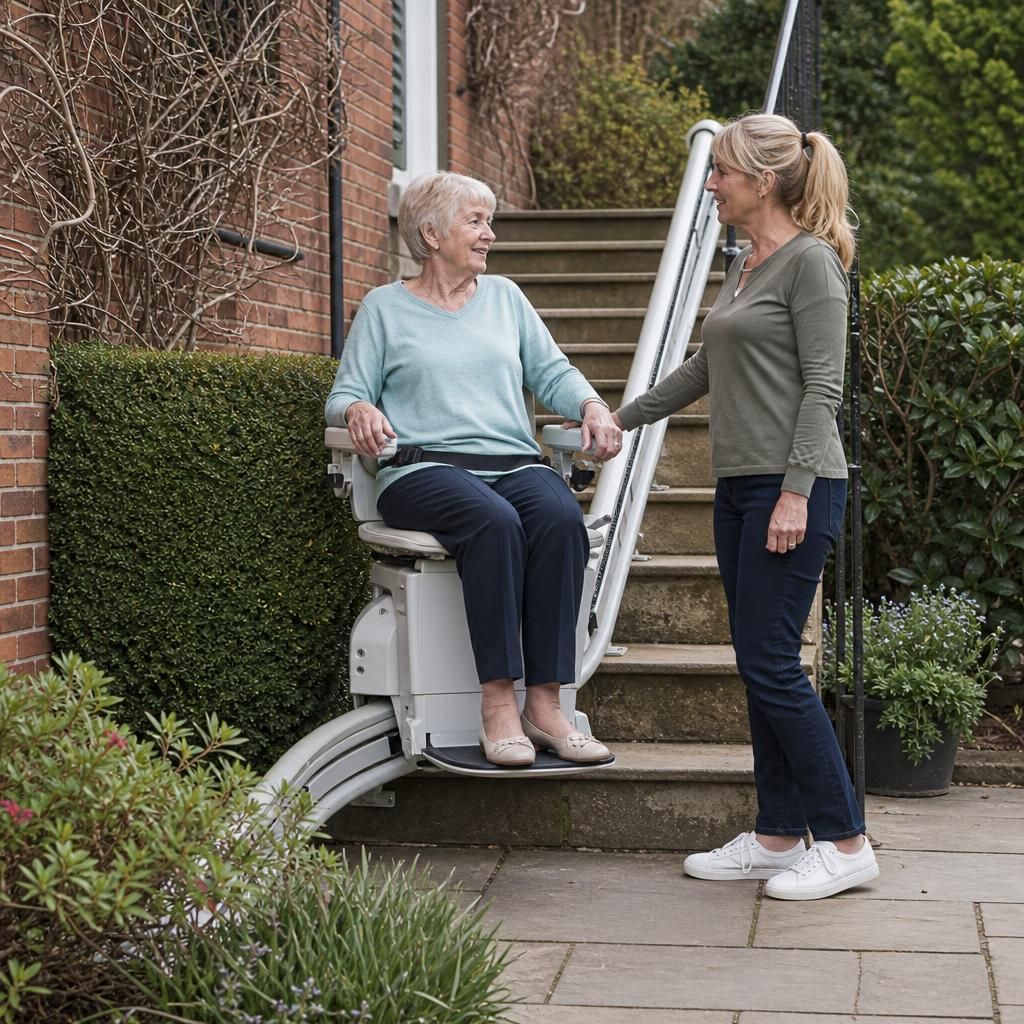
During an assessment, the installation team considers how you approach the stairlift, transfer onto the seat and leave it at the top or bottom. The position of the rail, seat and controls can then be planned to support safer transfers while preserving practical clearance for other people using the steps.
A tailored design can also account for outdoor conditions. The specification and parking position may be chosen with exposure to rain, frost, dirt, coastal air and direct sunlight in mind. Weather protection does not remove the need for cleaning and servicing, but it can help the equipment suit the environment and remain accessible for routine checks.
Arrange Your Bespoke Outdoor Stairlift Assessment
Arrange a bespoke outdoor stairlift assessment with Independent Stairlifts to review your steps, access requirements and exposure to the weather. We can explain which features and layout will provide the most suitable solution for your property.