
How do outdoor stairlift features differ from indoor models, and what impact does this have on pricing? Outdoor stairlifts use weather-resistant materials, sealed controls and more durable safety features, so they typically cost more than indoor models; the final price also depends on the staircase, installation and required customisation.
Outdoor stairlifts differ from indoor models through weather-resistant materials, sealed controls, corrosion protection and safety features designed for changing conditions. These additions, together with potentially more demanding installation and bespoke track requirements, generally make outdoor stairlifts more expensive than comparable indoor models.
Outdoor stairlifts are built to withstand rain, frost, sunlight, dirt and changing temperatures, whereas indoor models are designed for a relatively controlled environment. This means an outdoor model normally uses more durable materials, better-sealed electrical components and additional protection for the seat, controls, track and battery. Those features increase the equipment cost, while the external staircase and installation conditions can also make the overall price higher than that of a comparable indoor stairlift.
Weather-resistant construction is the main difference. Outdoor stairlifts commonly use corrosion-resistant fixings and finishes to reduce deterioration caused by moisture and temperature changes. Components exposed to sunlight may also need protection against ultraviolet damage, while surfaces and upholstery are selected to cope with damp conditions and regular cleaning. The exact level of protection varies between models, so an assessment should establish whether the stairlift will be fully exposed, partly sheltered or installed in a particularly demanding location such as near the coast.
Outdoor protection does not mean that every part can be left permanently exposed without care. A suitable cover may be recommended when the stairlift is not in use, particularly for the seat, arm controls and charging points. Good drainage is also important. Water should not collect around the track, steps, footrest or charging contacts, and the installation should not obstruct existing drainage routes. These requirements can affect both the product selected and the work needed during installation.
Controls and electrical components are generally more resistant to water and dust on an outdoor model. Buttons, switches, wiring and control housings may be sealed or positioned to reduce exposure. Outdoor units also need charging arrangements that remain reliable in changing conditions. If the stairlift cannot be parked at a suitable charging point, the installer may need to consider the track layout, power supply and how the lift will be used between charges.
Indoor stairlifts can often use lighter finishes and less specialised protection because they are not routinely exposed to rain, frost or direct sunlight. Their controls and charging points still need to be safe and dependable, but they do not usually require the same degree of environmental sealing. This difference in specification is one reason an outdoor stairlift is not simply an indoor model placed outside.
Safety features may also be adapted for outdoor conditions. The stairlift should provide secure travel when steps are wet, dirty or affected by seasonal debris. Depending on the design, useful features may include:
- weather-resistant controls that can be operated reliably with cold or damp hands;
- a seat, armrests and footrest that can be folded or positioned to reduce exposure and keep the steps clear;
- sensors that help detect obstacles on the track or staircase;
- durable, non-slip surfaces where appropriate;
- a swivel seat or powered movement option where the landing is narrow or uneven;
- remote controls, allowing the stairlift to be called to the required end of the track; and
- a suitable cover or parking position to protect the equipment when it is not being used.
Not every feature is necessary for every property. For example, a sheltered straight flight may need less protection than an exposed staircase with no canopy. A remote control may be particularly useful where more than one person uses the stairs, while a powered swivel or hinged rail can be important if the landing is restricted. Selecting only the features that solve a genuine access or environmental issue can help keep the price appropriate.
The staircase and site usually have as much influence on price as the outdoor specification. A straight external flight may allow a relatively straightforward installation, but the cost can rise where the stairs are uneven, unusually wide, steep, curved or interrupted by gates and landings. The installer may need to design a track around obstacles, allow clearance from walls or railings, or position the stairlift so that it does not interfere with doors, paths or other access routes.
External fixing can require more preparation than an indoor installation. The survey may need to consider the condition and strength of the steps, wall or supporting structure, the position of handrails, the surface beneath the staircase and the risk of water collecting at fixing points. Where the existing structure is unsuitable, additional supports, brackets, foundations or other preparation may be required. These site-specific works are priced separately from the basic stairlift in some quotations, so it is important to check what is included.
Track design affects the price directly. A standard rail for a simple straight staircase is usually less complex than a bespoke rail following several changes in direction. Outdoor tracks may also need additional consideration for parking, access at the top and bottom, weather exposure and safe clearance from nearby structures. A curved or individually configured outdoor stairlift therefore tends to cost more because the rail is made to suit the property rather than selected as a standard length.
Other factors that can influence the quotation include the chosen seat and control options, the need for a folding or hinged rail, electrical work, lifting or access equipment, removal of an existing stairlift and any repairs needed before installation. A reconditioned outdoor stairlift may be available in some circumstances, but it still needs to be suitable for external use and correctly assessed for the particular staircase. An indoor reconditioned model should not be treated as an equivalent outdoor solution.
Maintenance can add to the long-term cost. Outdoor equipment is exposed to conditions that can accelerate wear, including moisture, grit, frost, heat, salt and organic debris. Regular cleaning, checking of charging contacts, inspection of fixings and attention to covers or drainage can help identify problems early. Servicing may also need to pay closer attention to corrosion, seals, wiring, batteries, track condition and moving parts than would be necessary for an indoor model. The recommended schedule depends on the model, exposure and frequency of use.
Using the stairlift correctly also protects its performance. The user should follow the manufacturer’s guidance for covers, charging and cleaning, avoid placing wet or unsuitable items on the seat, and report unusual noises, reduced battery performance, sticking controls or visible corrosion. A cover should not be fitted in a way that traps moisture against the equipment, and the stairlift should not be used if water has entered an electrical component or if a safety fault is displayed.
The most reliable way to compare prices is to compare complete, site-specific quotations rather than headline equipment prices. Each quotation should make clear whether it includes the outdoor-rated stairlift, track, batteries, charging equipment, delivery, installation, electrical work, structural preparation, access equipment, warranty and aftercare. Ask whether the proposed model is intended for the level of exposure at your property and what ongoing maintenance or replacement items may be chargeable.
An assessment should consider the staircase, landing areas, weather exposure, drainage, power supply, user’s mobility and the way the stairlift will be parked and covered. This allows the specification to be matched to the property instead of paying for unsuitable features or discovering additional installation work later. In summary, outdoor models cost more because they combine environmental protection with potentially more complex installation requirements; the final price is determined by the level of exposure, the stairlift’s features, the track design and the work needed to install it safely.
Outdoor stairlifts cost more than indoor models because they are designed to resist rain, frost, sunlight, dirt and changing temperatures. Weather-resistant materials, sealed controls, corrosion-resistant fixings and protected charging components help the stairlift operate reliably in an exposed position.
The level of protection required depends on the staircase. A partly sheltered flight may need a different specification from one that is fully exposed or close to the coast. Covers, suitable drainage, protected charging points and durable seating can also affect the quotation. These features add to the equipment cost, while external fixing, electrical work and bespoke track requirements may increase installation costs.
When comparing quotations, check that the price includes the outdoor-rated equipment, track, installation and any site preparation. An indoor stairlift or indoor reconditioned model should not be used as an equivalent simply because its initial price is lower.
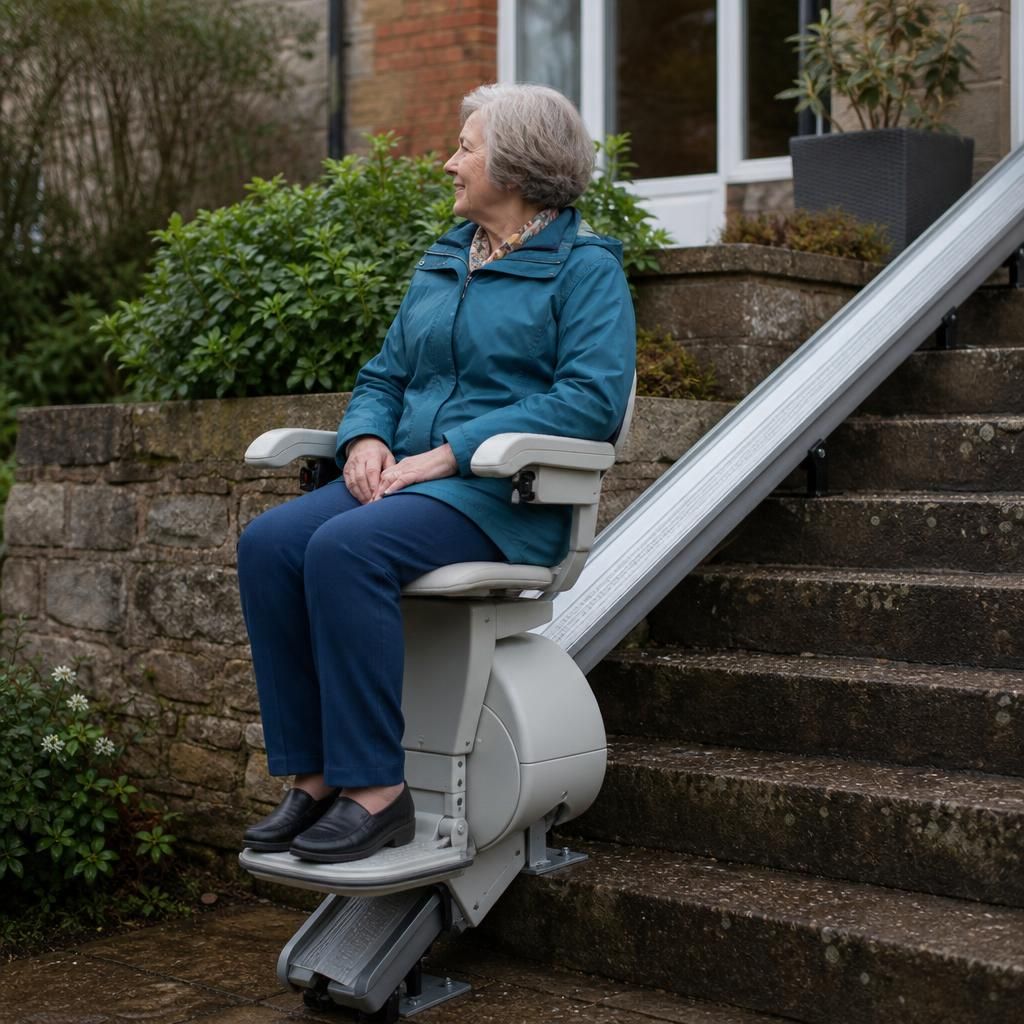
Arrange a tailored outdoor stairlift assessment
Arrange a tailored outdoor stairlift assessment with Independent Stairlifts to review your staircase, weather exposure, access requirements and charging arrangements. We can then recommend suitable features and provide a site-specific quotation covering the equipment and installation work required.