
Are there specific regulatory requirements for outdoor stairlifts in the UK?
Yes. Outdoor stairlifts in the UK must meet relevant machinery safety, electrical safety and installation requirements, with the equipment selected and fitted according to the manufacturer’s instructions and the property’s conditions. A professional assessment should confirm that the lift is suitable for the outdoor location, safely installed and properly maintained.
Outdoor stairlifts in the UK must comply with the safety legislation and technical standards that apply to stairlift machinery, electrical equipment and the installation itself. There is not usually a separate set of regulations applying only to outdoor stairlifts. Instead, the lift must be suitable for external conditions, correctly marked and documented, installed in accordance with the manufacturer’s instructions, and commissioned so that it can be used safely at the property.
The main requirements concern the following areas:
- Product safety and machinery requirements
- Electrical safety and electromagnetic compatibility
- Protection against weather, moisture and corrosion
- Safe installation and continued maintenance
- Building access, fire safety and the condition of the property
Product safety and conformity marking
A stairlift is machinery, so the manufacturer must design and produce it to meet the relevant machinery safety requirements. In Great Britain, this generally involves the Supply of Machinery (Safety) Regulations 2008, as amended, together with any other product safety legislation that applies to the equipment. The manufacturer or responsible supplier should carry out the necessary conformity assessment, provide technical information and issue a declaration of conformity.
You should also see the appropriate conformity marking on the stairlift or its documentation. Depending on where the product is placed on the market and the rules applying at the time, this may be a UKCA or CE marking. Different arrangements apply in Northern Ireland, so the supplier should confirm which marking and conformity route is relevant to the installation location. A marking alone is not proof that a stairlift is suitable for every outdoor setting; the equipment still needs to be specified and installed correctly.
Relevant technical standards
Stairlift manufacturers and installers commonly use recognised British or European standards when designing and assessing equipment. BS EN 81-40, which covers safety rules for stairlifts and inclined lifting platforms, is particularly relevant to this type of product. Standards are not legislation in themselves, but following an appropriate designated or harmonised standard can help demonstrate that the equipment has been designed to meet the applicable essential safety requirements.
The manufacturer’s instructions are also important. They should cover matters such as the permitted gradient, track arrangement, maximum load, travel limits, charging system, operating temperatures, exposure limits and maintenance procedures. An outdoor model should not be treated as an indoor stairlift simply because the route appears straightforward.
Electrical safety outdoors
Outdoor stairlift systems and their chargers must be suitable for the electrical conditions in which they are used. Relevant requirements may include electrical equipment safety and electromagnetic compatibility legislation, as well as the requirements for the fixed electrical installation supplying the charger.
Where new wiring, a socket, an isolator or other fixed electrical work is required, it should be designed and installed by a suitably competent electrical professional. The installation may need protection appropriate for an external environment, such as suitable enclosures and residual-current protection. The exact arrangement depends on the property, the existing consumer unit and the manufacturer’s instructions, so it should be assessed rather than assumed.
Outdoor electrical components should have an appropriate level of protection against water and dust, often described by an IP rating. The correct rating depends on the component’s position and the degree of exposure. A covered porch, an open balcony and an uncovered garden staircase do not present the same conditions. Cable routes, plugs, charging points and control equipment must also be positioned to reduce the risk of water ingress, damage or tripping.
Weather resistance is part of suitability
There is no general rule that makes every stairlift suitable for outdoor use. The model must be specifically designed or approved for external conditions. The assessment should consider rain, frost, direct sunlight, wind, condensation, dirt, leaves, salt and any nearby sources of spray. Metalwork and fixings may require protection against corrosion, particularly near the coast or where de-icing materials are used.
Weather protection does not mean that an outdoor stairlift can be left without care. Covers, drainage and protective housings must be used as instructed, and water should not be allowed to collect around the track, controls, batteries or charging equipment. Severe weather can affect availability even where the equipment remains compliant and correctly installed.
Installation and commissioning
The installer should assess the complete route before work begins. This includes the strength and condition of the steps, walls, landings, paving and fixing points; the position of gates and doors; the clearance from obstructions; and the way the stairlift will be accessed at the top and bottom of the stairs.
Installation should follow the manufacturer’s instructions and include suitable anchoring, safe clearances and correctly positioned controls. The installer should check that the lift stops safely, that safety edges and sensors operate correctly, and that the user can mount and dismount without entering an unsafe area. The stairlift should be tested and commissioned before handover, with operating and emergency instructions provided to the user or their representative.
An outdoor installation must not create an avoidable hazard for other people using the steps. For example, the parked stairlift should not obstruct a critical access route, prevent a gate from operating or leave insufficient space for pedestrians. Where the staircase forms part of an access or escape route, the proposed installation should be considered alongside the property’s fire safety arrangements.
Building and planning considerations
A domestic stairlift will not normally require planning permission, but this is not universal. Planning considerations may arise if the installation changes the external appearance of a property, projects into a public area, affects a listed building or takes place in a conservation area. Local authority requirements can also apply where the stairlift is fitted as part of an adaptation funded through a grant.
Building regulations may be relevant where the work alters the structure, access arrangements or electrical installation. The stairlift itself does not remove the need to keep steps, handrails, landings and surrounding surfaces reasonably safe. An installer should identify any property-specific issue before accepting the installation rather than relying on a standard layout.
Maintenance and ongoing safety
Regulatory compliance does not end when the stairlift is installed. The owner should follow the service schedule, keep charging points and running surfaces clear, report unusual noise or movement, and arrange repairs through a suitably competent provider. Outdoor equipment generally needs closer attention to corrosion, drainage, weather seals, batteries and exposed controls than an equivalent indoor model.
Users should not modify the stairlift, fit unapproved covers or extend wiring without professional advice. Any alteration can affect the conformity assessment, electrical safety or weather protection. The manufacturer’s instructions should state which cleaning products, covers and replacement parts are permitted.
Domestic use and other duties
Some workplace equipment duties, such as the Provision and Use of Work Equipment Regulations, are mainly relevant where a stairlift is used by employees or in a work environment rather than in an ordinary private home. Other regimes may apply in care settings, rented accommodation or managed properties. A landlord, care provider or organisation should obtain advice on its separate inspection, risk assessment and record-keeping responsibilities.
If an outdoor stairlift is being considered for a particular property, the most reliable approach is a site assessment before selecting the model. Ask the installer to confirm the applicable conformity marking, the outdoor suitability of the lift, the proposed electrical supply, any planning or building-related issue, the commissioning checks and the recommended maintenance plan. This creates a clear record that the equipment has been matched to the route and the conditions rather than installed as a standard indoor product.
Outdoor stairlifts must be specifically suitable for external conditions; an indoor model is not automatically safe to use outside. The installer should check the manufacturer’s stated limits for rain, frost, sunlight, temperature, moisture and corrosion before recommending a lift.
The site assessment should also cover the electrical supply, charging point, cable routes, drainage, fixing surfaces and clearances. Components exposed to weather need appropriate protection, and the lift must be tested and commissioned after installation. Following the manufacturer’s maintenance instructions is essential, particularly for cleaning, covers, batteries, seals and corrosion checks.
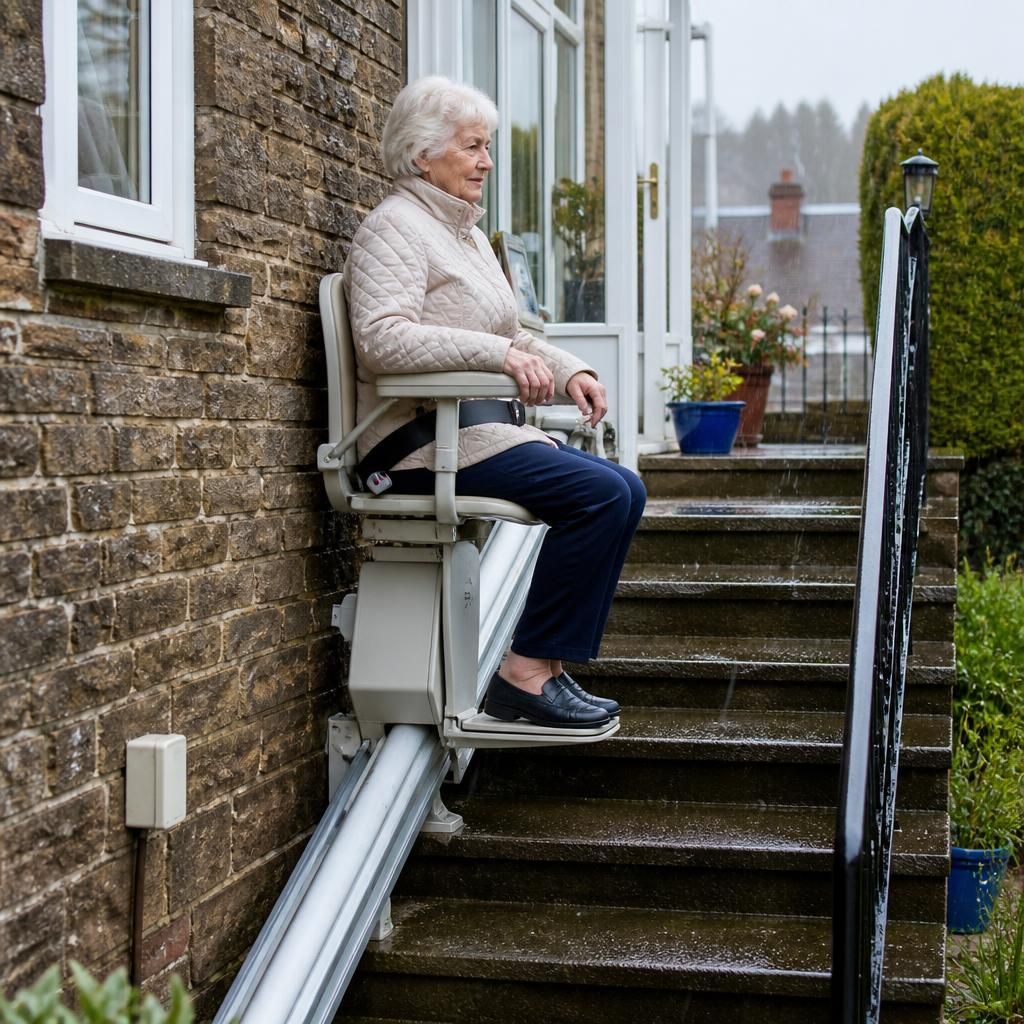
Arrange an Outdoor Stairlift Site Assessment
Arrange an outdoor stairlift site assessment so we can check the route, electrical supply, fixing points and exposure to weather. We will help confirm which model and installation approach are suitable for your property.