
How does customisation impact the cost of stair chair lift installations?
Customisation can increase stair chair lift installation cost because the rail, controls, seating and safety features may need to be adapted to your staircase and mobility needs. A bespoke assessment identifies which options are necessary, helping you compare the added cost of each feature with the benefits it provides.
Customisation affects stair chair lift installation cost by changing the design, equipment and labour required for your staircase. A standard straight stairlift usually needs fewer adaptations, while a curved, unusually shaped or outdoor staircase may require a bespoke rail, additional controls and more involved installation. The final price should therefore reflect both the physical layout of your home and the features needed for safe, comfortable use.
The staircase is usually the main cost factor. A straight flight can often accommodate a standard rail and installation process. If the stairs include a bend, landing, change of direction or several flights, the rail must be measured and made to follow the staircase. Tight turns, narrow sections and limited space at the top or bottom can require additional design work and careful positioning. These requirements increase the cost of the equipment and may also increase installation time.
A bespoke rail is not necessarily needed because the staircase is large. Compact or awkward layouts can be more demanding than a wide staircase with plenty of clearance. The assessment should consider the full route, including where the stairlift will start and finish, whether doors or walkways could be obstructed, and whether the user can transfer safely at each end.
Seat and user-positioning choices can also change the price. A standard seat may be suitable for many users, but some homes and mobility needs call for a different arrangement. Options can include a powered swivel seat, a manual swivel mechanism, a perch or standing seat, adjustable armrests, a higher or lower seat position, and additional support for posture. These features may make transfers easier or improve comfort, but they are not all necessary for every installation.
Some seating options require extra mechanical or electrical components. A powered swivel, for example, may add to the equipment cost and require additional installation checks. A perch-style seat can be useful where knee movement or staircase width is restricted, but suitability depends on the user’s balance, strength and ability to remain securely positioned. The correct choice should be based on a practical assessment rather than selected as a general upgrade.
Controls and access arrangements are another area of customisation. Stairlifts commonly use controls on the armrest, but the position and type of control may need to suit limited hand movement, reduced grip or one-sided weakness. Call and send controls at the top and bottom of the stairs can be useful where more than one person uses the lift or where the stairlift needs to be parked away from a landing. Additional controls may increase the quoted price, although they can be important for convenient and safe operation.
Safety-related adaptations should be considered separately from optional comfort features. A seatbelt, obstruction sensors, swivel locking mechanism, braking system and safe travel controls are fundamental parts of a suitable stairlift. A bespoke assessment may identify the need for a particular safety arrangement because of the staircase or the user’s mobility. These requirements should not be removed simply to reduce the initial price.
Electrical work and site conditions can add to installation costs. Most stairlifts use rechargeable batteries, but the charging points and power supply must be positioned appropriately. If the existing electrical arrangement is unsuitable, additional work may be needed. Outdoor installations may require equipment designed to withstand weather exposure, along with suitable protection for the charging point and controls. These conditions can make an outdoor stairlift more expensive than an equivalent indoor model.
Customisation can also involve changes to the way the stairlift is parked. A folding rail, hinged rail or shorter parking arrangement may be considered where the rail could interfere with a doorway, hallway or accessible route. These solutions can help preserve use of the stairs and surrounding space, but they may involve additional components and installation work.
Reconditioned stairlifts may offer fewer customisation choices. A reconditioned straight model can be cost-effective where the staircase and user requirements match an available configuration. Curved stairlifts, unusual layouts and specialist seating may have fewer suitable pre-owned options because the rail is made for a particular staircase. Choosing a reconditioned unit does not always reduce the cost if substantial adaptation, replacement parts or extra fitting work is required.
When reviewing a quotation, ask which parts are standard, which have been customised and why each option has been recommended. The quotation should make clear whether it includes the survey, bespoke rail, delivery, installation, electrical work, removal of existing equipment and any applicable aftercare. It is also useful to ask whether a recommended feature is essential for safe use, beneficial for comfort or simply optional.
The most practical way to control stair chair lift installation cost is to customise the solution where it affects safety, access and reliable operation, while avoiding features that do not address a genuine need. A home assessment should compare suitable alternatives, explain the cost effect of the staircase and selected features, and provide a clear specification before installation goes ahead.
Staircase shape is one of the main ways customisation affects stair chair lift installation cost. A straight flight can often use a standard rail, whereas bends, intermediate landings, narrow sections or changes in direction usually require a rail designed specifically for the staircase.
The assessment should cover the complete route, including where the lift parks and whether it could obstruct a doorway, hallway or landing. A bespoke rail and additional fitting work may increase the quotation, but they can provide safer transfers and preserve access around the stairs. Ask for the quotation to identify the cost of the customised rail separately from standard installation work.
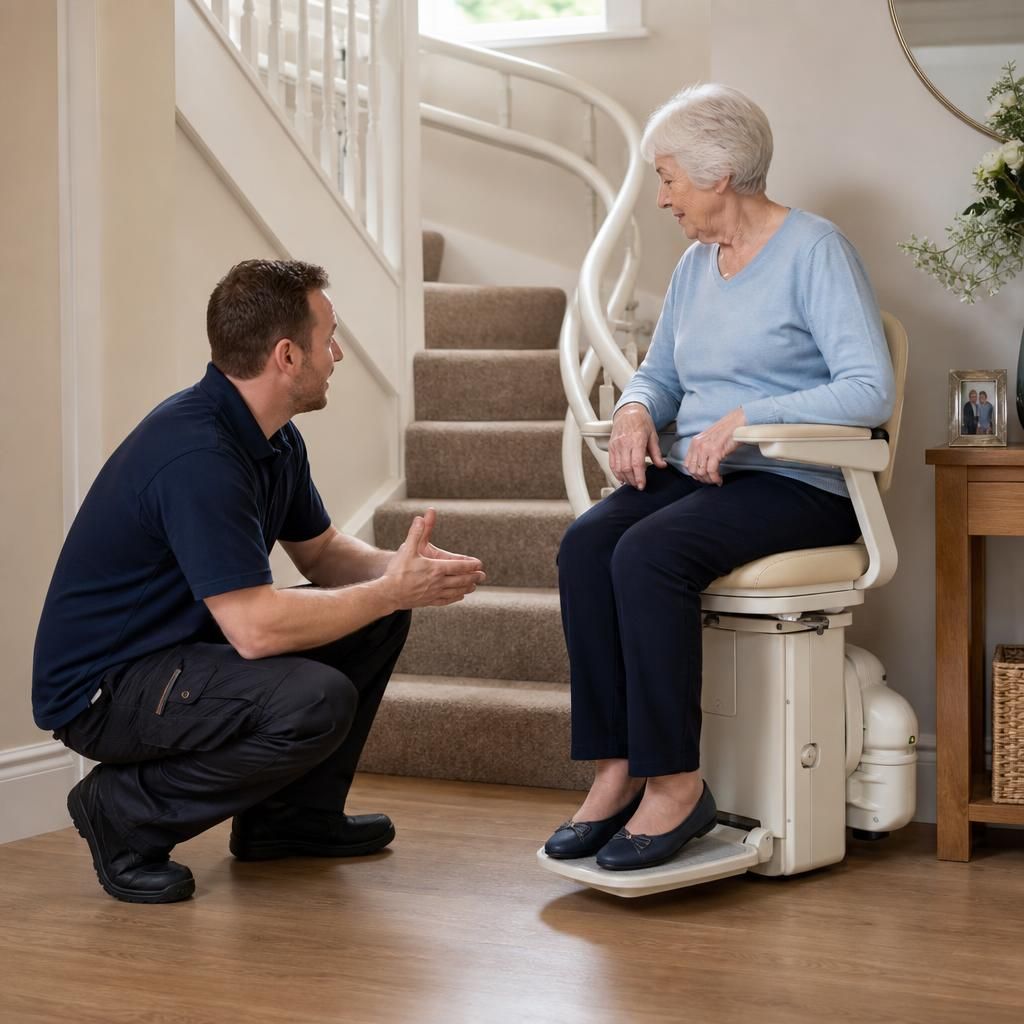
Arrange a Bespoke Stairlift Assessment
Arrange a bespoke stairlift assessment to identify which custom features your staircase and mobility needs require, and how they affect the installation cost.