
How do customised features impact the overall cost of stairlift installation?
Customised stairlift features can increase the overall installation cost because specialist seating, controls, safety options and made-to-measure rails require additional equipment or fitting. The final price depends on your staircase, mobility needs and chosen specification, so a tailored assessment is needed to provide an accurate quote.
Customised stairlift features affect the overall installation cost by adding specialist equipment, bespoke manufacturing, additional fitting time or changes to the standard installation process. The impact depends on the type of staircase, the user’s mobility requirements and the features selected. A tailored assessment is therefore the most reliable way to establish which options are necessary and how they will affect the quotation.
A standard stairlift configuration may include a suitable seat, basic controls, safety systems and a rail designed for the staircase. Customisation changes one or more of these elements. Some options involve a relatively straightforward specification change, while others require a made-to-measure rail, additional electrical work or more complex installation. The cost should be considered alongside the practical benefit of each feature rather than by looking at the feature in isolation.
Staircase design and rail requirements
The rail is often the most significant factor when customisation is needed. A straight stairlift normally uses a standard-length rail, although the rail may still need to be adapted for the available space at the top or bottom of the stairs. A curved stairlift requires a rail manufactured to follow the individual staircase. Landings, bends, intermediate steps, narrow sections and changes in direction all influence its design.
A bespoke rail can require more detailed surveying, manufacturing and installation than a standard rail. Features such as a hinged rail, parking arrangement or automatic swivel section may also add to the specification. These options can be useful where a doorway, hallway or passage would otherwise be obstructed, but their suitability depends on the layout and available clearance.
Seating and positioning options
Seat design can affect both equipment cost and installation requirements. Options may include:
- A powered swivel seat to help the user turn safely at the top or bottom of the stairs.
- A perch or semi-standing seat where bending the knees or sitting fully is difficult.
- A larger or more supportive seat for improved comfort and stability.
- Adjustable seat height to suit the user and the staircase.
- Powered controls to reduce the effort needed to swivel, fold or operate the seat.
- Different upholstery, armrest or footrest arrangements to accommodate individual needs.
Powered or specialist seating generally costs more than a manual standard seat because it includes additional mechanisms, controls and installation checks. It may also require more space when the seat is rotated or folded. A seat that improves transfer safety can be a practical investment, but the assessment should confirm that it works with the user’s strength, balance, height and usual method of approaching the stairlift.
Controls and ease-of-use features
Control options can be customised to make the stairlift easier to operate. These may include remote controls, controls positioned on a particular armrest, simplified switches or controls designed for limited hand movement. Some stairlifts can also be specified with powered functions, such as automatic swivel seating or a powered folding footrest.
Basic control changes may have a limited effect on the installation itself, but powered functions can increase the equipment cost and the time required for testing. The position of controls is also important. A control that is technically available may not be useful if it cannot be reached comfortably or operated reliably. The specification should reflect how the stairlift will actually be used rather than simply selecting every available option.
Safety and access features
Safety-related customisation may include a retractable or powered seat belt, adjustable armrests, improved footrest protection, obstruction sensors, a swivel lock or a different seat configuration. Some safety features are included as standard on particular models, while others are optional or available only with certain designs.
These features can affect the price of the stairlift, but they should not be treated as optional extras without considering the user’s circumstances. Reduced balance, limited leg strength, difficulty transferring or problems judging foot placement may make a particular safety feature especially important. An assessment helps distinguish between a useful adaptation and an option that adds cost without improving the installation for that user.
Power supply and charging arrangements
Most domestic stairlifts use rechargeable batteries and charge at designated points on the rail. If the existing electrical arrangement is unsuitable, additional electrical work may be needed. The installer may need to consider the location of a socket, cable routing and whether the charging position is convenient for the way the stairlift is parked.
Outdoor installations require equipment designed for exposure to weather, including appropriate protection for the seat, controls and charging components. The condition of the external staircase, drainage, lighting and access to a suitable power supply can also influence the work involved. As a result, an outdoor stairlift should not be priced solely by comparing it with an equivalent indoor model.
Finishes, upholstery and appearance
Choice of upholstery, colour or finish may alter the equipment price, particularly where a non-standard specification is required. These choices usually have less effect on the installation labour than structural or powered adaptations. They can still be relevant where the stairlift needs to fit the appearance of the home or where a particular material is easier to clean and maintain.
Folded dimensions and parking position are generally more important than appearance when assessing the installation. A visually suitable model may not be appropriate if it restricts a walkway, blocks a door or leaves insufficient room for safe transfers.
How customisation is reflected in a quotation
A clear quotation should identify the main elements contributing to the price, such as the stairlift model, rail type, seating configuration, control system, safety features and any additional installation work. It should also make clear whether the proposed price is based on a standard installation or a bespoke assessment.
The final cost may be affected by:
- The length, shape and access conditions of the staircase.
- Whether the rail is standard or made to measure.
- The number and type of powered features.
- Any changes needed to the seat, controls or safety equipment.
- Electrical work or alterations to the charging arrangement.
- Removal, relocation or disposal of an existing stairlift where applicable.
- Additional work needed to install the lift safely in an unusual or restricted space.
Customisation does not always mean that every feature increases the price independently. Some features may be included within a particular model or package, while others may require a different model altogether. Compatibility is also important when considering a reconditioned stairlift: a lower equipment cost may not apply if the required seat, controls or rail must be specially adapted.
The best approach is to identify the user’s essential requirements first, then compare suitable specifications rather than starting with optional features. During the assessment, consider how the user approaches the stairs, transfers to and from the seat, operates controls, manages the seat belt and moves around the stairlift when it is parked. This helps ensure that the final specification is safe, practical and proportionate to the installation cost.
A tailored quotation should take the staircase and the individual user into account. If your circumstances or requirements change after the assessment, discuss this before installation, as adding features later may be more disruptive or costly than including them in the original specification.
Customised stairlift features affect installation cost according to the extra equipment, manufacturing and fitting work they require. A made-to-measure rail for a curved staircase, powered seating or adapted controls will usually cost more than a standard specification because each element must be matched to the staircase and the user.
Some customisations mainly change the model price, while others affect the installation itself. For example, a powered swivel seat may require additional checks for clearance and safe transfers, while a hinged rail may need careful positioning to avoid obstructing a doorway or walkway. Outdoor installations can also require weather-resistant components and suitable charging arrangements.
A tailored assessment helps separate essential adaptations from optional features. The quotation should clearly identify the rail type, seat, controls, safety equipment and any electrical or structural work included, so you can compare the practical benefit of each customisation with its effect on the overall cost.
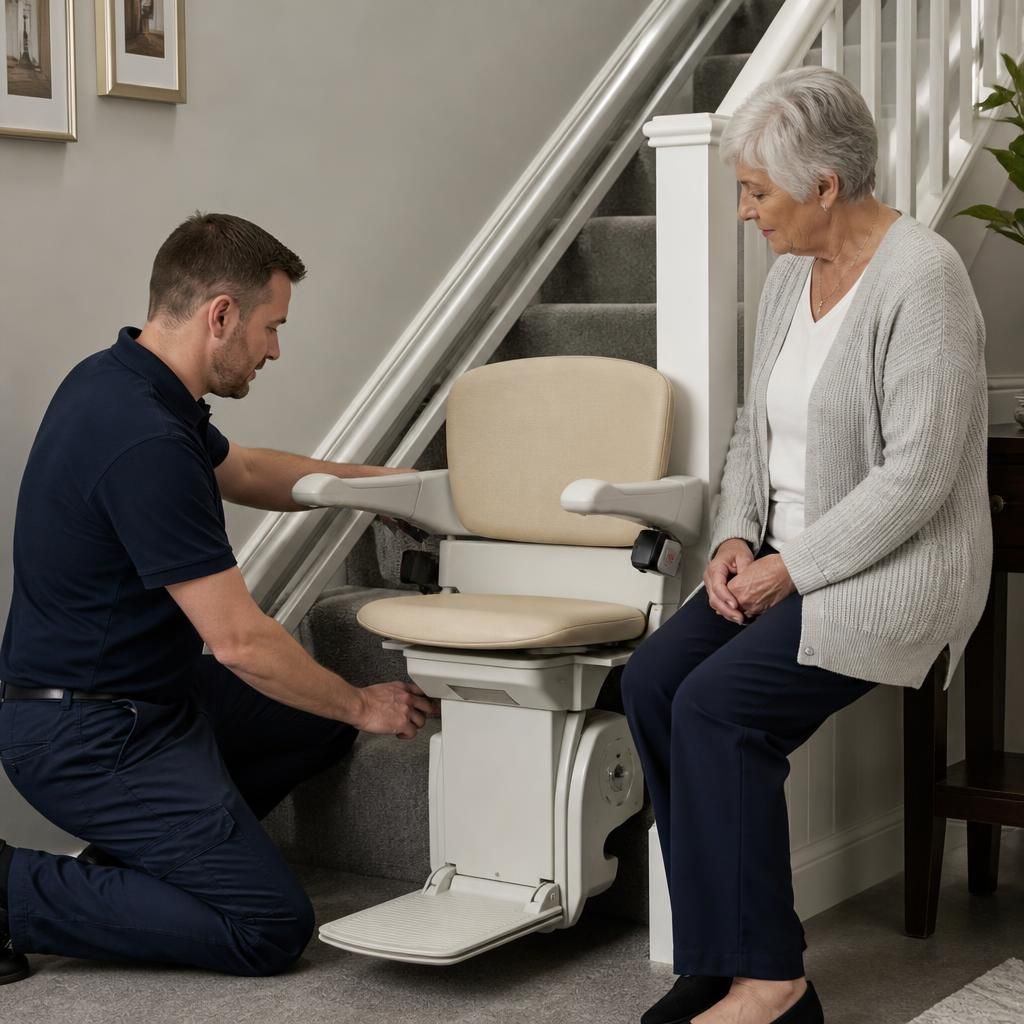
Arrange a Tailored Stairlift Assessment
Arrange a tailored stairlift assessment to identify the features your staircase and mobility needs require. We can explain how each option affects the overall installation cost and provide a clear quotation.