
What are the key benefits of choosing a Handicare stairlift over other models in the market?
Handicare stairlifts are chosen for their combination of safety-focused design, comfortable operation and flexible options for different stair layouts, including straight, curved and outdoor installations. The right model can provide a discreet, practical mobility solution, supported by professional assessment, installation and aftercare from an experienced UK stairlift provider.
Handicare stairlifts offer a combination of safety-focused engineering, comfortable operation and adaptable design. Their main advantage over a generic or poorly matched model is the breadth of options available for different stair layouts, user requirements and installation conditions. However, the most suitable stairlift still depends on your staircase, mobility needs, home environment and budget rather than the brand name alone.
Key benefits of choosing a Handicare stairlift include:
- Options for different staircases: Handicare provides solutions for straight, curved and outdoor stairs. Curved systems can be designed around bends, intermediate landings and changes in direction, while straight models are suited to a single continuous flight. This allows the lift to be matched to the structure of your home rather than forcing the staircase to accommodate a standard design.
- Safety-focused features: Depending on the model, features may include a seatbelt, swivel seat, obstruction sensors, controlled starting and stopping, and safety sensors that help detect objects on the stairs. These features are intended to reduce avoidable risks during use. A professional assessment is important because safe operation also depends on correct positioning, suitable access and the user’s ability to transfer on and off the seat.
- Comfort and ease of use: Handicare models are available with different seat configurations, controls and support features. A suitable seat can provide better support for the back and arms, while a powered swivel or folding function may make transfers easier for someone with limited strength or balance. Controls are generally designed to be straightforward, but they should still be checked in person if the user has reduced dexterity, vision or grip.
- Space-conscious designs: Folding seats, arms and footplates can help keep the staircase usable for other household members when the stairlift is parked. The available folded dimensions vary between models, so the remaining stair width should be measured carefully. On a narrow staircase, a compact design may be more important than additional powered features.
- Discreet installation: Many Handicare stairlifts use a rail fitted to the stairs rather than the wall. This can reduce the need for major structural work and allows the stairlift to follow the existing line of the staircase. On a curved stairway, the rail is made to suit the individual measurements, which can provide a neater result than trying to adapt a standard straight lift.
- Flexible controls and parking: A stairlift may be operated from controls on the armrest and, where appropriate, from call-and-send controls at the top or bottom of the stairs. Parking positions can also be planned to keep landings or doorways clear. These details are particularly useful where the lift needs to be moved out of the way when it is not being used.
- Suitability for outdoor access: Outdoor models can help with steps leading to a garden, entrance or other external area. They are designed for exposure to outdoor conditions, although the lift still needs appropriate protection, regular cleaning and servicing. The installer should assess drainage, weather exposure, electrical supply and the condition of the steps before recommending an outdoor solution.
- Professional assessment and fitting: A stairlift is not simply a piece of furniture that can be selected from a catalogue. Accurate measurements, rail positioning, charging points and seat height all affect safety and usability. A proper home assessment helps identify obstructions, landing clearances and transfer issues before installation, while professional fitting ensures the equipment is securely installed and tested.
- New and reconditioned choices: Depending on availability and the staircase involved, a reconditioned Handicare stairlift may provide a lower-cost route to an established model. Reconditioned equipment should be inspected, tested and supplied with clear information about its condition, warranty and servicing arrangements. It is also important to confirm that the rail and seat configuration are suitable for your staircase rather than assuming that any previously used lift will fit.
Another benefit is that Handicare offers a recognisable range with models intended for different levels of space, comfort and customisation. This can make it easier to compare a basic solution with one offering powered upgrades or enhanced seating. Features such as a powered swivel seat, powered footrest or automatic folding function may improve independence, but they also add complexity and cost. They should be selected because they solve a specific difficulty, not simply because they are available.
It is also worth considering ownership after installation. Ask what warranty applies, which parts and labour are covered, how faults are reported, and whether servicing or breakdown support is available in your area. Batteries and other consumable components may eventually require replacement, and regular servicing can help identify wear before it affects reliability. These arrangements can be as important as the initial purchase price when comparing stairlift options.
Handicare will not be the right choice in every situation. A different model may be more appropriate if the user needs a particular weight capacity, seating position, transfer arrangement or control system that is not available in the proposed configuration. The decisive comparison should therefore include the full installed cost, the usable space left on the stairs, the comfort of the seat, the controls, warranty terms, servicing and the installer’s assessment of the user’s needs.
For most households, the practical benefit of choosing a Handicare stairlift is the ability to combine a suitable stair configuration with established safety features, adjustable comfort options and professional installation. An in-home assessment and demonstration provide the clearest way to establish whether those benefits translate into a safe, comfortable and useful solution for your particular staircase.
A key benefit of choosing a Handicare stairlift is the range of configurations available for different staircases and mobility needs. Straight, curved and outdoor models can be assessed against the layout of your home, while options such as a powered swivel seat, folding footrest or alternative controls may make transfers and everyday use easier.
The benefit depends on selecting the right specification rather than choosing features automatically. During a home assessment, the installer can check stair width, bends, landing space, doorways, charging positions and the user’s ability to sit, stand and operate the controls. This helps ensure the stairlift is safe, comfortable and practical for the person using it, while keeping the remaining staircase as usable as possible for others.
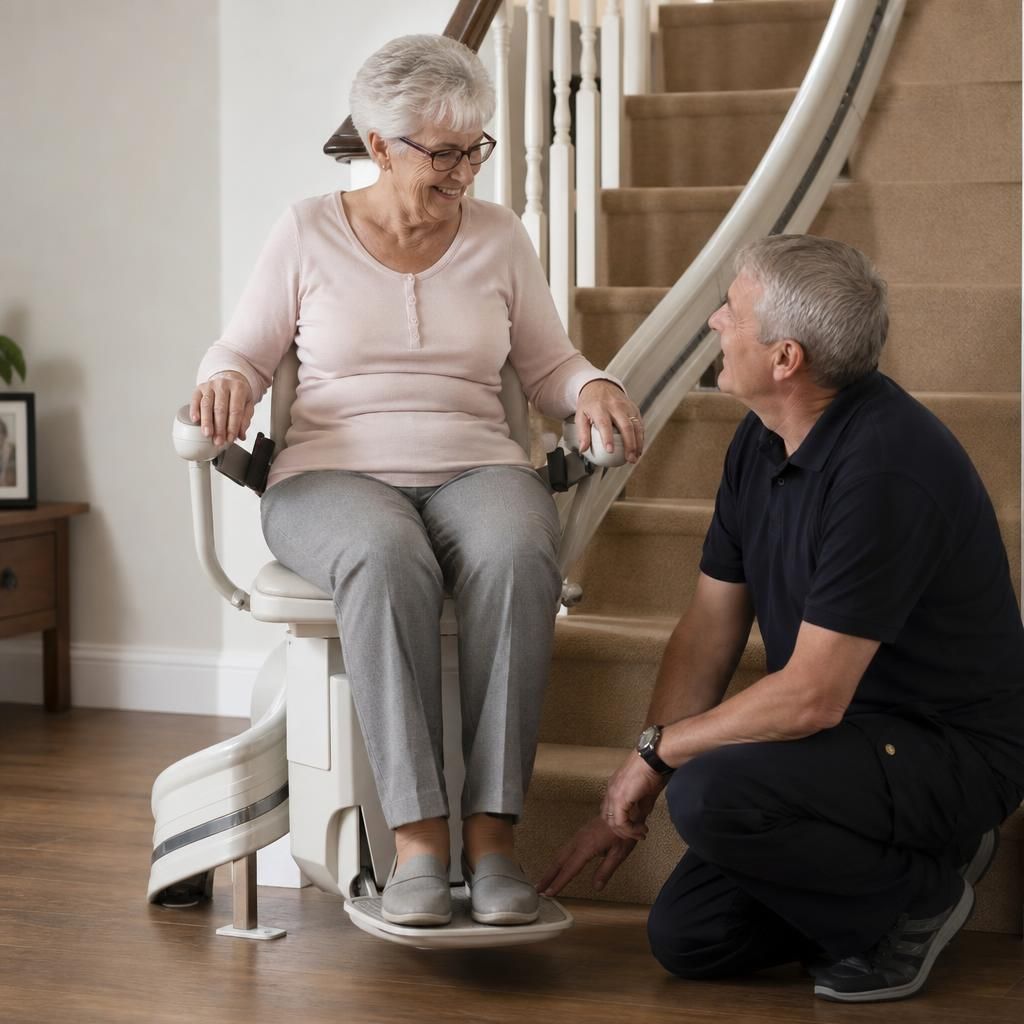
Arrange a Handicare stairlift assessment
Arrange a home assessment to discuss whether a Handicare stairlift is suitable for your staircase, mobility needs and budget. We can review the available options and explain the full installation and aftercare arrangements.