
How do I assess if a Handicare stairlift is suitable for my home layout and personal mobility needs?
A Handicare stairlift may be suitable if its rail can be fitted safely to your staircase layout and its seat, controls and operating position match your mobility, balance and transfer needs. An assessment by Independent Stairlifts will consider the staircase, access around the top and bottom, your ability to sit and transfer safely, and any features or adaptations required.
A Handicare stairlift is suitable when its rail can be installed safely on your staircase and its seat, controls and transfer features match the user’s mobility needs. The assessment should cover the full route—not just the stairs—including the space at the bottom and top, nearby doors and walkways, and how safely the user can sit down, travel and get off the lift.
A professional home assessment is the most reliable way to establish suitability. The assessor should inspect the staircase in person, discuss the user’s daily difficulties and observe how they approach, sit and stand. This helps identify whether a straight or curved stairlift is appropriate, whether adaptations are needed and whether the proposed position leaves enough usable access for other people in the home.
Assess the shape and construction of the staircase
The staircase layout determines the type of rail required. A straight stairlift may be suitable where the stairs run in one continuous direction without a landing or change of angle. Stairs with a bend, intermediate landing, multiple flights or a spiral section generally require a curved rail designed for that individual staircase.
The survey should consider:
- the width, length and angle of each flight;
- changes in direction, landings and the available space at the top and bottom;
- banisters, radiators, windows, doors and other fixtures beside the stairs;
- the position of light switches, sockets and other controls;
- the condition and strength of the stair treads and fixings; and
- whether the rail or parked seat could obstruct a doorway, hallway or escape route.
A narrow staircase does not automatically rule out a Handicare stairlift, but the available width must be checked with the rail, seat and user in position. A fold-up seat, arms and footrest can be important where the stairs are also used by other household members. At the top of the stairs, the user must have enough room to turn and transfer safely; a suitable seat alone cannot compensate for an unsafe landing.
Consider the user’s transfers and balance
The user should be able to approach the stairlift, turn or position themselves, sit down without losing balance, and stand up securely at the destination. If standing from a low chair or turning on the spot is difficult, the assessor may recommend a different seat height, swivel function or another configuration. The user should not have to lean over the stairs or twist awkwardly while getting on or off.
Discuss any difficulty with:
- walking to the lift or taking the first step;
- bending the knees, sitting down or standing up;
- maintaining an upright posture during travel;
- transferring from a wheelchair, walking frame or other mobility aid;
- lifting the feet onto the footrest; and
- using both hands, one hand or only the stronger side of the body.
Information about arthritis, reduced strength, balance problems, stroke-related weakness, visual impairment or other conditions can affect the recommendation. The assessment is not a medical diagnosis, but these details help the installer identify practical risks and suitable features. If the user’s condition is changing, explain this so that the proposed arrangement remains useful as needs develop.
Match the controls and seating to the user
Controls need to be reachable and simple to operate from the seated position. Consider whether the user can press and hold a control, use a remote control, identify the direction buttons and understand when the lift has reached its destination. Some users may need controls positioned on a particular armrest or an arrangement that can be operated with one hand.
Seating should provide stable support without making transfers harder. The assessor should discuss the seat height, back support, armrests, seat belt and swivel arrangement, along with the user’s size and posture. The selected model must remain within the manufacturer’s stated weight and operating limits. If the user has difficulty keeping their feet clear of the steps, a suitable footrest and safe positioning are especially important.
Where the user cannot sit safely, cannot follow the operating instructions reliably or needs to travel with a walking frame, a stairlift may not be the right solution without additional arrangements. The assessor should explain any limitations rather than assuming the equipment will solve every access problem.
Check the bottom and top landing
The landing areas are part of the installation. At the bottom, there must be enough space to approach the seat without contact with a wall, door or furniture. At the top, the user needs a safe place to swivel, release the belt and stand before moving away from the stairs. A hinged or shortened rail may be considered where a doorway or corridor is close to the first or last step, but its suitability depends on the exact layout and how it will be used.
Look at how the stairlift will be parked when it is not in use. A folded seat may reduce obstruction, while a powered folding or swivel function may help if the user cannot manage the movement manually. These features should be selected for a demonstrated need rather than added without considering their effect on operation and cost.
Review electrical and household requirements
The installer should identify a suitable power supply and explain where the charging point or equipment will be located. The stairlift should be kept clear of household clutter, pets and frequently used doors. If the property is rented, obtain the landlord’s permission before work begins. Any concerns about emergency access, shared stairways or other residents should be raised during the survey.
Use the assessment to make a practical decision
Ask to try the proposed seat and controls, where possible, and discuss how the lift will work during the user’s normal routine. Consider who will use it, whether visitors or other residents need to pass on the stairs, and what happens if the user stops midway or needs assistance. The written recommendation should set out the stairlift type, rail arrangement, seating position, required features, installation limitations and ongoing servicing arrangements.
A Handicare stairlift is likely to be appropriate if the user can transfer safely with the recommended configuration, the rail leaves adequate access, and the installation does not create a new obstruction. If those conditions cannot be met, Independent Stairlifts can explain alternative layouts or mobility solutions rather than proceeding with an unsuitable installation.
A Handicare stairlift is suitable only when the user can approach, sit down, travel and get off safely within the available space. The assessment must therefore include the top and bottom landings, not just the staircase itself.
Independent Stairlifts will consider balance, leg strength, posture and the ability to use the controls, as well as whether the user can transfer from a wheelchair or walking aid. A swivel seat, suitable seat height, armrests, belt or powered folding feature may help, but each option should address a specific difficulty and be tested as part of the proposed layout.
The final recommendation should also confirm that the parked lift will not obstruct doors, walkways or other household users. If the user cannot transfer securely or operate the lift reliably, the assessment should identify a safer alternative rather than treating the stairlift as a complete solution.
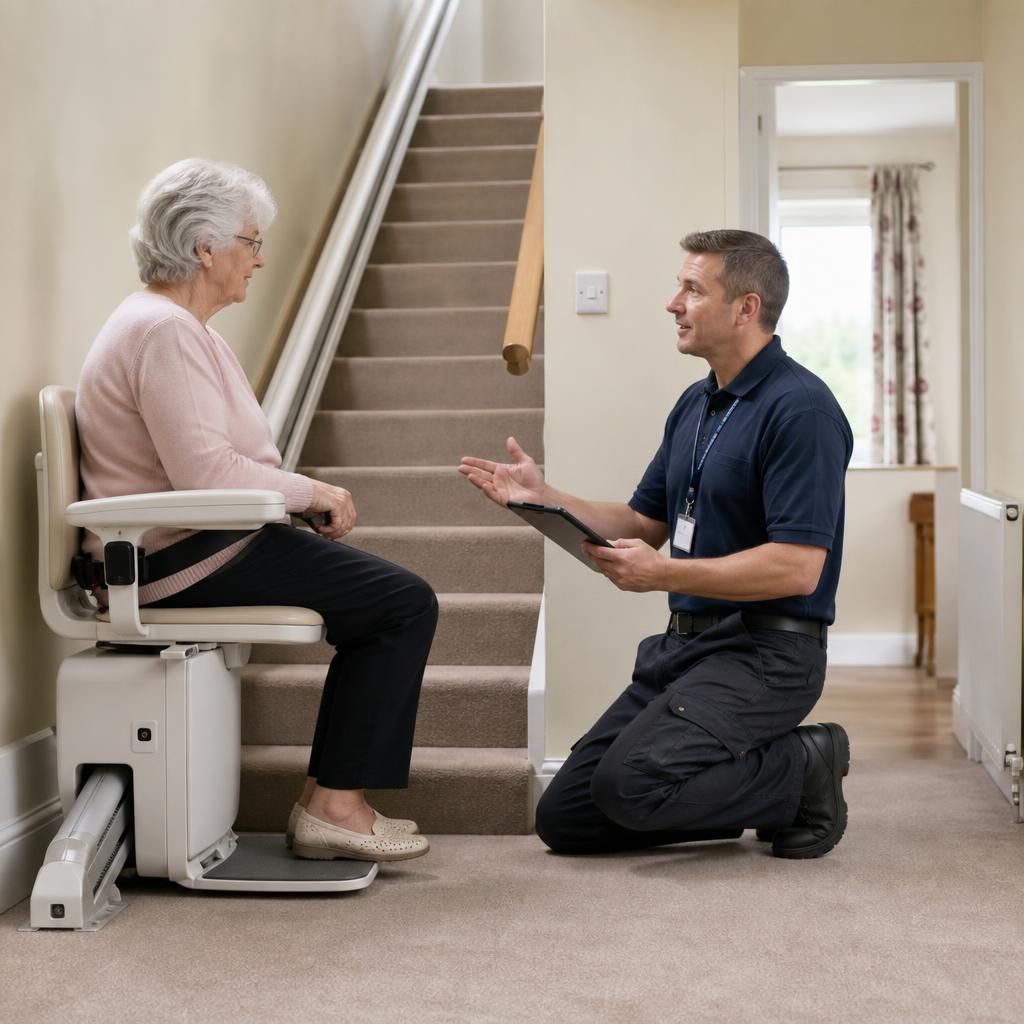
Arrange Your Handicare Stairlift Home Assessment
Arrange a home assessment with Independent Stairlifts to check whether a Handicare stairlift suits your staircase, landing spaces and mobility needs. We’ll recommend a safe, practical configuration based on how you use your home.