
How do the costs of outdoor stairlifts for the elderly compare with indoor models?
Outdoor stairlifts for elderly users generally cost more than comparable indoor models because they require weather-resistant components, additional protection and, often, more complex installation. The final price depends on the outdoor staircase, access conditions, stairlift specification and whether a new or reconditioned model is suitable.
Outdoor stairlifts for elderly users usually cost more than comparable indoor models because they must withstand rain, frost, sunlight, dirt and changing temperatures. They use weather-resistant materials, protected electrical components and durable upholstery, while installation can be more demanding where access is exposed or the staircase is uneven. The final cost still depends on the staircase, the model selected and the work needed at the property.
Indoor and outdoor stairlift costs compared
An indoor stairlift is normally installed in a relatively protected environment, such as a hallway or staircase inside the home. The rail, seat, controls and charging equipment are not exposed to the weather, so the design can focus primarily on safe movement, comfort and compatibility with the stairs. Outdoor models require additional protection and are therefore often priced higher than a similar straight indoor stairlift.
This does not mean every outdoor installation is more expensive than every indoor installation. A simple outdoor staircase may cost less than a complex indoor curved staircase, for example. Curved rails are made to fit the individual route and may involve more detailed surveying and manufacture. The most useful comparison is between systems designed for a similar staircase, with the same level of customisation and similar safety and comfort features.
Why outdoor models can cost more
- Weather-resistant construction: Outdoor stairlifts need finishes and materials that can cope with moisture, ultraviolet light, cold conditions and general exposure.
- Protected electrical parts: Batteries, charging points, motors and control systems need suitable protection, particularly where the lift is not under cover.
- Hard-wearing seating and controls: Outdoor upholstery and arm controls are selected to be more resistant to damp, dirt and temperature changes than standard indoor fittings.
- Additional covers or storage: A protective cover, weather shield or secure parking arrangement may be recommended to reduce exposure when the stairlift is not in use.
- More involved installation: Installers may need to work around external walls, gates, paths, steps, drainage, limited access or uneven surfaces. Electrical arrangements and safe positioning can also require extra planning.
The staircase and installation site are major cost factors
The type of outdoor staircase has a direct effect on the price. A straight flight with firm, regular steps is generally simpler to assess and fit than a curved, multi-flight or unusually shaped route. The width of the stairs, available clearance, landing space and position of the top and bottom steps all influence the rail design and the equipment required.
Access to the installation area also matters. If the staircase is narrow, elevated, enclosed, difficult to reach or exposed to severe weather, the survey may identify additional requirements. These could include adjustments to the fixing method, improved drainage, a suitable electrical supply, protective storage or changes to the landing area. Such work should be identified before installation rather than treated as an unexpected extra.
Ongoing costs and maintenance
The purchase price is only part of the comparison. Outdoor stairlifts are exposed to conditions that can increase cleaning, inspection and maintenance requirements. Dirt and moisture should be removed in line with the manufacturer’s guidance, and the equipment should be kept covered or parked in a protected position where appropriate. Batteries and other wearing parts will eventually need replacement on outdoor and indoor models, although the timing depends on use, conditions and maintenance.
When comparing quotations, check what aftercare is included and what is chargeable. Ask about servicing, call-out arrangements, battery replacement, warranty coverage and the treatment of weather-related damage. A lower initial price may not represent the best value if the model is not suitable for the location or if important protection and support are excluded.
Can a reconditioned outdoor stairlift reduce the cost?
A reconditioned stairlift may offer a lower purchase price where a suitable model is available. However, not every indoor stairlift can be adapted safely for outdoor use. The equipment must be appropriate for external conditions, professionally inspected and supplied with the correct weather protection and installation components. The condition of the battery, motor, controls, rail and seat should be checked, and warranty and servicing arrangements should be clear.
For a bespoke curved outdoor staircase, the rail is usually made or adapted for the individual route, so the scope for reducing the cost through reconditioning may be more limited than with a standard straight installation. A professional assessment is needed to establish whether a reconditioned option is genuinely suitable.
What to include when comparing quotations
- The stairlift model and whether it is new or reconditioned.
- Whether the quote covers the survey, delivery, installation and testing.
- The type of weather protection provided for the rail, seat, controls and electrical components.
- Any required electrical work, supports, covers, storage or alterations to the staircase or landing.
- Warranty terms, servicing options and the cost of future call-outs or replacement parts.
- Whether removal of the stairlift is included if it is no longer required.
It is also important to consider how the stairlift will be used. If the outdoor route is the only practical access to a garden, garage, annex or shared entrance, reliable operation in poor weather may be more important than selecting the lowest initial price. Seat height, swivel and folding features, arm controls and the ease of transferring on and off the lift should be assessed alongside cost.
An accurate comparison requires a survey of the actual staircase and surrounding access. Independent Stairlifts can assess the outdoor environment, identify installation requirements and explain whether a new or reconditioned stairlift is appropriate. This makes it easier to compare the complete cost, including installation and ongoing support, rather than comparing equipment prices in isolation.
Outdoor stairlifts for elderly users usually cost more than equivalent indoor models because they need weather-resistant components and protection from rain, frost, sunlight and dirt. The staircase and installation site also affect the price: a straightforward external flight may be less costly than a complex indoor curved installation, while uneven steps, difficult access or additional electrical work can increase the outdoor installation cost.
When comparing quotations, check that each includes the same essentials, including weather protection, installation, testing, warranty and aftercare. A professional survey can confirm whether the proposed stairlift is suitable for the location and identify any work required before installation.
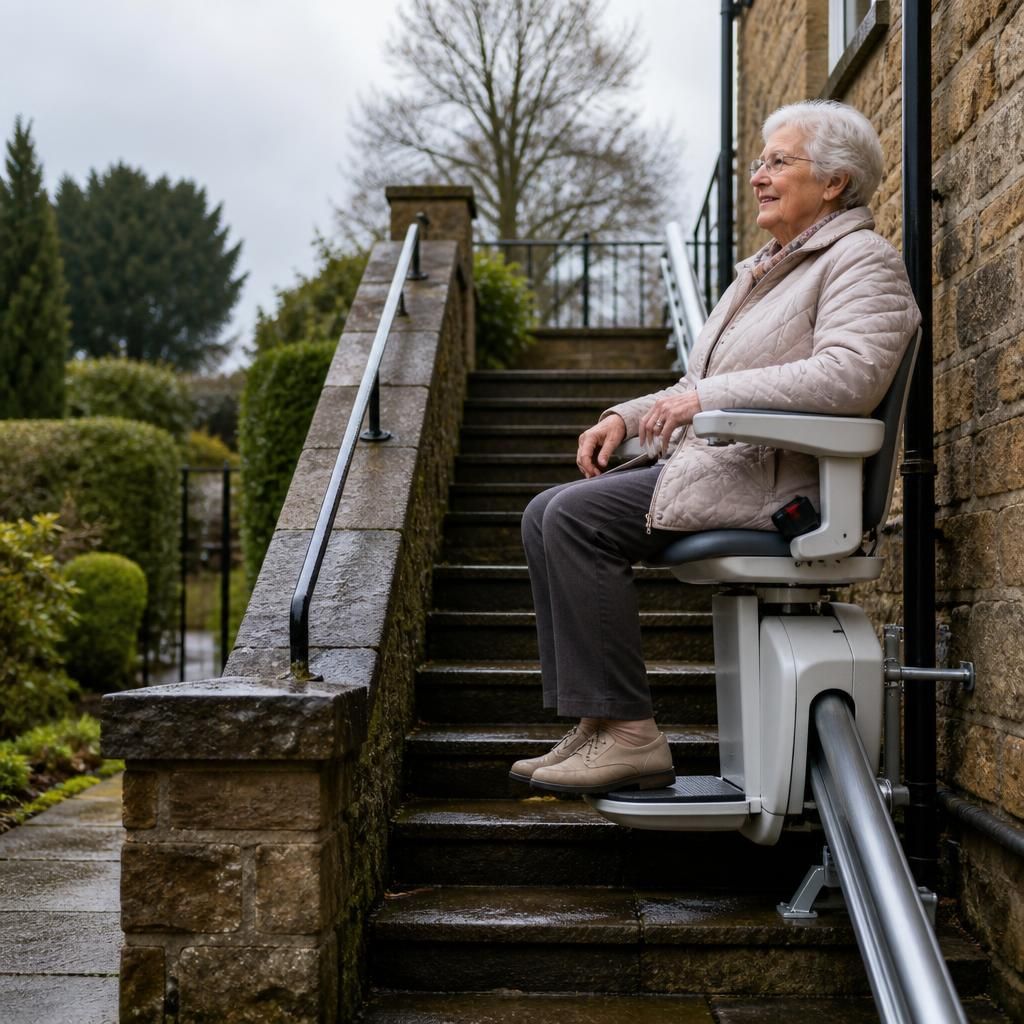
Arrange an outdoor stairlift cost assessment
Arrange an outdoor stairlift cost assessment with Independent Stairlifts to review your staircase, access conditions and weather-protection requirements. We can explain the expected installation costs and whether a new or reconditioned model is suitable.