
How do installation costs impact the overall price of a stairlift for seniors?
Installation costs form part of the total stairlift price and vary according to the staircase, fitting requirements and any electrical or structural adjustments needed. A professional assessment provides a clearer price by identifying the correct equipment and the labour involved, including whether the installation is straightforward or requires additional work.
Installation costs can make up a significant part of the overall price of a stairlift, but they cannot be assessed separately from the staircase and the equipment being fitted. A straightforward installation on a suitable staircase usually involves fixing the rail, connecting the lift and testing the system. More involved work, such as fitting a curved rail, adapting electrical supplies or working around structural features, increases the labour and preparation required.
The total price normally combines several elements:
- the stairlift itself, including the rail, seat, controls and safety equipment;
- the design and manufacture of the rail, where a bespoke curved system is required;
- delivery and preparation of the equipment;
- installation labour and commissioning;
- any electrical, joinery or structural work needed for a safe fitting; and
- demonstration, documentation and the arrangements included for servicing or support.
Installation is not simply a standard charge added to every stairlift. The fitting method is determined by the condition, shape and layout of the stairs. A professional survey identifies these requirements before a final quotation is prepared.
How staircase design affects installation costs
Straight staircases are generally less complex to fit because the rail follows a single flight and can often be installed with standard components. However, the survey still needs to consider the width of the stairs, the position of doors and landings, the location of the lift when parked and the available space at the top and bottom.
Curved stairlifts usually have higher installation costs because the rail is measured and made to follow the individual staircase. It may pass around bends, intermediate landings or changes in direction. The installation team must also position the rail and seat so that the user can transfer safely without obstructing entrances or walkways.
Outdoor stairlift installations can require additional preparation. The equipment and fixing points must be suitable for external conditions, and the installer may need to account for uneven steps, exposed walls, drainage, weather protection and a suitable power supply. These requirements can increase both preparation time and labour compared with an indoor installation.
Work that may be included in the fitting process
Most installations involve securely attaching the rail to the stairs or an appropriate supporting surface, fitting the carriage and seat, connecting charging equipment and checking the controls. The system should then be tested throughout its travel before it is handed over.
Additional work may be needed where:
- the staircase has unusual bends, narrow sections or limited headroom;
- the rail needs to finish in a particular position to preserve access;
- there is no suitable nearby electrical socket or the power supply needs modification;
- the stairlift requires a powered swivel seat, folding rail or another integrated option;
- minor joinery or trimming is needed around doors, skirting or obstacles; or
- an old stairlift must be removed and disposed of before the new one can be installed.
Not every property requires these services, and they should not be assumed to be included unless they are clearly stated in the quotation. A survey helps separate essential safety work from optional improvements.
Why a home survey matters
A surveyor assesses more than the length of the stairs. They check the construction and condition of the steps, available clearance, landing space, access to charging points and the most suitable position for the seat when entering or leaving the lift. They also consider how the intended user moves, including whether they need to transfer from a wheelchair or use a walking aid.
This assessment can prevent unexpected costs by identifying installation requirements in advance. It may also show that a different rail arrangement, seat configuration or parking position is safer and more practical. A quotation based only on general staircase information may not include every necessary adjustment.
New and reconditioned stairlifts
A reconditioned stairlift may have a lower equipment price, but the installation still requires appropriate surveying, fitting, testing and safety checks. A curved reconditioned system may not be suitable for another staircase unless its rail was made for that exact layout. In some cases, a replacement rail or additional components are needed, which can affect the saving.
When comparing a new and reconditioned option, consider the complete installed price rather than the equipment price alone. Ask what is covered by the warranty, whether removal of an existing lift is included, and whether any future adjustments or service visits are charged separately.
How to compare installation quotations
A useful quotation should distinguish the stairlift equipment from installation and identify any work that is provisional or excluded. Check whether it covers:
- the initial survey and design;
- delivery and standard fitting;
- electrical connections or any required electrical work;
- removal of an existing stairlift;
- minor building or joinery work;
- commissioning and user instruction;
- warranty support and follow-up adjustments; and
- VAT, where applicable.
VAT treatment depends on the circumstances of the purchaser, the type of work and the relevant eligibility rules. Being an older person does not automatically mean that VAT relief applies. The installer should explain what is included in the quoted price and what information is needed to establish whether any relief is available.
The cheapest installation quote is not necessarily the lowest overall cost if it excludes essential preparation, electrical work or aftercare. Conversely, a higher quote may reflect a genuinely bespoke rail or additional work required by the property. Comparing the scope of each quotation is more meaningful than comparing the headline figure.
Questions to ask before agreeing to the work
- Is the price based on an in-person survey of the staircase?
- Which installation tasks are included as standard?
- Could electrical, structural or joinery work be needed, and how would that be priced?
- Does the quotation include removal of an existing stairlift?
- Are delivery, testing, demonstration and any initial adjustments included?
- What happens if the stairlift needs repositioning after installation?
- Which warranty and servicing arrangements apply to the complete installation?
Installation costs should therefore be viewed as part of the safety and suitability of the complete solution, not as a separate add-on to minimise. An accurate survey, a clearly itemised quotation and confirmation of what happens after fitting make it easier to understand the final price and avoid unexpected charges. For an elderly user, the most appropriate stairlift is the one that fits the staircase correctly, supports safe transfers and is installed with all necessary work included.
Installation costs are the labour and preparation charges involved in fitting, testing and commissioning a stairlift safely at home. They form part of the total installed price, alongside the stairlift equipment, rail, delivery and any electrical or structural work required.
The most reliable way to understand these costs is through an in-person survey. The installer can assess the staircase layout, landing space, fixing points, power supply and the user’s transfer needs before confirming what work is necessary. This helps distinguish a straightforward fitting from one requiring a curved rail, repositioned charging point, minor joinery or removal of an existing lift.
When reviewing a quotation, check that it clearly states whether it includes:
- the survey, delivery and standard installation;
- electrical or other preparation work;
- removal and disposal of an existing stairlift;
- testing, demonstration and initial adjustments; and
- warranty support and follow-up visits.
Comparing the complete installed price, rather than the equipment cost alone, gives a more accurate view of affordability and helps prevent unexpected charges.
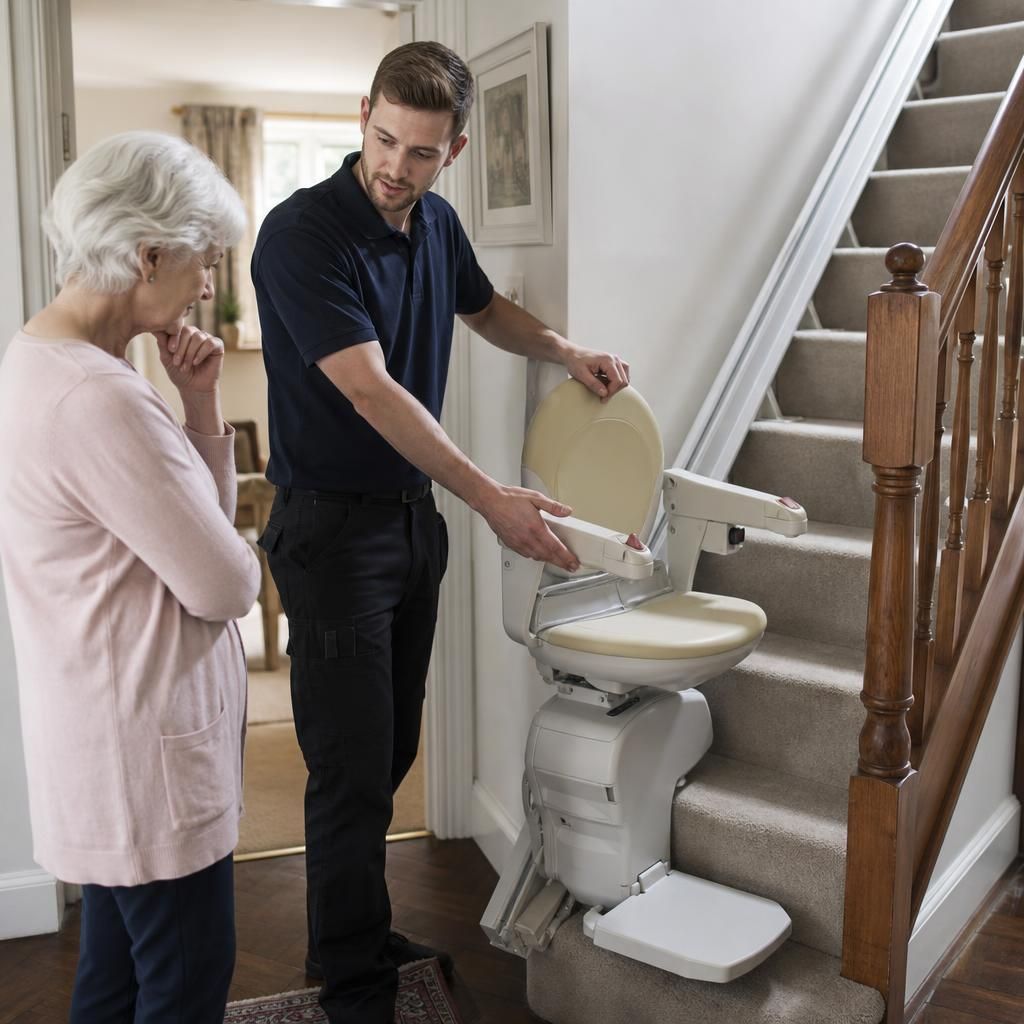
Arrange a Stairlift Installation Assessment
Arrange a stairlift installation assessment to have your staircase, access requirements and fitting needs reviewed before you receive a clear quotation.