
What factors should I consider when selecting a curved stairlift for my home?
When selecting a curved stairlift, consider your staircase layout, the user’s mobility needs, and the lift’s safety, comfort and ease of use. You should also assess seating and control options, parking positions, installation requirements, appearance, warranty and ongoing maintenance before choosing a bespoke or reconditioned model.
The right curved stairlift should suit both the staircase and the person using it every day. The main factors to assess are the staircase layout, the user’s mobility and physical requirements, the lift’s safety and seating features, available parking positions, installation conditions, appearance, aftercare and whether a new or reconditioned model is most appropriate.
Start with a professional staircase assessment
Curved stairlifts are made to follow the individual shape of a staircase. An assessment should consider straight sections, bends, intermediate landings, multiple floors, changes in gradient, doorways and the available space at the top and bottom. The position of handrails, radiators, skirting boards and nearby furniture can also affect the rail design and where the stairlift can be parked.
A survey is important even when the staircase appears straightforward. Two staircases with a similar overall shape may require different rail configurations, and a tight turn or restricted landing can influence the seat position, track design and installation method. The assessor should also discuss whether the rail will be fixed to the stairs or another suitable structural surface, while taking account of access and the condition of the property.
Consider who will use the stairlift
The user’s mobility, balance, strength and confidence should guide the choice of model and features. Consider whether the user can transfer safely from standing to sitting, bend their knees comfortably, operate controls and remain seated throughout the journey. If more than one person may use the lift, the design should accommodate the needs of each regular user.
It is also useful to discuss the user’s height, weight, leg movement and any difficulty with their hips, knees, back or upper body. A suitable seat height and seat width can make transfers easier, while an adjustable or supportive seat may improve posture and comfort. The lift must always be selected within the manufacturer’s stated weight and usage limits.
Check safety features and ease of operation
Safety features should be considered alongside convenience. Depending on the model, these may include a seat belt, swivel seat, armrests, sensors that stop the lift when an obstruction is detected, and controls that require deliberate pressure to operate. A powered swivel or hinged seat can be helpful where the user finds it difficult to turn or where space at the top or bottom of the stairs is limited.
Controls should be easy to reach and understand. A control on the armrest is normally used during travel, while remote controls can allow the stairlift to be called to another floor. Check that the buttons are suitable for the user’s hand strength, coordination and eyesight. A practical demonstration during the assessment can identify difficulties that may not be obvious from a specification sheet.
Assess seating and transfer space
Seat design affects both comfort and safety. Look at the seat height, cushioning, back support, armrest position and footrest size. A perch-style or semi-perch seat may be considered where bending the knees or lowering into a conventional seat is difficult, but it is not suitable for every user and should be assessed individually.
The space beside the stairlift is equally important. The user needs enough room to approach, turn and sit down without twisting awkwardly. At the top of the stairs, a parking position that moves the seat away from the edge may make getting off safer. At the bottom, the lift may need to park beyond the first step or on a nearby landing so that it does not obstruct a doorway or normal passage.
Review parking positions and access around the staircase
Ask where the stairlift will be stored when it is not in use. A rail that finishes around a bend, extends onto a landing or parks out of the way can improve access for other household members. However, an extended rail may require additional space and can affect the design and installation work.
Consider fire-escape routes, access to rooms, opening doors and the movement of people carrying items up or down the stairs. The stairlift should not create an avoidable obstruction. If the staircase is shared or particularly narrow, a folding seat, folding armrests, retractable footrest or hinged rail may help preserve usable space.
Consider the staircase material and property layout
Staircases may be made from timber, concrete or other materials, and the fixing approach must be suitable for the structure. The survey should identify any unusual construction, fragile finishes, uneven surfaces or restrictions caused by walls and landings. The condition of the stairs and surrounding surfaces can also affect how preparation and installation are carried out.
Think about how equipment and installers will reach the property. Restricted entrances, narrow hallways, limited parking or several internal flights may need to be discussed in advance. These factors do not necessarily prevent installation, but they can influence planning, access arrangements and the time required on the day.
Decide between a new and reconditioned stairlift
A new stairlift generally offers the widest choice of current seating, control and finish options, as well as a rail designed specifically for the surveyed staircase. A reconditioned curved stairlift may provide a more economical alternative, but the available equipment and rail configuration depend on the model and the staircase it was previously fitted to.
When considering a reconditioned lift, ask how it has been inspected, serviced and tested, which parts have been replaced, whether the rail is being adapted or newly made, and what warranty and service support are included. Suitability and condition are more important than price alone. The equipment must be appropriate for the user and reliably supported after installation.
Compare the full cost and aftercare
The quotation should make clear what is included, such as the survey, bespoke rail, delivery, installation, removal of an existing lift where relevant, user instruction and warranty cover. Curved stairlift prices vary because each rail is designed around the staircase, and the number and sharpness of bends, floors served, parking arrangements and additional features can all affect the work involved.
Ask about servicing, fault reporting, battery replacement, engineer availability and what happens if the stairlift stops working. Batteries are rechargeable and are normally replaced as part of ongoing ownership when they no longer hold sufficient charge. Keeping the charging points clear and following the manufacturer’s usage and maintenance guidance can help the lift remain dependable.
Consider appearance and household preferences
Although operation and safety should come first, the stairlift will form part of the home, so its visual impact may matter. Discuss the rail’s position, seat colour and finish, and whether the seat and arms can be folded when the lift is parked. The best choice balances appearance with the space, support and controls the user actually needs.
Use the assessment to make the final decision
Before agreeing to an installation, make sure the proposed design shows where the rail starts and finishes, how the seat parks, which controls and safety features are included, and what access other household members will retain. The user should be shown how to operate the lift, charge it, use the safety belt and respond if it stops.
A curved stairlift is a long-term mobility aid, so the most suitable option is not necessarily the one with the lowest initial price or the greatest number of features. It is the model and configuration that provide safe transfers, comfortable travel, straightforward operation and dependable access throughout the home, supported by an installation and aftercare plan suited to the staircase and the user.
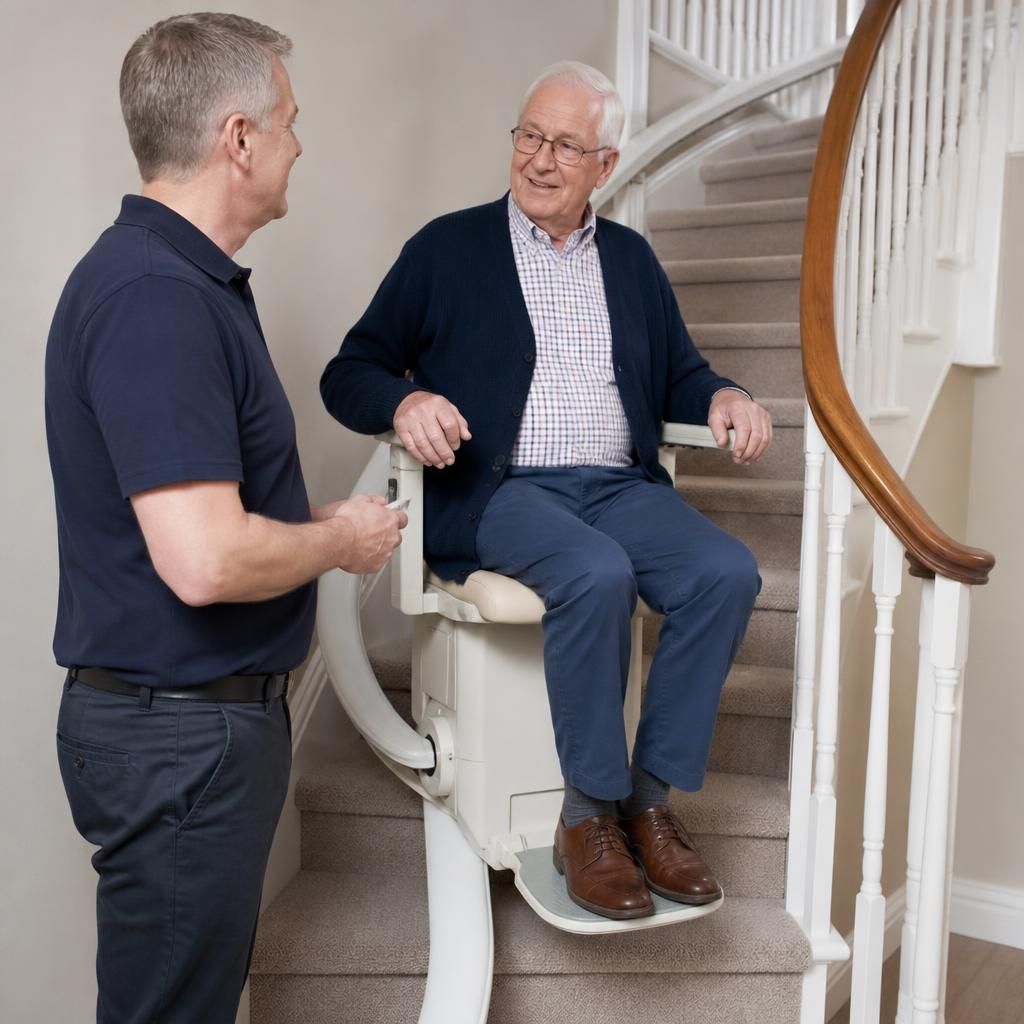
A professional staircase assessment is the most important step when selecting a curved stairlift, because the rail must be designed around the exact shape and structure of your stairs. The survey should consider bends, landings, changes in gradient, available space, handrails, doorways and suitable parking positions.
The assessment should also review the user’s transfers, seating posture, reach and ability to operate the controls. This helps determine whether features such as a swivel seat, powered hinge, folding components or a perch-style seat may be appropriate. Before installation, ask to see where the lift will start and finish, how it will be parked and what access will remain for other people in the household.
Arrange Your Curved Stairlift Assessment
Arrange a professional curved stairlift assessment with Independent Stairlifts to review your staircase, seating needs, safety features and preferred parking positions. We can then recommend a suitable configuration and explain the installation and aftercare included.