
What are the primary benefits of choosing a bespoke curved stairlift over a standard model?
A bespoke curved stairlift is designed and manufactured to follow the exact shape of your staircase, including bends, landings and changes in direction. Compared with a standard straight model, it provides a better fit, smoother access across multiple levels and greater flexibility where a conventional stairlift cannot be installed.
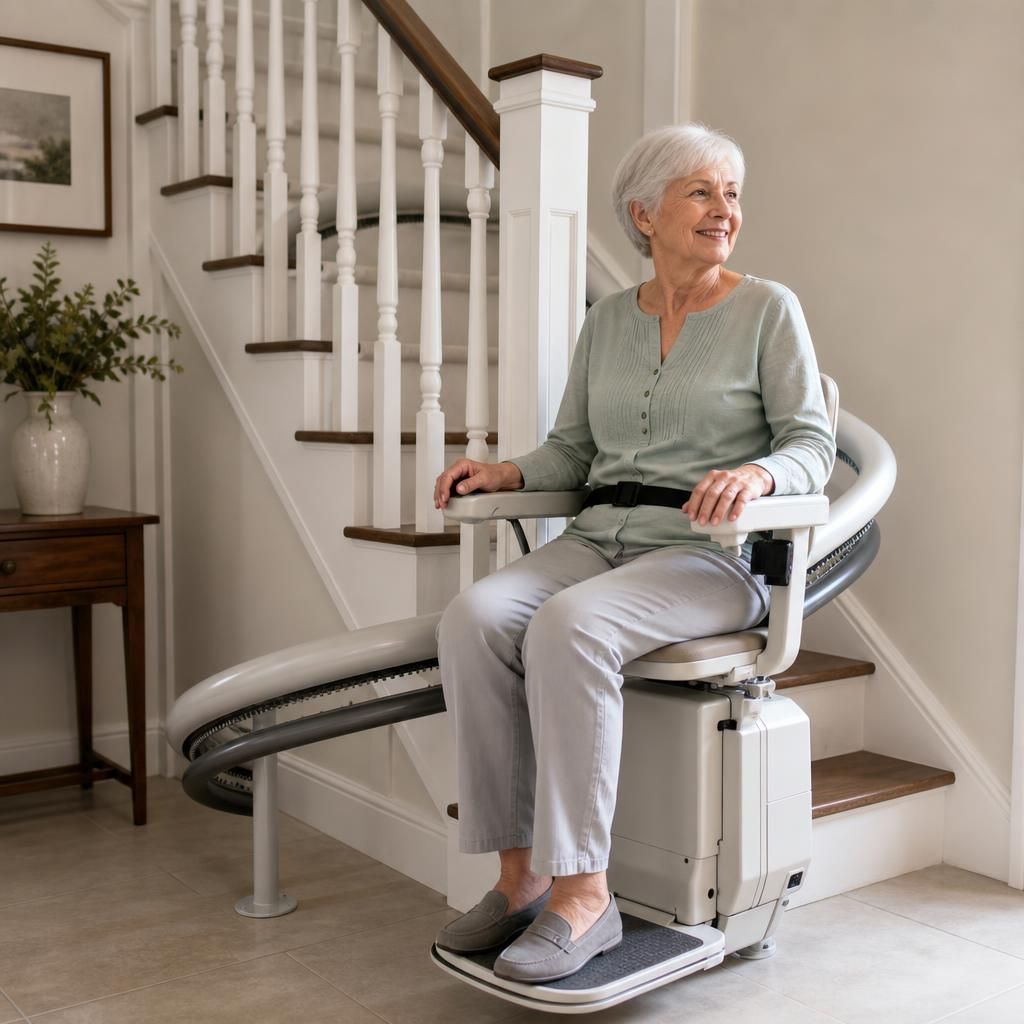
A bespoke curved stairlift is made to follow the precise shape of your staircase, including bends, landings, turns and changes in gradient. Its main advantage over a standard straight stairlift is that it can provide continuous, seated access across a more complex staircase without requiring the user to transfer between separate lifts or manage stairs between floors.
Every staircase is different, so a curved stairlift is designed following an assessment of the available space, stair geometry and the user’s mobility needs. The rail is manufactured to suit the property rather than relying on a standard straight section. This makes it suitable for many staircases where a conventional model cannot provide complete access.
Key benefits include:
- A precise fit for the staircase: The rail follows the actual line of the stairs, including intermediate landings, corners and changes in direction. This can provide a more practical solution in properties with unusual or restricted layouts.
- Access across multiple levels: A single curved stairlift can often travel around bends and between floors, depending on the staircase design and the results of the site assessment. This avoids the need to walk between sections or transfer from one stairlift to another at a landing.
- Smoother and more controlled movement: A properly designed system moves along a rail built for the staircase, with the controls and travel path set up for the user and the property. A professional assessment also helps identify potential issues at corners, narrow points and stopping positions before installation.
- Improved use of available space: The rail can be positioned to work with the width of the staircase, landings, doors and nearby furniture. When parked correctly, the stairlift can leave useful space for other household members, although the amount of clearance depends on the layout and the chosen model.
- Greater choice of seating and controls: A bespoke installation can be specified around the user’s posture, balance, transfer ability and reach. Options may include different seat positions, armrests, controls, swivel mechanisms and powered features. The appropriate specification should be based on safe, independent use rather than appearance alone.
It can make a complex staircase usable without major structural work. Curved stairlifts are commonly considered for staircases with quarter turns, half turns, intermediate landings, split levels or more than one flight. They may also be suitable where the staircase is narrow or where a straight rail would stop at a landing and leave part of the route inaccessible. Suitability cannot be confirmed from photographs alone, because clearances and stopping points need to be checked at the property.
A bespoke design can also be more discreet and practical than adapting the staircase. The rail is planned around existing features such as banisters, walls, doors and landing spaces. In some homes, the stairlift can be folded or parked away from the main walking line when it is not in use. The installer should explain where the lift will park and whether that position could affect access to a hallway, doorway or upper landing.
Safety is another important benefit, but it depends on correct assessment and use. A suitable curved stairlift should provide a stable seat, a secure restraint system, usable controls and safe stopping positions. Features such as sensors, swivel seating, powered footrests or hinged rails may be relevant where the user has limited strength, reduced balance or difficulty reaching down. The assessment should consider how the user approaches the lift, sits down, operates the controls and gets off at the destination. Carers and other household members should also understand how to use the lift safely.
The main trade-off is usually a higher initial cost than a standard straight model. Curved rails require individual design, surveying and manufacture, and the installation may involve more complex fitting. The final price can be influenced by the number and direction of turns, the length of the route, the number of floors served, parking arrangements, access conditions and any additional features. A site-specific quotation is therefore more reliable than a general price guide.
A bespoke curved stairlift is not automatically the best choice for every home. If the staircase is a single straight flight, a standard straight stairlift will generally be simpler and less expensive. If there are separate flights with a suitable landing, alternative arrangements may sometimes be considered. The right option depends on the complete route, the user’s abilities and how the staircase is used by everyone in the household.
During an assessment, the installer should review the staircase layout, available clearance, electrical supply, parking locations and any doors or obstructions near the route. It is also useful to discuss whether the user expects to travel between particular floors, whether someone else needs to pass on the stairs, and which controls or seating features would make transfers easier. These details help ensure that the proposed lift is genuinely usable rather than simply capable of fitting the rail.
In summary, the primary benefits of choosing a bespoke curved stairlift are a closer fit to the staircase, continuous access around bends and between levels, better use of available space, a specification tailored to the user and a controlled installation planned around the home. The additional cost is justified where the staircase is complex or where a straight model would leave part of the route inaccessible. An in-home assessment is the most dependable way to confirm suitability, features and total cost.
A bespoke curved stairlift is manufactured to follow the exact route of your staircase, including bends, intermediate landings and changes in direction. This allows one lift to provide seated access along a complex stairway where a standard straight model would stop at the first landing or require the user to transfer between separate lifts.
The rail is planned around the available clearance, doors, banisters and walking space. The assessment also considers where the lift should stop and park, helping to maintain practical access for other household members. The seat, controls and safety features can then be selected to suit the user’s posture, balance, reach and ability to transfer safely.
This tailored approach is particularly useful on narrow, steep or multi-level staircases, although suitability and the final specification can only be confirmed through an in-home assessment.
Arrange Your Bespoke Curved Stairlift Assessment
Arrange a bespoke curved stairlift assessment to confirm how the rail can fit your staircase and which seating and safety features suit your needs. We can then provide a tailored recommendation and quotation based on your home’s layout.