
Are curved stairlifts suitable for narrow or steep staircases?
Yes, curved stairlifts can often be designed for narrow or steep staircases, as their bespoke rails follow the exact shape and gradient of the stairs. Suitability depends on available width, bends, landings, headroom and safe access at the top and bottom, so a home assessment is needed to confirm the right solution.
Curved stairlifts can often be suitable for narrow or steep staircases because the rail is made to follow the staircase’s individual shape, bends and gradient. However, suitability is not determined by stair width or steepness alone. The available space, layout, headroom, landing areas, access at the top and bottom, and the user’s mobility all need to be assessed before a safe design can be confirmed.
Narrow staircases
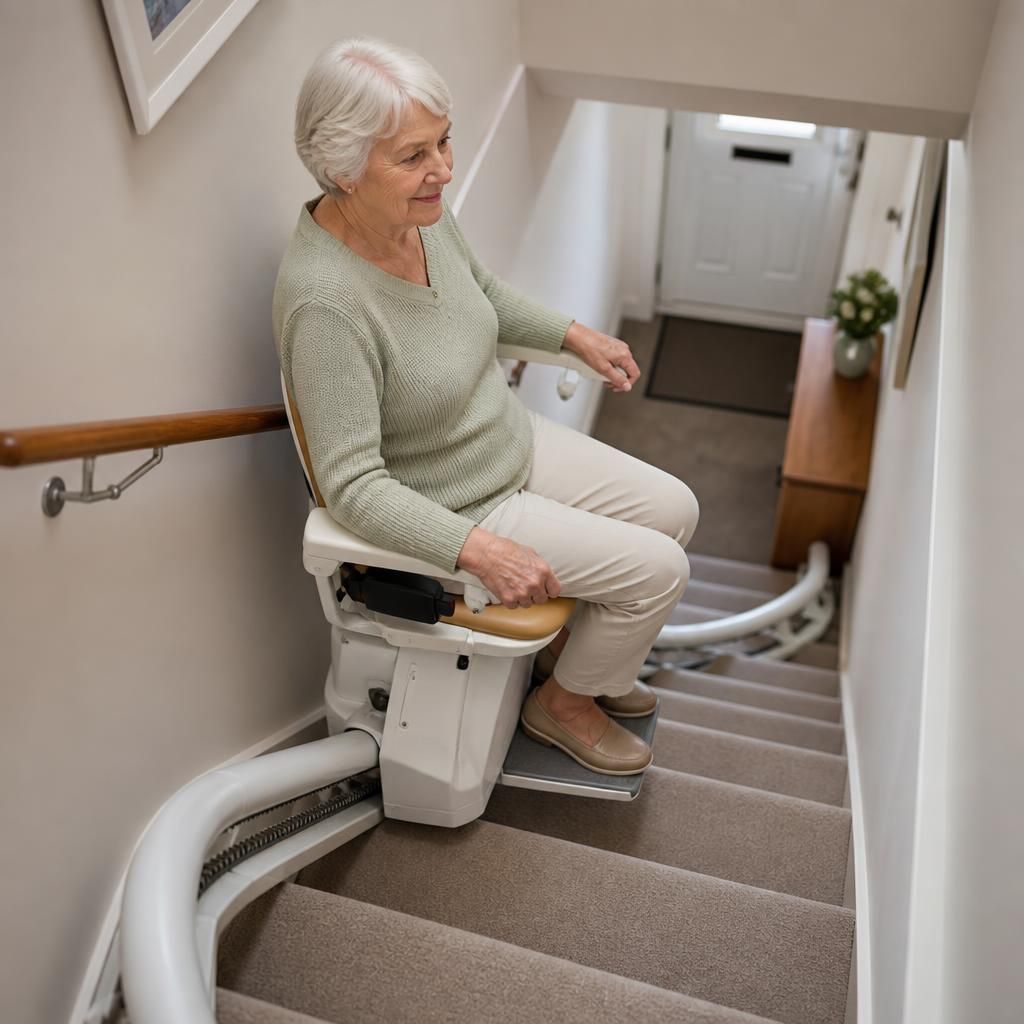
A curved stairlift may work on a narrow staircase where a standard straight model would not be appropriate, particularly when the rail is designed to fit closely to the stairs. The lift is normally installed on the stair treads rather than fixed to the wall, which can make it suitable for staircases with limited wall space or unusual layouts.
The stairlift still needs enough room for the user to sit safely, for the footrest and arms to be positioned correctly, and for other people to use the stairs where this is required. A seat that swivels at the top, a folding seat, folding arms and a folding footrest may help reduce obstruction when the lift is parked. On particularly restricted stairs, the position of the parked lift and the shape of the rail can be as important as the width of the staircase itself.
Where a staircase is narrow because of a handrail, dado rail, radiator or other obstruction, these features may affect the design. They do not always prevent installation, but they should be identified during the survey so that the rail, seat and controls can be positioned safely.
Steep staircases
Curved stairlifts can also be designed for many steep staircases. The rail follows the changing gradient, while the carriage and seat are designed to keep the user in a stable and comfortable position as the lift travels. The assessment must consider the steepest section, any changes in pitch, the distance between the user and the wall, and whether the user can transfer on and off the seat safely.
A steep staircase may require particular attention to seat positioning, swivel mechanisms, arm supports, the footrest and the controls. If the user has difficulty bending their knees, maintaining balance or turning at the top of the stairs, the most suitable configuration may differ from the one chosen for a less steep staircase. The lift should be specified around the person using it, not just around the staircase.
Staircases with bends and landings
A curved stairlift is especially useful where the staircase includes bends, intermediate landings, multiple flights or changes in direction. Its rail can be shaped to travel around these features and may be designed to park in a position that keeps a landing, doorway or hallway as clear as possible.
Landings need careful consideration. There must be a safe place for the user to get on and off, with sufficient clearance to turn or move away from the lift. At the top of the stairs, the rail may be extended or curved onto the landing so the seat reaches a more convenient position. At the bottom, it may be possible to park the lift out of the main walkway, although the available space and nearby doors must be checked.
What can affect suitability?
- The usable width of each section of staircase, including space occupied by handrails or other fixtures.
- The staircase gradient and any changes between flights.
- The position and size of bends, corners and intermediate landings.
- Headroom around the user’s head, shoulders and knees, particularly near low ceilings or door openings.
- The clearance available at the top and bottom for safe transfers and parking.
- Whether other household members need to continue using the stairs while the lift is parked or moving.
- The user’s height, weight, balance, flexibility, posture and ability to transfer independently.
- The position of doors, radiators, windows, furniture and other obstructions.
- The location of a suitable power supply and the practical route for installing the rail.
A staircase can therefore appear suitable at first glance but require a different rail route, seat arrangement or parking position once these details are considered. Conversely, a staircase that looks too narrow or steep may still accommodate a bespoke solution after the available space has been measured accurately.
When might a curved stairlift not be suitable?
Installation may be unsuitable if there is insufficient clearance for the user to travel safely, no practical place to transfer at either end, inadequate headroom, or an obstruction that cannot be moved or worked around. In some homes, the staircase layout may make the rail technically possible but leave an unsafe or impractical exit point. A survey should identify these issues before any recommendation is made.
If a conventional seated stairlift is not appropriate, alternative arrangements may need to be considered. These could include changing the rail’s parking position, selecting a different seat configuration, adapting an obstruction, or assessing another type of mobility equipment. The right option depends on the property and the person’s needs, so a generic recommendation cannot replace an individual assessment.
How the suitability assessment works
During a home assessment, the staircase and surrounding areas are measured and checked in detail. The assessment considers the full route rather than only the narrowest or steepest section. It also includes the user’s preferred method of access, how they currently manage the stairs, where the lift should park, and whether family members need to pass the installation.
You should raise any concerns about knees, hips, balance, memory, transfers or emergency use during the assessment. These factors can influence the seat height, swivel arrangement, controls and safety features. It is also useful to discuss whether the stairlift will be used on every journey or mainly at particular times, as this may affect the preferred parking position and configuration.
In summary, narrow or steep stairs do not automatically rule out a curved stairlift. A bespoke rail can accommodate many complex domestic staircases, but the installation must provide safe travel, comfortable seating and reliable access at both ends. An assessment by Independent Stairlifts will establish whether your staircase is suitable and explain any design choices that may affect the specification and overall curved stairlift price.
Curved stairlifts can often be installed on narrow staircases because their rails are made to follow the exact route of the stairs rather than using a standard straight track. The rail can be positioned around bends and landings, while folding arms, a folding footrest and a swivel seat may help reduce obstruction when the lift is parked.
Available width is only one part of the assessment. Handrails, radiators, doorways, low headroom and the space needed to transfer safely at the top and bottom can all affect the design. An Independent Stairlifts home assessment will confirm whether the staircase can accommodate a safe, comfortable configuration and identify any changes needed to the rail or parking position.
Arrange a Home Assessment for Your Staircase
Arrange a home assessment with Independent Stairlifts to confirm whether your narrow or steep staircase can accommodate a safe, comfortable curved stairlift. Our adviser will assess the full staircase and discuss the most suitable rail, seat and parking configuration for your needs.