
What factors contribute to the affordability of a stairlift without sacrificing essential features or safety?
A stairlift is more affordable when its design matches the staircase and the user’s essential needs, with costs managed through options such as a straightforward configuration, a reconditioned model where suitable, or a tailored package rather than by removing safety features. A professional assessment should confirm safe operation, secure installation, suitable controls, a reliable seat and necessary safety sensors before any decision is made.
Affordability comes from matching the stairlift to the staircase and the user’s essential requirements, rather than removing safety features. The main cost influences are the staircase design, whether the lift is new or reconditioned, the complexity of installation, the equipment specification and the support included after fitting. A professional assessment helps identify where costs can be controlled without compromising secure installation, reliable operation or safe use.
Choose the simplest suitable stairlift design
A straight stairlift is generally less complex to manufacture and install than a curved model because it uses a standard rail along a single, uninterrupted flight. If the staircase is straight and there are no landings or changes of direction, choosing a suitable straightforward configuration can avoid paying for features that are not needed.
Curved staircases require a rail designed around the bends, landings and available space. The design may also need to account for narrow sections, doorways, adjoining flights or the position where the user needs to get on and off. This bespoke work affects the price, but it is necessary where a standard straight lift would not provide a safe or practical route. An accurate survey can prevent the cost and inconvenience of choosing a model that is unsuitable for the home.
Separate essential features from optional upgrades
Every stairlift should provide the safety functions appropriate to its design and the user. These commonly include a properly fitted seatbelt, obstruction sensors, secure controls, a stable seat and armrests, and a means of stopping safely if an obstruction is detected. Battery operation and suitable charging arrangements are also important, particularly because a stairlift needs to remain usable during a temporary power cut.
Other features may improve comfort or convenience without being essential for every installation. Examples can include powered swivelling or folding components, upgraded upholstery, additional remote controls, alternative control positions and powered footrests. These options can be valuable for someone with limited strength, balance or dexterity, but they should be selected according to the user’s abilities and the layout of the home. Removing an unnecessary comfort option may reduce the price; removing a safety function should not.
Consider a reconditioned stairlift where it is appropriate
A professionally reconditioned stairlift can provide a lower-cost alternative to a new model, particularly on a suitable straight staircase. It should be inspected, cleaned, tested and installed by a competent provider, with attention given to the lift’s batteries, drive system, safety sensors, controls, seatbelt and charging points. The condition of the equipment and the support available after installation matter more than the label “reconditioned” on its own.
Reconditioned equipment is not suitable in every situation. A complex curved staircase may require a newly manufactured rail, and a user with particular mobility requirements may need a specification that is not readily available as a reconditioned option. Ask what has been checked, what warranty is included and whether replacement parts and servicing are available before comparing the initial prices.
Understand how installation affects the total cost
The quoted price should reflect the work needed to install and test the stairlift, not just the equipment itself. Installation considerations can include the staircase length and shape, access to the property, the position of charging points, the condition of the steps, clearance at the top and bottom, and whether the lift must park away from a doorway or passage.
A proper assessment should also consider how the user approaches the stairlift, transfers into the seat and exits at the destination. A technically cheaper installation may not represent good value if the seat stops in an awkward position, obstructs a route or leaves insufficient space for a safe transfer. The best-value arrangement is one that works with the home’s normal circulation and does not require avoidable alterations later.
Match the specification to the person using it
The user’s height, weight, balance, leg strength, flexibility, vision and hand control can all affect the most appropriate model. A compact seat may be suitable where space is restricted, but it must still provide a stable and comfortable position. A powered swivel or a different control arrangement may be more important than decorative finishes if turning at the top of the stairs is difficult.
Controls should be reachable and straightforward to operate. If more than one person uses the stairlift, call and send controls may be needed at both ends of the route. If the user has reduced grip or movement, the installer may recommend a joystick, adapted control or a different armrest arrangement. Spending money on the right functional feature can avoid the greater cost of changing an unsuitable lift later.
Compare the complete ownership cost
The initial quotation is only one part of affordability. Check what is included, such as the survey, delivery, installation, testing, user instruction, warranty and removal of an old stairlift if applicable. Also ask about future servicing, battery replacement, call-out arrangements and the availability of parts. A lower initial price may not be the best value if essential support is excluded or repairs are difficult to arrange.
For a reconditioned stairlift, clarify whether the warranty applies to the whole installation or only selected components. For a new stairlift, establish what happens when the warranty ends and whether a service plan is available. These details make it easier to compare options on a like-for-like basis rather than choosing solely by the purchase price.
Ask for a clear assessment and quotation
A suitable assessment should explain why a particular stairlift has been recommended, which features are essential for safe use, and which are optional. It should identify any limitations, such as restricted parking space, a narrow staircase or a difficult transfer point. The quotation should also make clear whether the price is fixed and whether any additional work could be required.
Depending on personal circumstances, VAT relief may be available on qualifying mobility equipment for disabled or chronically ill customers. Eligibility and the required declaration should be confirmed before relying on this when comparing prices.
In practical terms, an affordable stairlift is one with a suitable design, necessary safety equipment, competent installation and dependable aftercare. Costs can often be managed by choosing a straightforward model, selecting only relevant upgrades, considering a properly reconditioned option and comparing the full package. A professional home assessment is the safest way to identify these savings while preserving the features that protect the user and support confident day-to-day operation.
An affordable stairlift is one that meets the user’s essential mobility and safety needs without paying for unsuitable features. Cost should be controlled through the staircase design, equipment choice and installation requirements—not by removing safeguards such as the seatbelt, obstruction sensors, stable seating, secure controls or reliable charging.
A professional assessment can identify which features are necessary for safe transfers and comfortable use, and which are optional upgrades. For example, a powered swivel seat or adapted control may be important for someone with limited balance or hand movement, while upgraded upholstery may not be essential. Comparing the complete package—including installation, testing, warranty and aftercare—also helps ensure that a lower initial price does not create higher costs later.
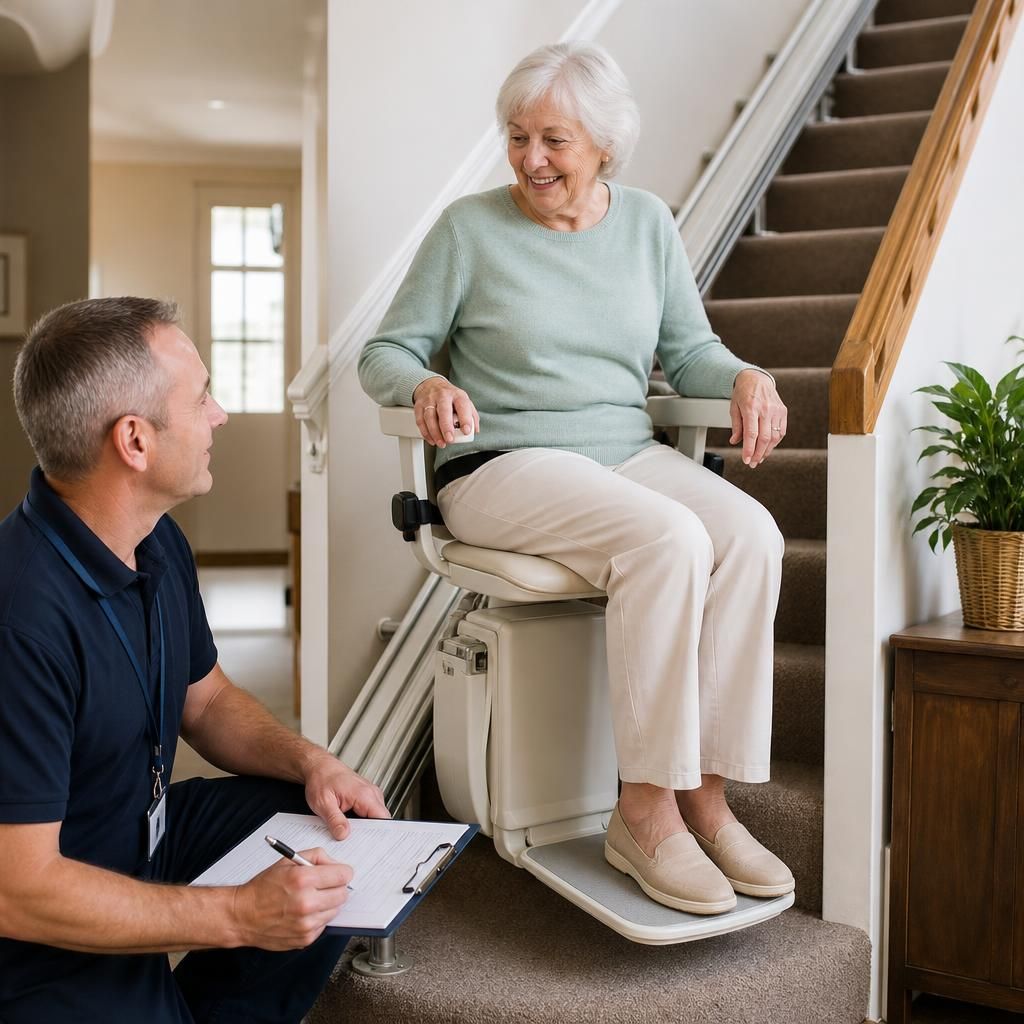
Arrange Your Stairlift Assessment
Arrange a professional stairlift assessment to identify the essential features for your staircase and mobility needs, while highlighting suitable ways to manage the overall cost. You can then compare a clear quotation covering installation, safety checks, warranty and aftercare.