
What are the key features to consider when selecting an affordable stairlift for a multi-level home?
When selecting an affordable stairlift for a multi-level home, prioritise essential safety and comfort features, dependable battery charging, easy controls, and a rail or configuration that suits each staircase. A professional assessment should also establish whether one lift can serve multiple floors or whether separate stairlifts, landings, or transfer points will provide the safest and most cost-effective solution.
An affordable stairlift for a multi-level home should combine essential safety, dependable operation and a configuration that suits every staircase, rather than simply having the lowest purchase price. The key features to assess are the stairlift’s route, seating and transfer arrangements, safety sensors, controls, battery system, charging points, installation requirements and ongoing support. A professional home assessment is important because the most economical solution may be one continuous bespoke lift, separate lifts for different staircases, or a lift with a safe transfer point between levels.
Start with the layout of the stairs. Multi-level homes can include straight flights, turns, intermediate landings, narrow passages or more than one staircase. A straight stairlift may be suitable for an uninterrupted flight, while a curved stairlift is normally needed where the staircase changes direction or follows a landing. If the home has several flights, the installer should assess whether a single rail can follow the complete route and stop safely at each required level. In other properties, separate stairlifts may be more practical and affordable, particularly where the flights are independent.
The assessment should also consider where the user will get on and off the lift. A parking position at the top or bottom of a staircase may need to be extended beyond the edge of the steps, or the seat may need to swivel to make the transfer safer. These details affect the rail design, the amount of usable space and the overall cost, so they should be included in the quotation rather than treated as an afterthought.
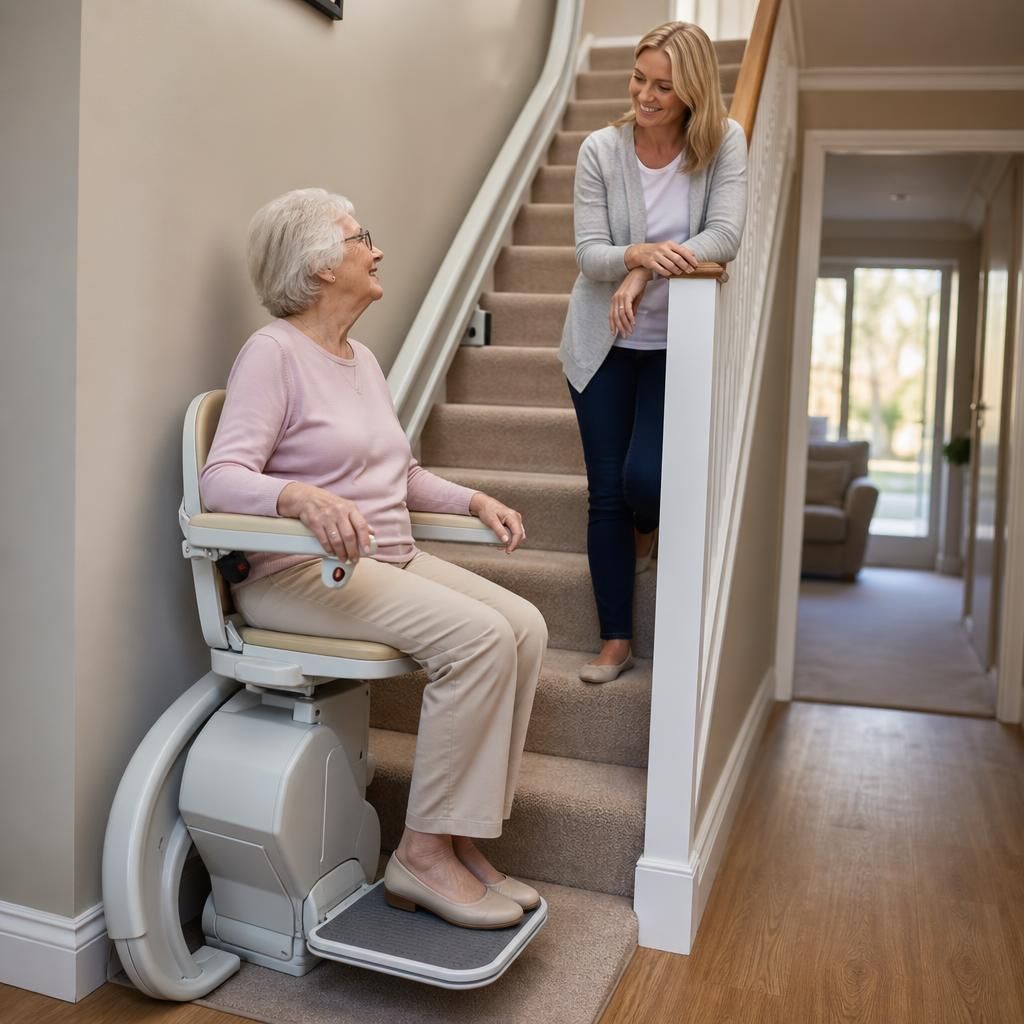
Safety features should remain a priority. A suitable stairlift should have sensors that detect obstacles on the stairs and stop the lift if something is in its path. A seat belt or safety harness, secure armrests and a stable footrest are also important. The lift should start and stop smoothly, with controls that allow the user to operate it without stretching or twisting. For a multi-level home, check that these safety features work consistently at every stopping point and that the chosen route does not create a hazardous transfer between flights.
A swivel seat can help the user face the landing before standing up, reducing the need to turn while on the stairs. Depending on the home and the user’s mobility, a powered swivel or powered footrest may provide useful assistance, although manual versions can keep the price lower. The right choice depends on strength, balance, dexterity and how independently the user can transfer from the seat.
Choose controls that are simple and accessible. Most stairlifts use controls on the armrest, with remote controls available for calling the lift to another floor. Controls should be easy to identify and operate, particularly for someone with limited hand strength, reduced vision or arthritis. If separate lifts are installed, the controls and charging arrangements should be straightforward and consistent. A professional assessment can identify whether a standard joystick, a push button or an alternative control would be most suitable.
Check the battery and charging system. Battery-powered stairlifts are designed to operate during a power cut, provided the batteries are charged and maintained correctly. For a multi-level home, the lift should have reliable charging points at the places where it is normally parked. Ask how the batteries are charged, what warning is given when the charge is low and how long replacement batteries are expected to last under normal use. A lift that cannot reach a charging point at the end of its journey may be inconvenient or unreliable, even if its initial price is attractive.
Consider the seat and track dimensions carefully. The seat should provide adequate support without making the staircase feel unnecessarily obstructed. A foldable seat, armrests and footrest can help preserve access for other household members when the lift is parked. On narrow stairs, the folded dimensions of the lift are particularly important. The rail may also need to be positioned close to the steps, skirting board or wall, so the installer should confirm that doors, hallways and landings remain usable.
Weight capacity, seat width and the user’s posture should be checked before selecting a model. A compact seat is not good value if it is uncomfortable or difficult to use safely. Conversely, choosing features that are not needed can increase the price and reduce available space. Affordability is best achieved by selecting the specification that meets the user’s actual needs, rather than removing safety or essential comfort features.
Look for a rail configuration that can be installed without unnecessary building work. Most stairlifts are fitted to the stairs rather than the wall, which can avoid major structural alterations. However, multi-level installations may require careful positioning around landings, doorways and handrails. Ask whether the proposed rail will need alterations to flooring, bannisters or door access, and whether the lift can be removed or adapted if the home’s needs change. A clear installation plan helps prevent unexpected costs.
For a home with more than one staircase, compare the practical cost of different arrangements. One bespoke lift may provide a continuous route but involve a more complex rail. Separate straight lifts may have a lower initial cost on suitable flights, but the user may need to transfer at a landing. That transfer is only appropriate where the landing is level, adequately clear and safe for the individual. The cheapest arrangement is not suitable if it makes the user walk, turn or stand where they are unsteady.
Assess comfort features in relation to daily use. A padded seat, supportive backrest, adjustable seat height and smooth movement can make regular journeys easier. A user who has difficulty bending may benefit from a higher seat or powered adjustments. A lift used several times a day may justify comfort features that would be unnecessary for occasional use. Discuss the user’s condition and typical routine during the assessment so that the specification reflects real use rather than a generic model.
Confirm reliability, servicing and warranty arrangements. An affordable stairlift should have accessible technical support, clear instructions and a suitable warranty. Ask what is covered, how faults are reported and whether servicing or battery replacement is included or charged separately. Reconditioned stairlifts can offer value when they are professionally inspected, correctly matched to the staircase and supplied with appropriate aftercare. Their condition, available warranty and suitability for the specific route should be confirmed before installation.
When comparing quotations, check that each one includes the same essential elements: survey and design, delivery, installation, testing, user instruction, removal of packaging and any agreed aftercare. A lower headline price may exclude alterations, extended rails, additional charging points or work needed to make a transfer area safe. Comparing the complete installed solution gives a more accurate view of value.
Before making a decision, ask the installer to confirm:
- Whether one stairlift can serve all required levels or whether separate lifts are safer and more economical.
- Where the lift will park and charge on each floor.
- How the user will transfer at intermediate landings.
- Which safety sensors, seat-belt arrangements and obstruction controls are included.
- Whether the seat, footrest and controls suit the user’s mobility and dexterity.
- How much space remains for other people to use the staircase.
- What building work, rail extensions or access changes are included in the quotation.
- What warranty, servicing and breakdown support will be available after installation.
The most cost-effective stairlift for a multi-level home is therefore the one that provides a safe, usable route with only the features the user needs. Prioritise a suitable rail design, safe transfers, reliable charging and controls that can be operated confidently. Optional powered features can then be considered where they offer a genuine benefit, while a professional assessment helps avoid paying for an unsuitable or unnecessarily complicated installation.
For a multi-level home, the most important affordable stairlift feature is a route that allows the user to travel between floors without unsafe transfers. During the assessment, confirm whether one continuous curved rail can serve each staircase or whether separate lifts with a suitable landing transfer will be safer and more economical.
Check that each lift has a secure seat belt, obstruction sensors, accessible controls and dependable charging at its parking position. A swivel seat and foldable footrest can make getting on and off safer while preserving access for other household members. These essential features should be prioritised before optional powered adjustments, so the final specification remains practical without compromising safe daily use.
Arrange a Multi-Level Stairlift Assessment
Arrange a multi-level stairlift assessment to confirm the safest and most cost-effective route, including suitable rail design, transfer points, parking positions and charging arrangements.
Our advisers can assess your staircases and explain which essential features are appropriate for the user and home.