
How do bespoke and reconditioned stairlifts compare in terms of cost and value?
Bespoke stairlifts are made or configured to suit the individual staircase, so they usually cost more but provide a better fit for unusual layouts and specific mobility needs. Reconditioned stairlifts generally cost less and can offer excellent value on suitable staircases, provided their condition, safety checks, warranty and installation are assessed carefully.
Bespoke stairlifts usually cost more than reconditioned stairlifts because they are selected, configured or manufactured to suit a particular staircase and set of mobility requirements. Reconditioned stairlifts generally have a lower initial price and can provide very good value where the staircase is suitable and the lift has been properly inspected, serviced, installed and covered by an appropriate warranty. The better option depends on the shape of the staircase, the user’s needs, the expected length of use and the level of future support required.
What is meant by a bespoke stairlift?
A bespoke stairlift is not limited to one particular product type. It may involve a stairlift made for a curved staircase, or a carefully configured solution for a straight staircase with unusual dimensions, restricted space, narrow access or specific seating and control requirements. A professional assessment considers the staircase and the person using the lift together, rather than treating the installation as a standard fit.
Bespoke options may include:
- A rail shaped to follow one or more bends, landings or changes in direction.
- A compact seat or folding components where space at the bottom or top of the stairs is limited.
- Seat, armrest, footrest or control adaptations to make transfers safer and more manageable.
- A configuration that accommodates a particular posture, weight requirement or level of mobility.
- Finishes and positioning chosen to work with the home while maintaining safe access to the stairs.
Because more assessment, design and installation work may be involved, a bespoke solution normally has a higher purchase price. That extra cost can be justified when a standard rail would not fit correctly, would obstruct a doorway or walkway, or would not provide the support the user needs.
What is a reconditioned stairlift?
A reconditioned stairlift is a previously used lift that has been removed, examined, cleaned, serviced and prepared for another installation. The exact process varies between suppliers. A responsible reconditioning process should include checks on the drive system, controls, safety sensors, batteries, charging equipment, seat and rail, together with replacement of worn or unsuitable components where necessary.
Reconditioned stairlifts are often particularly cost-effective on straightforward staircases. A suitable used lift and rail may be available without the cost of manufacturing a new system from scratch. However, the rail must still be compatible with the staircase and the lift must be suitable for the person who will use it. A low price alone does not establish good value.
For curved staircases, the position is more complicated. A curved rail is made to follow the individual staircase, so a previously used curved stairlift may not fit another home. It can sometimes be adapted or sourced for a suitable layout, but availability is more limited than for standard straight-stairlift installations. This is why a bespoke curved solution is often the more practical choice, even when the initial cost is higher.
How the costs compare
The headline purchase price is only one part of the comparison. The total cost can include the assessment, rail, seat and controls, delivery, installation, removal of an existing lift, alterations to the staircase, servicing and future repairs. Ask for these elements to be explained in the quotation so that a lower advertised price is not compared with a more comprehensive package.
- Initial cost: Reconditioned equipment usually has the lower upfront cost, while bespoke equipment generally costs more because of its design and fitting requirements.
- Staircase complexity: Bends, intermediate landings, tight turns and limited parking areas can increase the cost of a bespoke installation. They can also make a reconditioned lift unsuitable.
- Installation: Both options should be professionally installed. A used lift is not necessarily a simple or inexpensive installation if the rail, wiring or positioning requires modification.
- Warranty: Check exactly what is covered, for how long and whether labour, batteries and call-outs are included. Warranty terms can have a significant effect on overall value.
- Ongoing maintenance: A reliable supply of parts and access to qualified servicing may matter more than a small difference in the original price.
- Future changes: If the user’s mobility is likely to change, a seat, swivel mechanism, controls or powered options may make the lift more useful over time.
Which option offers better value?
A reconditioned stairlift can offer the best value when the staircase is uncomplicated, the available model meets the user’s needs and the equipment comes with documented checks, professional installation and meaningful aftercare. It may be appropriate where the lift is needed for a limited period, although the expected duration of use should not be the only consideration. A lift that is uncomfortable or difficult to operate may prove poor value regardless of its initial price.
A bespoke stairlift can offer better long-term value when the home has an unusual layout or the user needs a particular seating position, transfer arrangement or control system. The closer fit may improve day-to-day usability, reduce the risk of the lift being abandoned because it is uncomfortable, and avoid the expense of trying to adapt an unsuitable standard model.
Value should therefore be judged by what the stairlift enables safely and reliably, not simply by the purchase price. Consider:
- Whether the user can sit down, travel and get off the lift without unnecessary difficulty.
- Whether the controls can be reached and operated consistently.
- Whether the stairlift leaves adequate room for other people to use the stairs.
- Whether the seat, footrest and armrests provide suitable support.
- Whether the lift can park without blocking a doorway, hallway or landing.
- Whether servicing, repairs and replacement parts will remain available.
Questions to ask before choosing
For a reconditioned stairlift, ask which components have been checked or replaced, whether the rail is new or previously used, whether the batteries are covered, and what happens if a fault develops after installation. Ask also whether the model remains supported and whether a service agreement is available.
For a bespoke stairlift, ask what makes the proposal bespoke, which features are essential for the user, whether a standard alternative has been considered, and what is included in the design and installation price. The assessment should explain how the proposed lift will fit the staircase and how it will support safe transfers and everyday use.
A home assessment is important for both options. It allows the installer to measure the staircase, identify obstructions, consider parking positions and discuss the user’s strength, balance, posture and ability to operate the controls. A quotation should be based on this assessment rather than on a generic price for a stairlift.
In summary
Choose a reconditioned stairlift when a suitable, fully checked model can be installed safely and its warranty and aftercare provide sufficient protection. Choose a bespoke solution when the staircase is curved or unusually configured, or when the user needs adaptations that a standard used model cannot provide. Comparing the complete installation, warranty, maintenance arrangements and suitability for the user will give a more accurate view of cost and value than comparing prices alone.
The value of a stairlift depends on more than its purchase price. A reconditioned stairlift may cost less initially, but a bespoke solution can provide better long-term value when the staircase is curved, space is restricted or the user needs specific seating and control features.
Before comparing quotations, check what is included. The total cost may cover the assessment, rail, installation, batteries, warranty and aftercare, while servicing and future repairs may be charged separately. For a reconditioned model, ask which parts have been inspected or replaced and whether the lift is suitable for the intended staircase and user.
A professional home assessment helps establish whether the lower-cost option will work safely and comfortably. If the lift is difficult to use, obstructs access or cannot be maintained reliably, its lower price may not represent good value. The most suitable choice is the one that provides safe, dependable access with costs and support clearly explained.
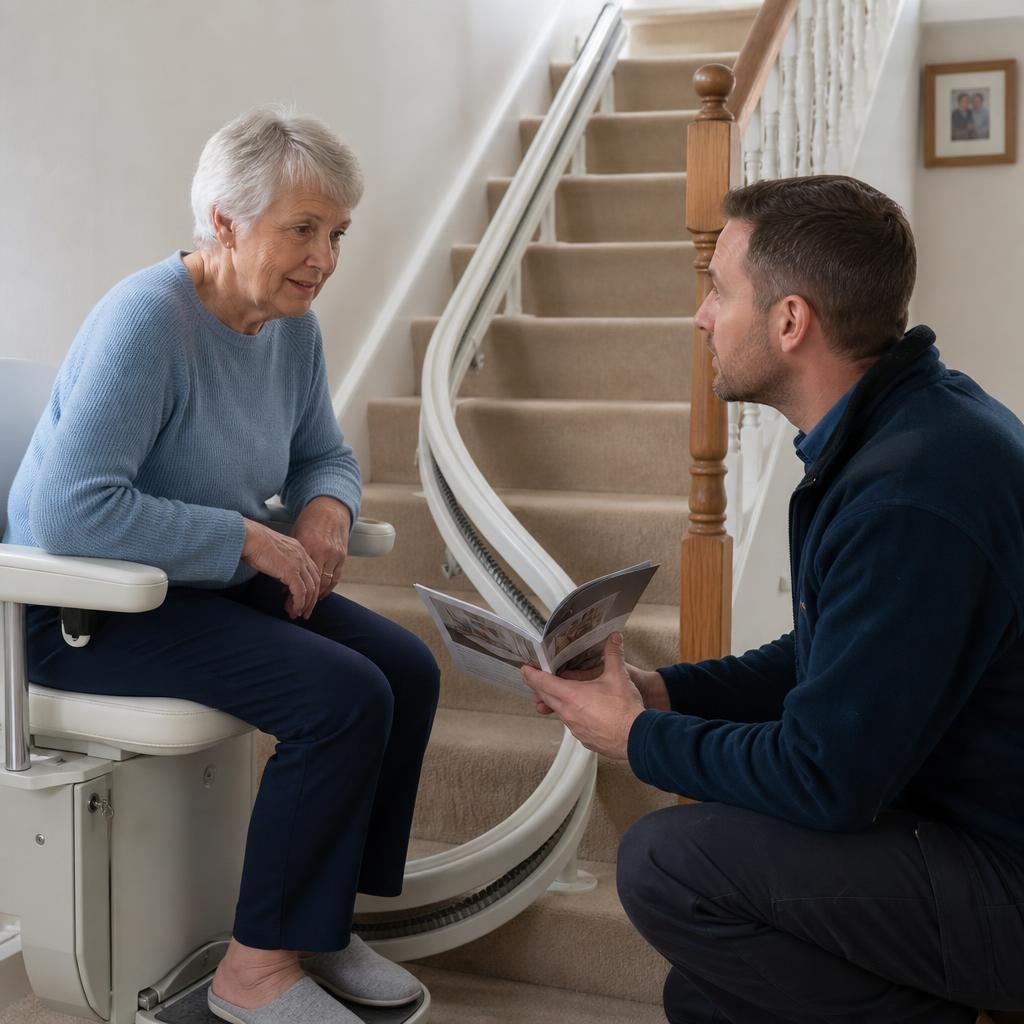
Arrange a stairlift assessment to compare your options
Arrange a home assessment to compare bespoke and reconditioned stairlift options based on your staircase, mobility needs and budget. We’ll explain the complete costs, installation requirements, warranty and aftercare before you decide.