
How can I ensure that an affordable stairlift provides a long-lasting and reliable solution?
Choose an affordable stairlift based on its suitability, safety features and expected condition—not price alone—and have it professionally assessed and installed for your staircase and mobility needs. To support long-term reliability, check the warranty, servicing arrangements, availability of replacement parts and, for a reconditioned model, the inspection, refurbishment and testing completed before installation.
An affordable stairlift provides a long-lasting and reliable solution when its price is considered alongside its condition, suitability, installation quality, ongoing support and total cost of ownership. The right model should be professionally assessed for your staircase and mobility needs, include essential safety features, and be supported by clear warranty, servicing and replacement-parts arrangements.
Start with suitability rather than price
A stairlift that is inexpensive but unsuitable for the staircase or the person using it is unlikely to represent good value. A professional assessment should consider the shape, width and structure of the stairs, the available space at the top and bottom, the position of doors and landings, and whether the lift will obstruct other household activities.
The assessment should also take account of the user’s mobility, balance, strength, posture and ability to transfer safely on and off the seat. Important choices can include the seat height, swivel and folding functions, armrest support, controls and the position of the charging points. If more than one person will use the stairlift, the design should be suitable for everyone who needs it rather than selected solely for the primary user.
Check the essential safety features
An affordable stairlift should still provide the features needed for safe, controlled use. Depending on the model and the staircase, these may include a stable seat and armrests, a seat belt, obstruction sensors, a swivel seat, a manual or powered footrest, simple controls and battery backup. The most suitable combination depends on the user’s abilities and the layout of the home.
Controls should be easy to operate and positioned where the user can reach them without stretching. Remote controls can be useful when the stairlift needs to be called to another floor, particularly in a shared household. However, additional features should be selected for a practical reason, not simply because they are available. Avoid reducing essential safety or support features to achieve a lower purchase price.
Understand the condition of a reconditioned stairlift
A reconditioned stairlift can provide good value, but its reliability depends on how it has been assessed and prepared. Ask what inspection, cleaning, refurbishment and testing have been completed before installation. The important issue is not simply that the lift has been used previously, but whether its mechanical, electrical and safety-critical components have been checked and brought to an appropriate standard.
Ask whether worn parts have been replaced, whether the batteries have been tested and whether the stairlift is being installed with a suitable rail and configuration for your staircase. You should also receive clear information about the model’s condition, any limitations and the cover provided after installation. A low price without this information makes it difficult to judge the likely lifespan or future cost.
Compare the complete cost
The purchase price is only one part of affordability. Request a clear quotation that explains what is included, such as the survey, stairlift, rail, fitting, removal of an existing lift where applicable, user instruction and aftercare. Check whether any alterations to the staircase, electrical work or other installation requirements could result in additional charges.
It is also sensible to consider potential ongoing costs. These may include servicing, replacement batteries, repairs and the cost of removing or relocating the stairlift in the future. A slightly higher initial price may be more economical if it includes stronger aftercare or reduces the likelihood of unexpected expenditure. Conversely, an expensive specification is not automatically better if its additional functions are not needed.
Verify the warranty and aftercare arrangements
Before agreeing to a stairlift, read the warranty terms carefully. Confirm what components are covered, how long cover lasts, whether labour and call-outs are included, and what exclusions apply. Ask what happens if the stairlift develops a fault and how to request assistance.
Reliable long-term support also depends on access to compatible replacement parts and technicians who understand the model. This is particularly relevant for older or reconditioned stairlifts. Find out whether servicing is available locally or across the area in which you live, and whether routine maintenance is recommended for your installation.
Give installation the same attention as the equipment
Correct installation is essential to the stairlift’s performance and safety. The rail must be securely fitted to the stairs or an appropriate supporting structure, the lift must run smoothly along its route, and charging points must be positioned correctly. The installer should check clearances, travel limits, sensors, braking and battery charging before handing the equipment over.
Do not rely on a generic fitting assumption for a staircase with tight turns, narrow sections, unusual steps or limited landing space. A bespoke rail or tailored configuration may cost more than a standard arrangement, but it can provide a better fit and avoid unsafe compromises. The finished installation should not create an avoidable obstruction or interfere with doors, handrails or access routes.
Learn how to use and care for the stairlift
Ask the installer to demonstrate normal operation, parking, charging, use of the safety belt, swivel-seat operation and the response to a power cut or obstruction warning. The user should be able to understand the controls and know what to do if the stairlift stops unexpectedly. Written instructions should be kept somewhere accessible.
Keeping the rail and surrounding area clear, using the stairlift as instructed and reporting unusual noises, jerky movement, reduced travel speed or charging problems promptly can help prevent a minor issue becoming a larger fault. Do not attempt electrical or mechanical repairs yourself. Contact the appropriate support service and follow the manufacturer’s or installer’s guidance.
Use practical checks before making a decision
- Have the staircase and the user’s needs assessed in person where possible.
- Confirm that the proposed model is suitable for the staircase layout and expected level of use.
- Check the condition and testing history of any reconditioned stairlift.
- Make sure essential safety features have not been removed to lower the price.
- Request a written quotation showing installation, warranty and aftercare inclusions.
- Ask about replacement parts, servicing, battery support and fault response arrangements.
- Ensure the user receives a full demonstration and is comfortable operating the controls.
Be cautious of a quotation that gives little information about the model, installation work or support after fitting. A dependable provider should be able to explain why the proposed stairlift is appropriate, what condition it is in, what is covered and how future servicing will be handled. These checks help ensure that an affordable stairlift remains safe, usable and supportable throughout its working life.
An affordable stairlift is more likely to remain reliable when it includes clear warranty cover, accessible servicing and support for replacement parts. Before installation, confirm what the warranty covers, whether labour and call-out costs are included, and how faults are reported and dealt with.
These arrangements are particularly important for reconditioned stairlifts or older models, where compatible batteries and components may need to be sourced. Ask the installer to explain the recommended servicing schedule, battery support and aftercare process so that a low purchase price does not lead to unexpected repair costs later.
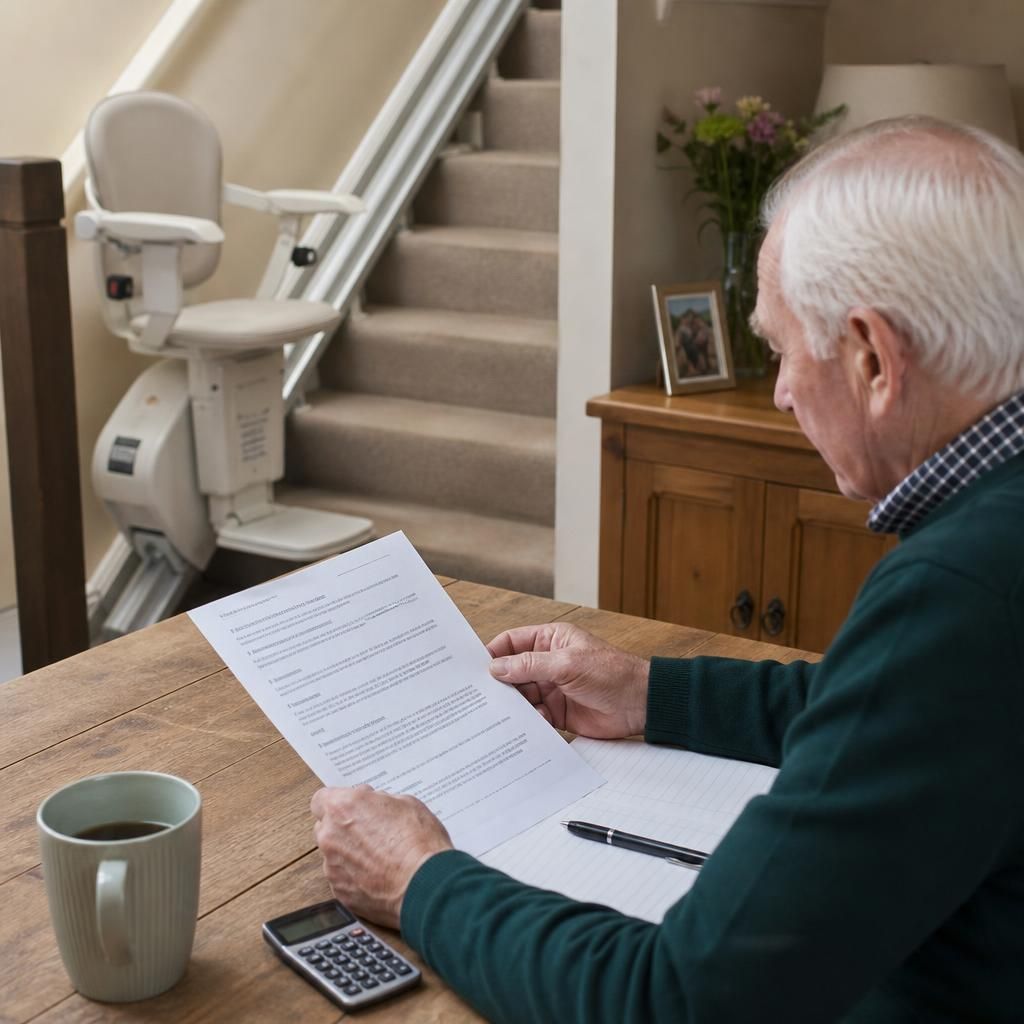
Discuss your affordable stairlift options
Discuss your affordable stairlift options with our team to compare suitable new or reconditioned models, installation requirements, warranty cover and ongoing support. We can arrange a professional assessment and provide a clear quotation based on your staircase and mobility needs.