
Are there particular installation considerations to be aware of when choosing a budget-friendly stairlift?
Yes. When choosing a budget-friendly stairlift, check the stairway’s width, layout, bends, landings, fixing surface, power supply and access at the top and bottom, as these affect the suitable model and installation work. A professional assessment is essential to confirm that the lift can be fitted safely and that choosing a lower-cost option will not compromise reliable operation or safe access.
Yes. A budget-friendly stairlift still needs to be matched carefully to the staircase and fitted by a competent professional. The main installation considerations are the stairway’s width and shape, the condition of the stairs and walls, clearance at the top and bottom, access to nearby doors and corridors, the electrical supply, and the user’s ability to get on and off the seat safely. These factors can affect both the type of stairlift required and the total installation cost.
Staircase layout and available space
A straight stairlift is usually the simplest and most economical option where the staircase runs in one uninterrupted flight. However, a staircase with a bend, intermediate landing, multiple flights or a change of direction generally requires a curved or specially configured system. Trying to use an unsuitable standard rail to reduce the initial price can create difficulties with parking, access or safe transfers, so the stairlift should be selected only after the complete staircase has been assessed.
The width of the stairs is important, but it is not the only measurement that matters. The installer must consider the space occupied by the seat, armrests and footplate, as well as the clearance available for other people using the stairs. On narrower stairs, a compact seat, folding footplate or hinged rail may help, but these features must be suitable for the person using the lift and the layout of the property. A folding rail may also be needed if a doorway, hallway or entrance is close to the bottom of the stairs.
Top and bottom access
The lift needs a safe and practical place to stop at both ends. At the bottom, there should be enough room for the user to sit down without obstructing a doorway or being left close to a hazard. At the top, the user must be able to turn or transfer safely onto the landing. If the staircase finishes close to a wall, door or narrow passage, the installer may recommend a swivel seat, a different parking position or a rail design that extends beyond the final step.
These details can be particularly important when the stairlift is being installed for someone with limited balance, reduced strength or difficulty turning. The cheapest installation is not necessarily the best value if it leaves the user unable to reach a room, open a door or move safely away from the stairlift.
Condition of the stairs and fixing surface
Most stairlifts are fixed to the stair treads rather than attached to the wall. The installer will check that the treads, risers and supporting structure are sound and able to accept the necessary fittings. Uneven, damaged or loose steps may need attention before installation. If the staircase has unusual construction, decorative features or limited usable tread depth, additional planning may be required.
Where the rail is fixed to the floor or another supporting surface, that area must also be suitable. A professional survey should identify any structural or access issue before a price is confirmed. It is worth asking whether the quoted price includes minor fitting adjustments and what would happen if previously hidden problems are found.
Electrical supply and charging
Most modern stairlifts use rechargeable batteries and charge at a designated point, often at the top, bottom or both ends of the rail. The installer will check that the power supply is accessible and that the stairlift can be left charging when parked. If a new socket or electrical alteration is needed, this should be discussed before installation because it may add to the cost.
The charging position should also suit how the lift will be used. If the stairlift is regularly parked away from its charging point, the batteries may not recharge properly. Ask how the system indicates its charging status and what routine is recommended if the lift is not used for an extended period.
Safety and user requirements
A lower-cost stairlift must still provide the safety features appropriate to the user and the staircase. These may include a seat belt, swivel or powered swivel seat, safety sensors, obstruction detection, suitable armrests and controls that the user can operate reliably. The footplate should provide stable support, and the controls should be positioned for the user’s reach and dexterity.
Consider how the person will use the lift rather than choosing features solely by price. Someone with painful hips may need easier swivelling at the landing, while someone with reduced hand strength may require a simple control or a powered function. If more than one person will use the stairlift, the assessment should take account of the different users’ sizes, mobility and transfer methods.
Installation access and preparation
Installers need access to the staircase, nearby rooms and the electrical supply. Furniture, ornaments, rugs and other obstructions may need to be moved before fitting. If the property has narrow hallways, restricted parking or difficult external access, tell the installer in advance so the work can be planned properly. These practical matters do not usually change the stairlift itself, but they can affect how efficiently it can be delivered and installed.
In many cases, a stairlift can be fitted with limited disruption and without major building work. Nevertheless, the installer should explain any drilling, cable routing, rail sections, protective measures and finishing work that will be involved. Confirm whether removal of packaging, basic cleaning and demonstration of the controls are included.
Existing decoration, doors and household use
The rail and seat may affect the way the staircase looks and how nearby doors or cupboards open. A folded stairlift should leave the required route available, but this needs to be checked at the survey rather than assumed. If the stairs form part of an escape route or are used to move furniture between floors, discuss this before selecting the model.
External stairlifts require additional consideration because the installation is exposed to rain, temperature changes and dirt. The installer should assess the condition of the outdoor steps, the fixing surface, drainage, weather protection and the location of the charging equipment. A model intended for indoor use should not be substituted simply because it is cheaper.
Professional assessment and the total cost
A proper assessment should establish whether a straight, curved, outdoor, new or reconditioned stairlift is appropriate. It should also identify any optional features that are genuinely necessary and distinguish them from features that may not be useful for the intended user. Ask for a clear quotation covering the stairlift, fitting, electrical work if required, commissioning, user instruction and any applicable aftercare.
When comparing budget-friendly options, compare the complete installed solution rather than the rail or seat price alone. A lower initial quotation may not represent good value if it excludes alterations, delivery, removal of an existing lift or essential safety features. A reconditioned stairlift can be a practical way to control costs, provided it is suitable for the staircase, professionally checked and installed with appropriate support.
Before the installer leaves, the user should be shown how to operate the controls, use the seat belt, swivel and fold the seat, respond to an obstruction and charge the batteries. The installation should be tested with the user in normal conditions, including getting on and off at both ends where appropriate. If the assessment identifies a compromise between price and usability, raise it before fitting; changing the plan at that stage is usually simpler than adapting an unsuitable installation afterwards.
A professional survey is essential when choosing a budget-friendly stairlift because the staircase and the user’s access needs determine whether the quoted option is suitable. The assessment should check the stairway layout, available clearance, fixing surfaces, charging position and safe transfers at the top and bottom.
Ask for a clear quotation covering the stairlift, installation, any required electrical work, commissioning and user instruction. Comparing the complete installed cost helps avoid unexpected charges and ensures that reducing the price does not mean compromising safe, practical operation.
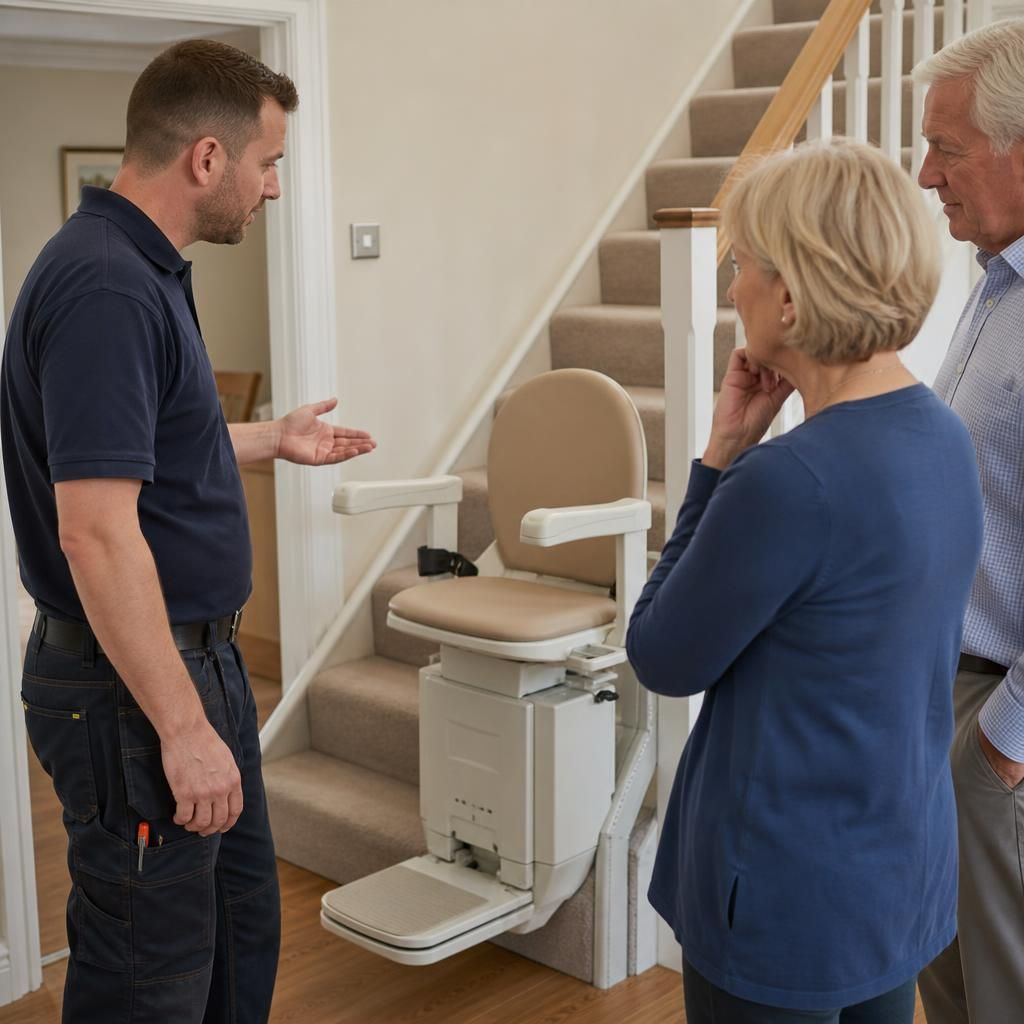
Arrange a professional stairlift assessment
Arrange a professional stairlift assessment so the staircase, access points, fixing surfaces and charging position can be checked before you choose a budget-friendly option. This helps confirm the complete installation requirements and identify any potential additional costs in advance.