
What factors influence the overall cost of an Acorn stairlift installation?
The overall cost of an Acorn stairlift installation is mainly influenced by your staircase layout, the model required, whether the lift is new or reconditioned, and the complexity of fitting it. Additional features, adaptations, delivery and ongoing service or warranty cover may also affect the final price, so a proper home assessment is needed for an accurate quote.
The overall cost of an Acorn stairlift installation depends on the staircase, the model and rail required, the condition of the equipment, and the work involved in fitting and commissioning it. A straight stairlift is generally more straightforward to price than a curved installation, but the final cost can also be affected by optional features, access arrangements, removal of an existing lift and any continuing service or warranty provision. A home assessment is therefore the most reliable way to establish the correct specification and an accurate quotation.
Staircase layout is usually the most important factor. A straight staircase may only require a standard rail, subject to suitable space at the top and bottom of the stairs. A curved staircase needs a rail manufactured to follow the individual shape of the stairs. Bends, intermediate landings, changes in direction, narrow sections and unusually shaped steps can all affect the rail design and installation time.
The available clearance is also assessed carefully. The installer will consider the width of the stairs, the position of doors and hallways, the space needed to get on and off the lift safely, and whether the chair needs to park out of the way. Where space is limited, options such as a powered swivel seat, folding components or a different parking position may be considered. These choices can influence the equipment specification and the overall quotation.
The Acorn model and its specification also affect the price. Different models and configurations are designed for different levels of space, comfort, practicality and user support. A basic specification may be appropriate where the staircase is uncomplicated and the user needs a simple means of travelling between floors. Additional functions may be useful where the user has reduced balance, limited strength or difficulty transferring on and off the seat.
Possible options can include a powered swivel seat, powered or automatic folding parts, different seat or armrest configurations, and controls suited to the user. Not every option is necessary, and the most expensive specification is not automatically the best choice. The assessment should establish which features provide a genuine safety or usability benefit rather than adding unnecessary cost.
Whether the stairlift is new or reconditioned makes a significant difference. A reconditioned Acorn stairlift may cost less than a new installation, although availability depends on the model, rail configuration and suitability for the staircase. Reconditioned equipment should be checked, serviced and tested before installation, with its condition and included cover explained clearly. A new stairlift may offer a wider choice of specification and a rail made specifically for the installation.
For a reconditioned curved stairlift, the existing rail may sometimes be suitable if the staircase has the same or a compatible layout. In other cases, a different rail or additional work will be needed. This is why a reconditioned option cannot be priced accurately by looking at the lift alone; the rail, controls, batteries, safety features and fitting requirements all need to be considered.
Installation complexity contributes to the final cost. Fitting normally involves securing the rail to the stair treads, installing the lift, connecting and checking the charging system, and testing the safety functions. Additional time may be required where access is difficult, the stairway is unusually narrow, the parking position is restricted or the equipment has to be carried through a challenging property layout.
The installer may also need to consider the electrical supply and charging location. Most stairlifts use rechargeable batteries and are designed to charge at a designated point, but the practical position of that point depends on the installation. Any electrical work or property adaptation outside the standard fitting should be identified and discussed before work begins.
Property-related work can add to the installation cost. Examples may include removing an existing stairlift, disposing of old equipment, moving furniture to provide safe access, or dealing with a stairway where a standard installation is not suitable. Structural changes are not normally required for a typical stairlift installation, but any non-standard requirement should be confirmed in the written quotation rather than assumed to be included.
Delivery and access arrangements can also be relevant. The quotation should make clear whether delivery, installation, demonstration and removal of packaging are included. If an existing lift is being replaced, ask whether dismantling and removal are covered or priced separately.
Aftercare affects the cost over the period of ownership rather than just on installation day. Warranty terms, servicing arrangements, replacement parts and call-out conditions can vary according to the equipment and the cover selected. A lower initial price may not represent the lowest overall cost if important servicing or repair requirements are excluded. Check what is covered, how long the cover lasts, whether labour and parts are included, and what happens when the warranty ends.
VAT treatment may also affect the amount payable. Some disabled or chronically sick customers may qualify for VAT relief on eligible mobility equipment and associated services, subject to the relevant conditions and declaration requirements. Eligibility is personal and should be confirmed before the quotation is finalised; it should not be assumed solely because a stairlift is being installed.
For a useful comparison between quotations, check that each one describes the same basis of supply. The specification should identify whether the stairlift is new or reconditioned, the model and rail type, included options, installation work, delivery, removal of existing equipment, warranty and any ongoing service plan. Comparing headline prices without checking these details can produce a misleading result.
Independent Stairlifts can assess the staircase and the user’s mobility requirements before recommending a suitable Acorn configuration. The assessment should cover how the user approaches the stairs, transfers to the seat, operates the controls and gets on and off safely at each level. Once the layout and specification are confirmed, the quotation can show which elements are included and which, if any, are optional. This gives you a clearer view of both the immediate installation cost and the likely ongoing costs.
The staircase layout is usually the main factor influencing the overall cost of an Acorn stairlift installation. A straight staircase generally uses a standard rail, while a curved staircase requires a rail designed to follow its bends, landings and changes in direction.
The installer will also assess stair width, available space at the top and bottom, door positions and where the lift can park safely. Restricted clearance may require options such as a powered swivel seat or folding components, which can affect the specification and quotation. A home assessment is therefore essential, particularly for curved or unusually shaped stairs.
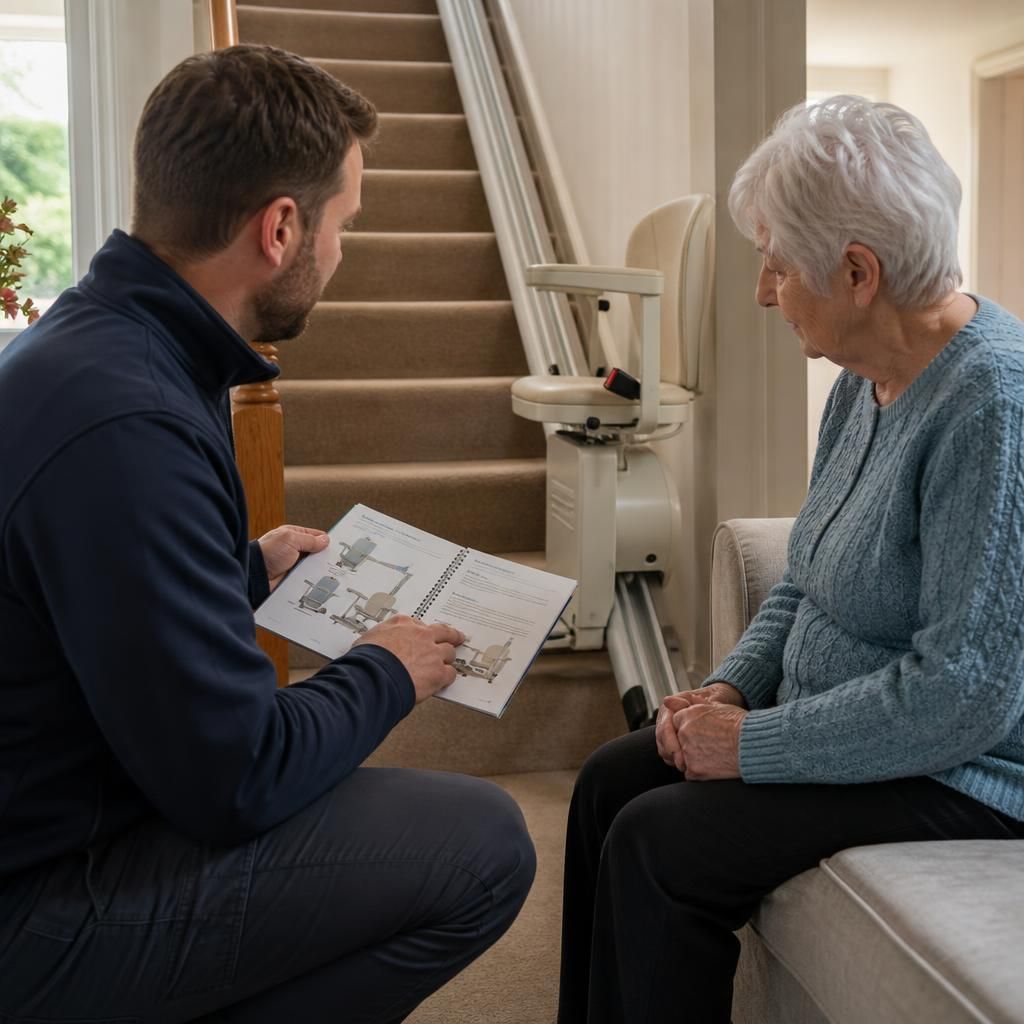
Arrange Your Acorn Stairlift Assessment
Arrange your Acorn stairlift assessment with Independent Stairlifts to confirm the right model, rail and installation requirements for your staircase. We can then provide a clear, tailored quotation based on your home and mobility needs.