
What should I consider when comparing warranties offered on reconditioned stairlifts?
When comparing warranties on reconditioned stairlifts, check the cover period, what parts and labour are included, and whether call-outs, batteries and servicing are covered. Also review exclusions, response arrangements, transferability and the process for making a claim, so you understand exactly what support is available after installation.
A warranty on a reconditioned stairlift is the supplier’s written promise to address specified faults for a defined period. When comparing warranties, look beyond the length of cover and check exactly which components, labour, call-outs and remedial work are included. A shorter warranty with clear, comprehensive terms may provide more useful protection than a longer warranty with significant exclusions.
Check when the warranty starts and how long it lasts. The cover should state whether it begins on installation, delivery, payment or another date. Confirm the end date in writing and ask whether any parts replaced during the warranty receive separate cover or remain protected only until the original warranty expires. If the stairlift is being installed for an existing customer, make sure the warranty documents relate to the actual lift and installation address.
Establish what is covered. A useful warranty should explain whether it applies to the complete stairlift or only selected parts. This may include the motor, drive mechanism, control systems, charging equipment, seat, armrests, swivel mechanism, rail and safety sensors. On a reconditioned stairlift, ask specifically whether refurbished, replacement and consumable parts are treated differently. For a curved stairlift, clarify whether the bespoke rail and its fittings are covered, as these may have been made for the staircase and can be more difficult to replace.
Check whether labour and call-outs are included. Parts cover alone may leave you responsible for an engineer’s attendance, diagnosis, travel or installation labour. The warranty should say whether these costs are included when a fault is accepted as covered. Ask how faults are assessed, whether an initial inspection is chargeable and what happens if the engineer finds that the problem falls outside the warranty.
Pay particular attention to batteries and chargers. Batteries are commonly treated as serviceable or wear-related items, so they may have different terms from the main lift. Find out whether battery failure, reduced capacity, charging faults and replacement labour are covered. It is also useful to understand whether the warranty requires the lift to be left charging in accordance with the manufacturer’s instructions.
Review exclusions and conditions. Read the sections covering circumstances in which a claim can be declined. Typical exclusions may relate to accidental damage, misuse, unauthorised alterations, failure to follow operating guidance, water damage on an outdoor installation, power-related damage or normal wear and tear. Some warranties may also exclude cosmetic deterioration or faults caused by changes to the staircase or surrounding electrical installation. Exclusions should be specific and understandable rather than relying only on broad wording.
For outdoor stairlifts, check whether exposure to weather, moisture, temperature changes and corrosion is covered. For lifts installed in homes with more than one user, ask whether the warranty places any restrictions on use. If the lift is moved, modified or reinstalled, confirm whether this affects the warranty before arranging any work.
Understand the aftercare arrangement. The warranty should identify who to contact, how faults are reported and what support is available outside normal working hours. Ask about the expected response process for a lift that has stopped working, particularly where the user cannot safely manage the stairs without it. Also check whether routine servicing is included, recommended or chargeable. A warranty does not necessarily include preventative maintenance, cleaning, adjustments or replacement of parts that have reached the end of their usable life.
Check the remedy offered. A warranty may provide repair, replacement of a faulty component, reinstallation or, in some circumstances, a replacement stairlift. Confirm whether the supplier can use reconditioned parts and whether these will be tested and warranted. It should also be clear what happens if the same fault returns or if a repair cannot be completed promptly. Keep records of reported faults, engineer visits and any parts fitted.
Ask whether the warranty can be transferred. This matters if the property is sold, the stairlift is moved to another address or another person becomes responsible for its use. Transfer may be prohibited or may require written approval, a condition assessment or payment of a fee. Do not assume that a warranty automatically follows the equipment.
Compare the written terms rather than relying on a verbal description. Before installation, ask for the warranty document and check that it identifies the stairlift, installation date, provider and contact details. Keep it with the user instructions and any service records. If a sales explanation differs from the written terms, ask for clarification before proceeding.
Finally, a warranty is additional support and does not remove your legal rights as a consumer. The rights that apply can depend on the circumstances of the sale, the age and condition of the equipment, and what was agreed about the stairlift. If you are unsure whether a fault should be reported under the warranty or as a service issue, contact Independent Stairlifts promptly and describe the symptoms without arranging unauthorised repairs. Comparing cover in this way helps you judge both the value of the warranty and the level of practical support available after your reconditioned stairlift is installed.
When comparing warranties for reconditioned stairlifts, check whether the cover includes both parts and the labour needed to diagnose and repair a fault. A warranty covering parts alone may still leave you paying for an engineer’s visit, travel, or fitting the replacement component.
Ask specifically whether the following are included:
- Engineer call-outs and fault diagnosis
- Replacement parts, including refurbished components where applicable
- Repair or fitting labour
- Battery and charger faults
- Follow-up visits if the original repair does not resolve the problem
These details are particularly important for curved or outdoor stairlifts, where specialist parts or additional assessment may be required. Request the full written warranty terms and confirm what happens if an engineer decides that the fault is excluded before accepting any chargeable work.
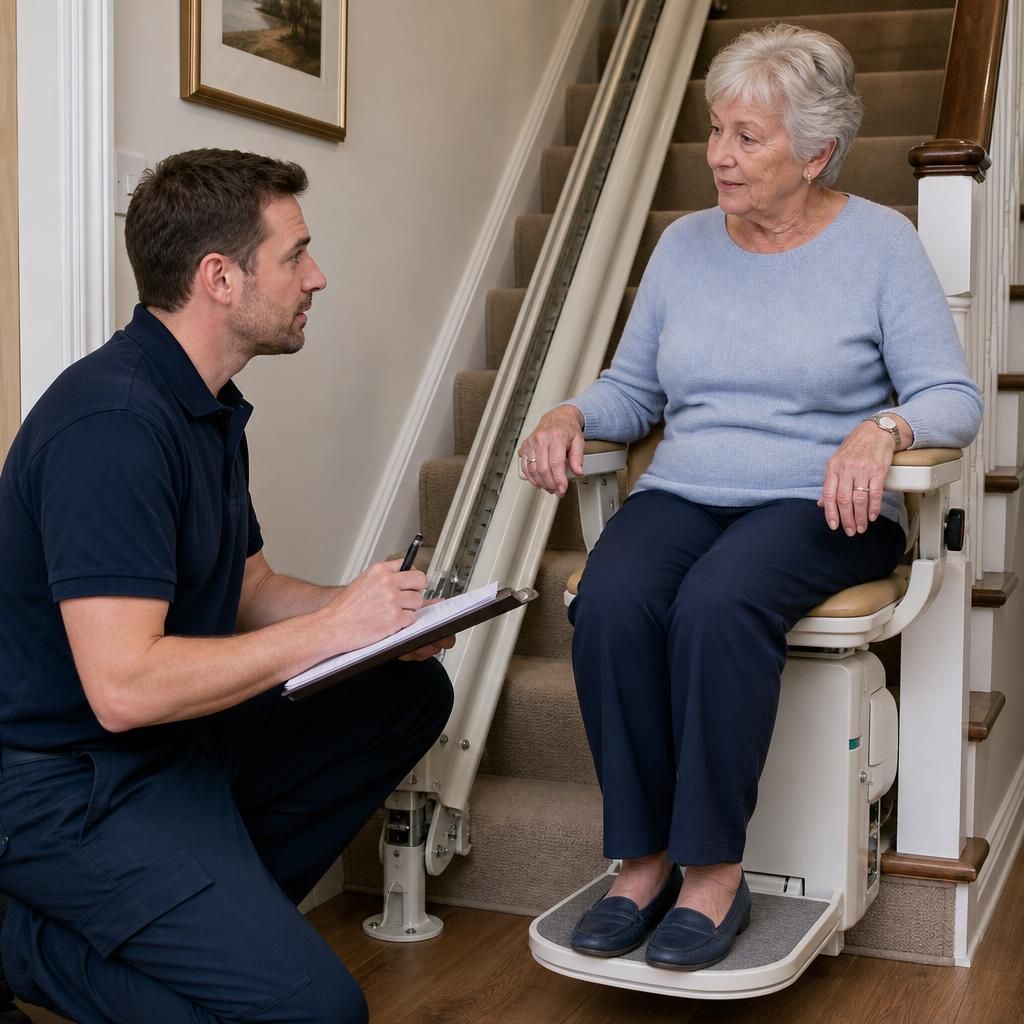
Discuss Your Reconditioned Stairlift Warranty With Us
If you have questions about the warranty for your reconditioned stairlift, contact Independent Stairlifts to discuss what is covered, including parts, labour, call-outs and batteries. We can also clarify the claims process and any exclusions that may apply to your installation.