
What factors should I evaluate to ensure the refurbishment quality of a reconditioned stairlift matches my expectations?
Assess a reconditioned stairlift by checking that it has undergone documented safety testing, thorough refurbishment of its mechanical and electrical components, and a professional installation suited to your staircase. Confirm the condition of the seat, upholstery, batteries, controls and rails, and make sure the warranty, servicing arrangements and aftercare support match your expectations.
The quality of a reconditioned stairlift should be judged by the condition of its safety-critical parts, the completeness of its refurbishment, the suitability of the installation and the support provided afterwards. Before accepting a stairlift, ask for a clear explanation of what has been inspected, replaced, tested and covered by the warranty.
Ask for a documented refurbishment and safety check. A reputable refurbishment process should include inspection and functional testing by a competent technician. The checks should cover the drive system, braking mechanism, sensors, charging system, controls, seat safety features and any manual lowering or emergency functions fitted to the model. Ask whether the stairlift has been tested in accordance with the manufacturer’s instructions and whether the installer can provide a service record or written confirmation of the work completed.
Safety testing should not be limited to switching the stairlift on and checking that it travels up and down the rail. The technician should verify smooth starting and stopping, correct operation of the safety edges and sensors, secure locking of the seat and armrests, and reliable charging at the parking position. Any unusual noise, juddering, hesitation or intermittent control response should be investigated before installation is considered complete.
Check the mechanical and electrical components separately. The motor, gearbox, drive mechanism and braking components should be assessed for wear and correct operation. Electrical connections, wiring, circuit boards, switches and charging contacts should be clean, secure and free from damage. Batteries are particularly important because a stairlift may appear to work during a brief demonstration but still have inadequate capacity or fail to charge consistently. Confirm whether the batteries have been tested and whether replacement is included if they do not meet the required operating standard.
The rail also needs careful assessment. A straight rail should be secure, correctly aligned and free from damage that could affect travel. With a curved stairlift, the rail must match the staircase accurately and its joints, fixings and bends should be checked. A used rail may be suitable for reuse, but it must be compatible with the stairlift and installed securely for the particular staircase. Ask whether any alterations, additional fittings or remedial work are needed before the installation date.
Assess the visible condition, but do not confuse appearance with refurbishment quality. Reconditioned equipment can show reasonable signs of previous use, such as minor marks on the casing or upholstery. These do not necessarily indicate a mechanical problem. However, the seat, swivel mechanism, armrests, footrest, covers and controls should be clean, intact and suitable for safe everyday use. Check that the seat provides the support you need, that the controls can be operated comfortably and that any agreed cosmetic repairs or replacement covers have been completed.
Ask the installer to explain the condition of the stairlift in practical terms rather than relying only on a general description such as “refurbished”. Useful questions include:
- Which parts have been inspected, serviced or replaced?
- Have the batteries, drive components and safety sensors been tested?
- Is the rail new, reused or adapted, and is it suitable for this staircase?
- Are the seat, controls and safety features in the condition agreed during the assessment?
- Has the stairlift been tested after installation under normal operating conditions?
- What work is covered if a fault is found shortly after installation?
Evaluate the installation as part of the refurbishment quality. Even a well-serviced stairlift will not perform reliably if it is poorly fitted. The stairlift should be mounted securely, travel smoothly throughout the staircase and stop at the agreed upper and lower positions. Check that the footrest and seat clear the stairs, walls and landings, and that the controls are accessible from the seated position. If the staircase is narrow or has unusual bends, confirm that the installation has been assessed for clearance and safe transfers rather than treated as a standard fit.
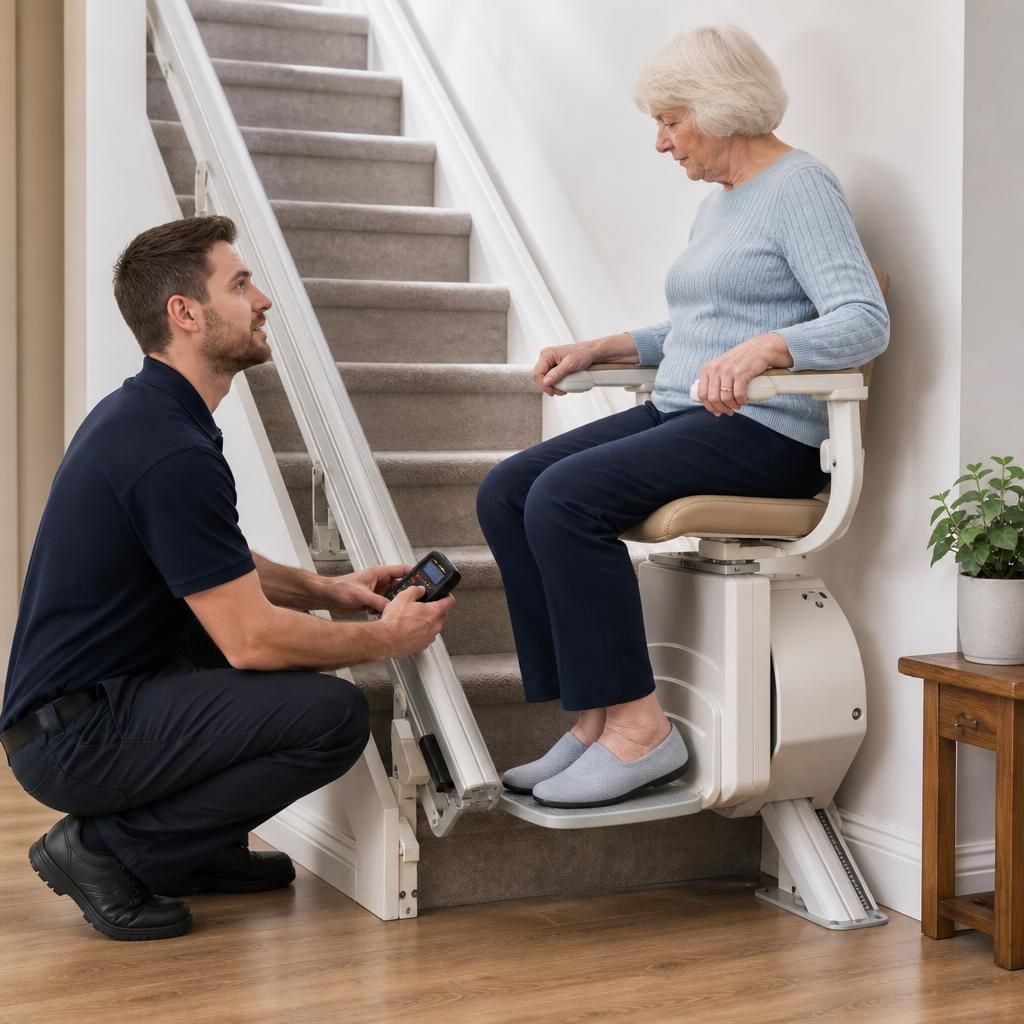
After installation, operate the stairlift yourself while the installer is present. Try the main controls and remote controls, use the swivel seat if fitted, and check the armrests, seat belt, footrest and charging position. Ask what the warning sounds or indicator lights mean and how to stop the stairlift safely if an obstruction is detected. This is also the appropriate time to raise concerns about noise, movement, access or comfort.
Compare the warranty with the actual condition and intended use. A warranty should state what is covered, how long cover lasts, whether parts and labour are included, and how faults are reported. Check whether batteries, call stations, remote controls and upholstery are treated differently from the main drive unit. Also ask whether the warranty has exclusions relating to misuse, accidental damage, water exposure, servicing or alterations by another person. A clear warranty is an important indicator of what support you can reasonably expect, but it does not replace proper inspection and installation.
Find out what aftercare is available locally and how a service call is arranged. You should know whom to contact if the stairlift stops working, whether routine servicing is recommended, and whether replacement parts remain available for the model. Keep the handover information, warranty details and service record in an accessible place. If the stairlift is being installed for someone who may need help using it, ensure that a family member or carer also understands the controls and basic fault procedure.
Be cautious if the refurbishment work cannot be explained, the warranty is unclear, the installer discourages questions or the stairlift is offered without a proper assessment of the staircase. A low price alone does not establish value; the relevant comparison is the total condition of the equipment, the suitability of the installation, the work included and the support available after fitting.
In practical terms, the refurbishment matches your expectations when the stairlift is safe, mechanically and electrically sound, comfortable to use, correctly fitted to your staircase and supported by clear written cover. If any part of the equipment or documentation differs from what was agreed, raise it with the installation team before signing off the work.
Documented safety testing is one of the clearest ways to judge whether a reconditioned stairlift has been refurbished properly. Ask for confirmation that the drive system, braking mechanism, sensors, controls, batteries and charging contacts have been inspected and tested by a competent technician, rather than relying on a general description such as “refurbished”.
The stairlift should also be tested after installation on the actual staircase. It should start and stop smoothly, travel without juddering or unusual noise, charge reliably at its parking position and stop safely at the agreed points. The installer should demonstrate the seat belt, swivel seat, armrests, footrest, controls and any emergency functions, while explaining what the warning lights or sounds mean.
Keep the service record and warranty information with the handover documents. These should make clear what work was completed, which parts are covered and whom to contact if a fault appears. This combination of documented testing, practical demonstration and clear aftercare gives you a more reliable basis for assessing refurbishment quality than appearance alone.
Discuss your reconditioned stairlift’s refurbishment quality
Speak to Independent Stairlifts about the refurbishment checks, installation details and warranty cover for your stairlift. We can clarify any concerns and confirm that the equipment and aftercare arrangements meet your requirements.