
How does the refurbishment process ensure the safety and reliability of reconditioned stairlifts?
Reconditioned stairlifts are made safe and reliable through a structured process of inspection, cleaning, replacement of worn or faulty parts, and functional safety testing before installation. A qualified technician also checks the lift on your staircase after fitting to confirm that it operates correctly and safely in your home.
Reconditioned stairlifts are made safe and reliable through a controlled process of inspection, refurbishment, component replacement, testing and professional installation. The lift is assessed before it is offered for reuse, worn or unsuitable parts are replaced, and the completed stairlift is tested both away from and on the customer’s staircase. This process is intended to confirm that the equipment operates correctly, responds to its safety systems and is suitable for the individual installation.
The process begins with a detailed inspection. A technician examines the stairlift’s main assemblies, including the carriage, drive system, track, seat, armrests, footrest, controls and charging equipment. They look for wear, damage, corrosion, unusual noise, movement in the seat or carriage, and signs that a component may not perform reliably in continued use. The electrical connections, batteries and safety switches are also checked. A stairlift that does not meet the required condition is not suitable for reconditioning simply because it can be made to run.
The inspection also considers the lift’s history and compatibility. Where information is available, the technician can review previous servicing or faults. The model must have suitable parts and controls available, and its design must be appropriate for the intended staircase and user. This helps prevent a lift being installed where its age, specification or condition would make ongoing maintenance impractical.
Cleaning and preparation are part of the refurbishment, but they are not the safety check. The stairlift is cleaned to remove dirt and accumulated debris from surfaces, the track and accessible mechanical areas. Components are then prepared for closer examination. Cleaning can reveal damage or wear that is difficult to identify when parts are dirty, while appropriate lubrication and adjustment help the drive system and moving mechanisms operate as intended. Lubrication is applied carefully because excess lubricant can attract debris or affect components that need to remain clean.
Worn, damaged or unreliable parts are replaced or repaired. Depending on the assessment, this may include batteries, rollers, switches, charging contacts, control components, seat parts, covers or other mechanical and electrical items. Replacement parts must be compatible with the stairlift and fitted correctly. Not every part on a reconditioned stairlift will be new; the important point is that retained components are inspected and judged suitable for safe continued use. Parts showing excessive wear, damage or uncertain performance should not be retained merely to reduce the work required.
Particular attention is paid to the systems that protect the passenger during movement. These can include obstruction sensors on the footrest or carriage, seat and swivel interlocks, armrest or safety controls, braking functions, speed control and the stairlift’s emergency stop or operating controls. The technician checks that the lift will stop or prevent movement when a relevant safety condition is detected. The seat belt and seating position are also checked so that the passenger can use the stairlift in the intended way.
Electrical and battery checks help establish dependable day-to-day operation. Batteries must hold an adequate charge and allow the stairlift to travel without cutting out under normal conditions. Charging points and contacts are inspected, and the lift is checked for correct charging at its parking positions. Controls are tested for consistent response, including the handset and any controls fitted to the armrest. Fault indications, unusual sounds and intermittent operation are investigated rather than treated as minor issues.
After refurbishment, the stairlift undergoes functional testing. It is operated repeatedly to assess starting, stopping, travelling, charging and control response. The technician checks that the carriage runs smoothly along the track and that safety features work when tested. Any fault identified during this stage needs to be corrected and the relevant test repeated. A stairlift should not be considered ready for installation solely because the motor runs.
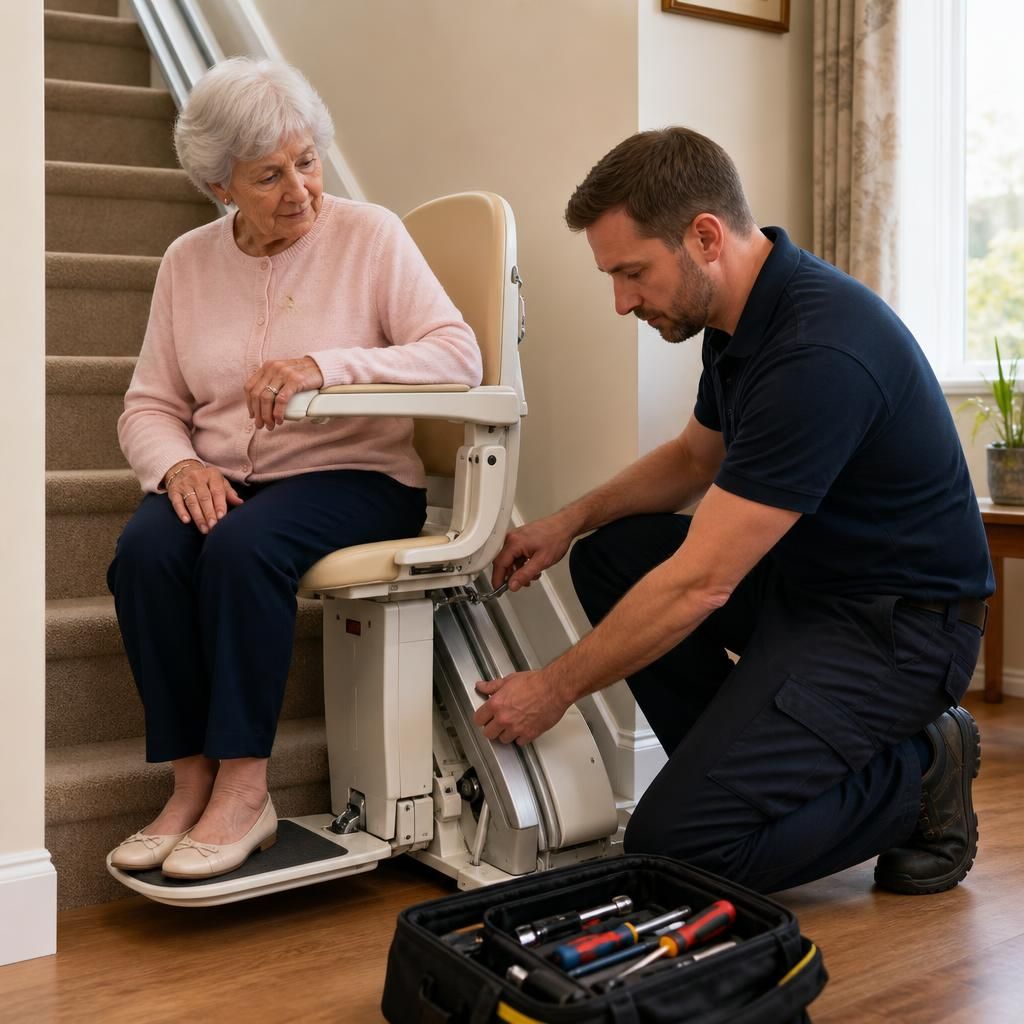
Installation provides a further, staircase-specific safety check. A stairlift can operate correctly in a workshop but still require adjustment when fitted in a particular home. During installation, the track is secured to the staircase structure, the carriage and seat are set up for the layout, and charging points are positioned correctly. The technician checks clearances at the top and bottom of the stairs, the position of the seat when getting on and off, and the interaction between the lift, landings, doors and surrounding furniture.
The installed lift is then tested on the staircase under its actual operating conditions. This includes travelling in both directions, checking the parking and charging positions, confirming that the seat and controls operate correctly, and verifying that the lift stops safely when an obstruction or other relevant safety condition is encountered. The technician can also explain the controls, charging routine, safe use of the seat belt and the steps to take if the lift stops unexpectedly.
Reliability depends on continued maintenance as well as the initial refurbishment. Batteries and moving parts are subject to normal wear, and a reconditioned stairlift may require servicing in the same way as a new installation. Keeping the track and charging contacts clear, using the lift as instructed and reporting unusual noises, slower movement, failed charging or warning lights promptly can help prevent a minor issue from becoming a breakdown. Servicing arrangements and warranty terms should be confirmed for the specific stairlift supplied, as these can vary by model and refurbishment package.
A reconditioned stairlift is therefore not judged safe because it has simply been cleaned or made presentable. Its suitability comes from the combination of a documented assessment, appropriate replacement or repair of components, safety and functional testing, and checks after installation. When comparing options, ask what inspection has been carried out, which parts have been replaced, what testing is included, who installs the lift and what support is available afterwards. These details provide a more useful indication of refurbishment quality than appearance or age alone.
The final safety check takes place on your staircase after the reconditioned stairlift has been installed. This matters because a lift that operates correctly during workshop testing must still be checked against the exact layout, clearances and access points in your home.
The technician tests travel in both directions, starting and stopping, parking and charging positions, seat and control operation, and the relevant safety sensors. They also check that the seat is positioned safely for getting on and off, that the track is secure, and that the lift stops as intended if an obstruction is detected. Any adjustment needed for your staircase is completed before the installation is treated as finished.
Arrange your reconditioned stairlift assessment
Arrange your reconditioned stairlift assessment with Independent Stairlifts to check your staircase, mobility needs and the most suitable refurbished option. We can also explain the refurbishment checks, installation process and aftercare available for your stairlift.