
What should I consider when buying a reconditioned stairlift from a private seller?
When buying a reconditioned stairlift from a private seller, check its condition, safety history, compatibility with your staircase, installation requirements, warranty and total cost before paying. A qualified stairlift installer should assess the lift and fit it correctly, as a private sale may not include professional testing, adaptation or aftercare.
A reconditioned stairlift bought from a private seller should be assessed as a used mobility product, not simply as a low-cost appliance. Before paying, confirm its condition, safety history, suitability for your staircase, installation requirements, warranty and total cost. A private sale may provide the lift only, leaving you responsible for transport, fitting, testing, future servicing and any faults.
Check whether it is genuinely reconditioned. The terms “used”, “refurbished” and “reconditioned” are not always used consistently in private advertisements. Ask what work has actually been completed. A properly prepared stairlift should have been inspected, cleaned and function-tested, with worn or failed parts identified and replaced where necessary. Ask for a written description of the work, rather than relying on a general statement that the lift was serviced.
Find out the stairlift’s make, model, age and serial number. These details can help an installer identify compatible parts, controls, batteries and charging equipment. Ask whether the lift was removed from a working installation and why it was taken out. A lift removed because the user moved home may have a different history from one removed because it repeatedly developed faults.
Inspect the main components and safety features. If possible, see the stairlift operating before agreeing to buy it. Check that it starts, stops and travels smoothly without unusual noise, juddering or hesitation. The seat should lock securely in its travel position and, where fitted, swivel safely at the top or bottom of the stairs. Examine the footrest, armrests, seat belt, controls, remote controls and charging points for damage or excessive wear.
Ask the seller or an installer to check safety-related features, including the obstruction sensors, braking system, limit switches, diagnostic indicators and emergency stop controls. Batteries are particularly important because a stairlift can appear to work during a brief demonstration while still needing replacement batteries. Battery condition, charger performance and the availability of replacement parts should be confirmed before purchase.
Confirm that it will fit your staircase. A stairlift is not necessarily transferable between homes. Straight stairlifts usually use a rail designed for a particular stair length and layout, while curved stairlifts have rails made to follow the bends, landings and changes in direction of a specific staircase. A curved rail from another property will rarely be suitable without significant alteration, and some rails cannot be altered economically or safely.
Even on a straight staircase, the rail length, stair width, number of steps, clearances and position of doors or radiators must be checked. The installer also needs to consider whether the seat, footrest or rail will obstruct a doorway, hallway or access route. A home assessment is therefore advisable before you commit to a private purchase. Provide photographs and measurements only as preliminary information; they do not replace an in-person assessment.
Consider the person who will use the lift, not just the staircase. Seat width, seat height, swivel direction, weight capacity, control position and the ease of using the seat belt may all affect suitability. Someone with limited dexterity may need simple controls, while a person with balance difficulties may require a particular seat or powered option. An apparently compatible lift may still be unsuitable if its configuration does not meet the user’s needs.
Arrange professional removal and installation. Stairlift installation involves securing the rail correctly, setting the lift’s travel limits, connecting charging points and testing safety systems. Removing a lift without suitable care can damage the rail, carriage, wiring or surrounding fixtures. Installation by an unqualified person can create a safety risk and may leave the lift incorrectly adjusted.
Ask an experienced stairlift installer whether they are willing to inspect and fit a lift purchased privately before you pay. Some installers may not support equipment they have not supplied, particularly if its history, condition or parts availability cannot be verified. Obtain confirmation of what they will do and whether their installation work is covered separately from the stairlift itself.
Calculate the complete cost. The seller’s price is only one part of the purchase. Add the cost of:
- professional inspection and safety testing;
- removal from the seller’s property, if required;
- transport and protective packaging;
- installation and commissioning;
- replacement batteries, handset, charger or worn components;
- rail alterations or other adaptations, where possible;
- future servicing and call-out visits; and
- repairs if the lift fails after installation.
Ask whether the quoted installation includes dismantling, fitting, electrical work, testing, demonstration and removal of packaging. A private purchase that looks inexpensive can offer little saving once these additional costs and risks are included. Compare the complete installed cost with a professionally supplied reconditioned stairlift that includes assessment, fitting and aftercare.
Get warranty and aftercare terms in writing. A private seller may offer no warranty, or may only agree informally to help if a problem appears. Clarify exactly what is included, how long cover lasts, who is responsible for labour and parts, and whether batteries, remote controls and call-outs are excluded. Check whether the warranty transfers to you and whether it depends on installation or servicing by a particular provider.
Do not assume that a manufacturer’s original warranty remains valid after the lift has been removed and installed in another home. Ask who will provide technical support if a fault occurs and whether compatible parts are still available. A written warranty is useful, but it does not replace a pre-purchase inspection and a clear installation agreement.
Understand your position as a private buyer. Buying from an individual is different from buying from a business. Consumer protections that apply when a business sells goods may not apply in the same way to a genuine private sale. The seller should still describe the stairlift accurately and should not misrepresent its condition, age, history or suitability, but you may have limited practical recourse if you discover a fault after the transaction.
Keep the advertisement, messages, photographs, receipts and any written statements about the lift. Ask the seller to confirm important points in writing, including the model, serial number, known faults, included accessories, service history and whether the lift is being sold as working. Avoid paying a deposit or the full amount until the lift and the proposed installation have been checked. Be cautious if the seller will not allow an inspection, cannot provide basic details, pressures you to pay immediately or makes claims that cannot be verified.
Check the installation history and paperwork. Useful documents may include the original user manual, service records, previous inspection reports, purchase information and details of any repairs. Paperwork will not prove that the lift is safe today, but it can help establish its age, configuration and maintenance history. Confirm that the serial number on the lift matches the documents and that all required remotes, keys, charging equipment and accessories are included.
Outdoor stairlifts require additional checks because exposure to rain, cold and dirt can affect electrical connections, controls, batteries and protective covers. A lift that has been used outdoors should not be treated as equivalent to an indoor model. Ask specifically about weather protection, corrosion, storage, servicing and whether its condition is suitable for your installation environment.
For a curved staircase, obtain an assessment before considering the purchase particularly carefully. The rail is normally the most staircase-specific part of the system, and a second-hand curved lift may need a new rail or substantial modification. In some cases, the carriage and seat may be reusable while the existing rail is not. The seller’s assurance that it came from a “similar” staircase is not enough to establish compatibility.
Use a staged decision process. First, obtain the complete model and history. Next, arrange a staircase and user assessment with a qualified installer. Then request a written quotation for inspection, transport, installation, testing and any likely replacement parts. Only compare the private seller’s price with other options after you know the total installed cost and the level of warranty and aftercare available.
A private purchase can be suitable when the lift’s history is clear, the equipment matches the staircase and user, professional installation is available and the overall saving justifies the reduced protection. If any of those points cannot be established, a professionally supplied reconditioned stairlift is usually the more predictable option because assessment, preparation, fitting and support can be managed together.
A reconditioned stairlift bought from a private seller must be checked against your staircase and the user’s needs before payment. A lift that worked safely in another home may not be suitable for your layout, particularly if it has a curved rail designed for different bends, landings or stair widths.
Arrange an assessment with a qualified stairlift installer and ask for a written quotation covering inspection, transport, installation, commissioning and any replacement parts. The installer should also check clearances around doors and hallways, the seat and controls, charging points, batteries and safety features. This confirms whether the private purchase offers a genuine saving and gives you a clear plan for safe fitting and future support.
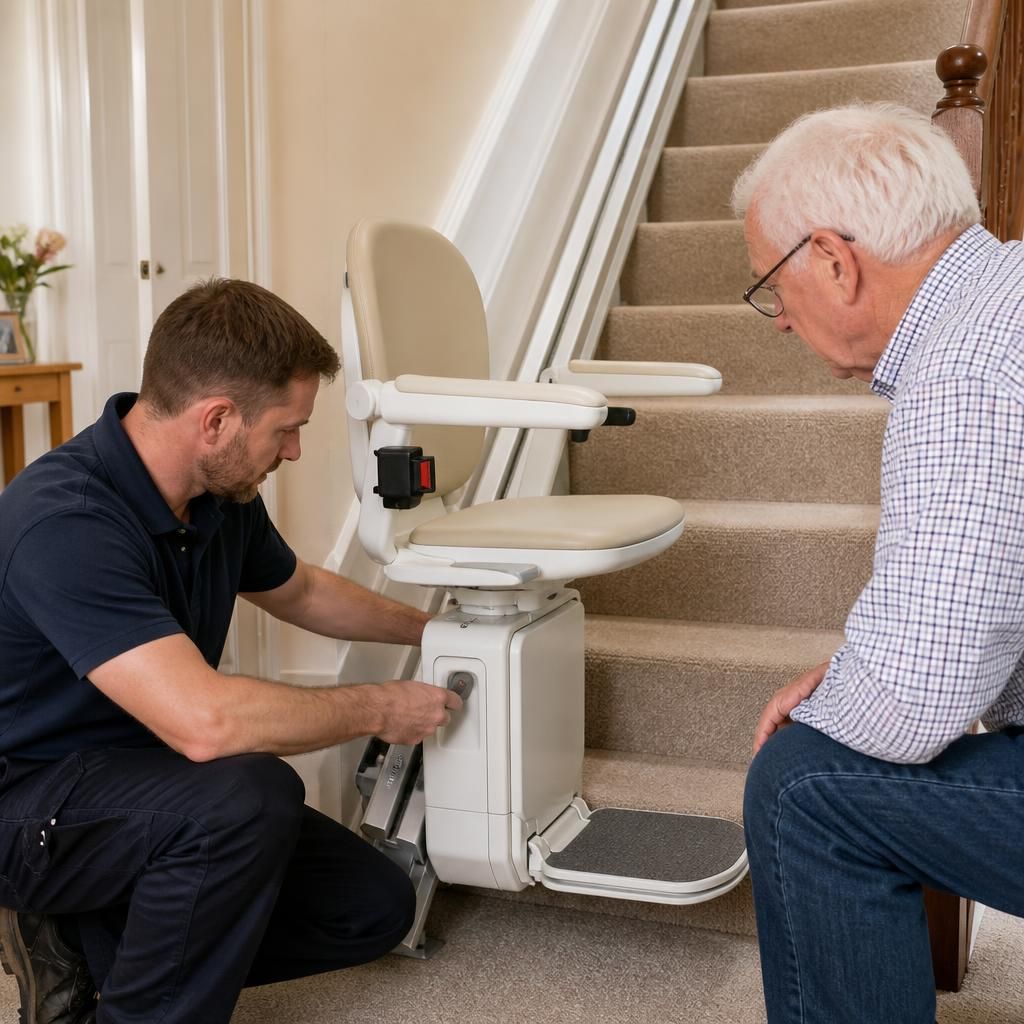
Arrange a professional assessment before buying privately
Arrange a professional assessment before buying a reconditioned stairlift privately. We can check whether the lift suits your staircase and needs, then provide a clear quotation for installation, testing and any required parts.