
What factors should I consider when selecting a reconditioned stairlift for a curved staircase?
When selecting a reconditioned stairlift for a curved staircase, prioritise a correctly measured and fitted rail, safe operation on every bend or landing, the lift’s condition and suitability for the user, and the quality of its warranty and aftercare. A professional assessment should confirm whether a reconditioned model can be adapted reliably to your staircase and provide clear information about installation, servicing and future maintenance.
When selecting a reconditioned stairlift for a curved staircase, the most important considerations are the fit of the rail, the lift’s tested condition, the user’s safety and comfort, and the standard of installation and aftercare. A curved stairlift usually requires a rail made or adapted for the individual staircase, so a professional survey must confirm that the reconditioned unit can be installed reliably around every bend, landing and change of gradient.
Check that the stairlift is suitable for the staircase
Curved staircases vary considerably. The rail may need to follow several bends, narrow sections, intermediate landings, varying gradients or changes in stair width. Unlike a standard straight rail, it is not normally a simple off-the-shelf component. Ask the installer to assess:
- the complete shape and measurements of the staircase;
- the position of bends, landings and changes in direction;
- available clearance for the user, other household members and doors;
- whether the rail can be positioned without obstructing hallways or access to rooms;
- where the stairlift will park at the top and bottom; and
- whether the proposed rail is new, adapted, or being reused from another staircase.
A reconditioned stairlift may be suitable even when the original rail came from a different property, but the rail must be correctly designed or modified for the current staircase. Do not assume that a similar-looking staircase will accept the same rail. The survey should establish the exact installation requirements before a price or delivery timescale is confirmed.
Understand what is being reconditioned
Reconditioned does not necessarily mean that every part of the stairlift is new. The installer should explain which components have been inspected, cleaned, serviced, repaired or replaced. This may include the motor and gearbox, drive mechanism, batteries, charging equipment, control systems, seat, armrests, footrest, sensors and safety edges.
Ask whether the rail is included in the reconditioning work and whether it has been checked for damage, wear, secure fixings and correct alignment. If a new or remade rail is required, establish whether this is included in the quotation. A clear description helps you compare the overall solution rather than comparing only the price of the seat unit.
Confirm inspection and safety testing
A reconditioned stairlift should be examined and tested by a competent technician before installation. The checks should cover smooth movement over the full rail, reliable stopping, charging, controls and safety systems. Important safety features include obstruction sensors, a working seat swivel or locking mechanism where fitted, armrest and footrest controls, a secure seat belt, and a manual or emergency lowering procedure where applicable.
Ask what testing has been completed and whether the stairlift will be tested again after it has been installed on your staircase. Testing should take account of the actual bends and gradients, because a unit that operates correctly on a workshop test rail still needs to perform safely on the bespoke rail in your home.
Match the lift to the user
The most suitable model is determined by the person using it as well as by the staircase. Consider:
- the user’s height, weight and sitting position;
- the width and support provided by the seat;
- whether the user can transfer safely on and off the seat;
- the position and ease of use of the controls;
- whether a powered swivel seat, powered footrest or other adjustment would be helpful;
- the user’s grip, vision, balance and ability to operate the controls; and
- whether another person may need to use the stairlift in the future.
On a curved staircase, the seat must remain stable and comfortable as the lift travels through each turn. A survey and demonstration can help identify whether the seat height, swivel action and clearances are appropriate. If the user has particular mobility or transfer needs, explain these before the model is selected rather than relying on adjustments after installation.
Consider parking positions and day-to-day access
Where the stairlift parks can affect access throughout the home. A lift parked at the bottom may reduce space in a hallway, while a lift parked at the top may affect a landing or doorway. A hinged rail, folding seat, powered swivel or alternative parking position may help, depending on the staircase and the model available.
Check that the folded lift does not create an avoidable obstruction and that other household members can use the stairs safely when the stairlift is parked. On a shared staircase, the installer should discuss how the rail and seat will affect normal movement, doors, handrails and emergency access.
Review the warranty carefully
Warranty terms for reconditioned stairlifts can differ, so check the cover before agreeing to the purchase. Confirm:
- how long the warranty lasts;
- whether it covers parts, labour, call-outs and the rail or only the stairlift mechanism;
- which batteries and consumable items are included;
- what exclusions or maintenance requirements apply;
- how faults are reported; and
- who will provide assistance if the lift stops working.
Ask whether the warranty remains valid if the stairlift needs to be moved, serviced by another provider or used by a different person. Keep the written warranty and installation information with the operating instructions.
Assess installation and aftercare
Correct installation is particularly important on a curved staircase because small alignment or positioning errors can affect clearances, ride quality and safety. The installer should secure the rail correctly, position the charging points, check every safety function and demonstrate normal operation before completing the work.
Make sure you know how to call the stairlift to different positions, charge it, use the swivel and safety controls, and respond if it stops during a journey. You should also receive guidance on routine care, such as keeping the rail and sensors clear, charging the lift as instructed and reporting unusual noises, jerky movement or repeated fault indications promptly.
Ask about ongoing servicing and the availability of replacement parts. A reconditioned lift can remain dependable when maintained properly, but its future support depends on the model, the age and condition of its components, and whether suitable parts and technical assistance remain available.
Compare the complete cost, not just the initial price
Request an itemised quotation covering the survey, rail, stairlift, preparation or adaptation work, installation, electrical requirements, removal of an existing lift if relevant, warranty and any planned servicing. A lower purchase price may not represent better value if the rail requires substantial modification or if important aftercare is excluded.
Also consider whether your circumstances may change. If the stairlift may need to be removed, relocated or adapted later, ask whether the proposed system can support this and what charges or limitations could apply. Curved rails are generally made for a particular staircase, so they may not be reusable elsewhere without further assessment.
Use the survey to make the final decision
Before choosing, ask for a written summary of the recommended model, the rail arrangement, the condition and testing completed, the user weight and suitability requirements, the warranty and the aftercare provision. A reputable assessment should identify any limitations rather than treating every curved staircase and every user as the same.
If the existing staircase, user requirements or available reconditioned equipment do not provide a safe and practical match, a different model or a new bespoke solution may be more appropriate. The right choice is the stairlift that fits the staircase accurately, operates safely throughout its route and can be supported for as long as it is needed.
For a curved staircase, the rail is the most important part to assess because it must follow the exact route of your stairs. A reconditioned stairlift is only suitable if its rail is correctly designed or adapted for every bend, landing and change of gradient in your home.
Ask the installer to confirm:
- how the staircase has been measured;
- whether the rail is new, adapted or reused;
- where the stairlift will park at the top and bottom; and
- that clearances for the user, other people, doors and handrails have been checked.
A similar-looking staircase does not guarantee that an existing curved rail will fit safely. The quotation should clearly state whether any rail alterations, replacement sections or additional installation work are included.
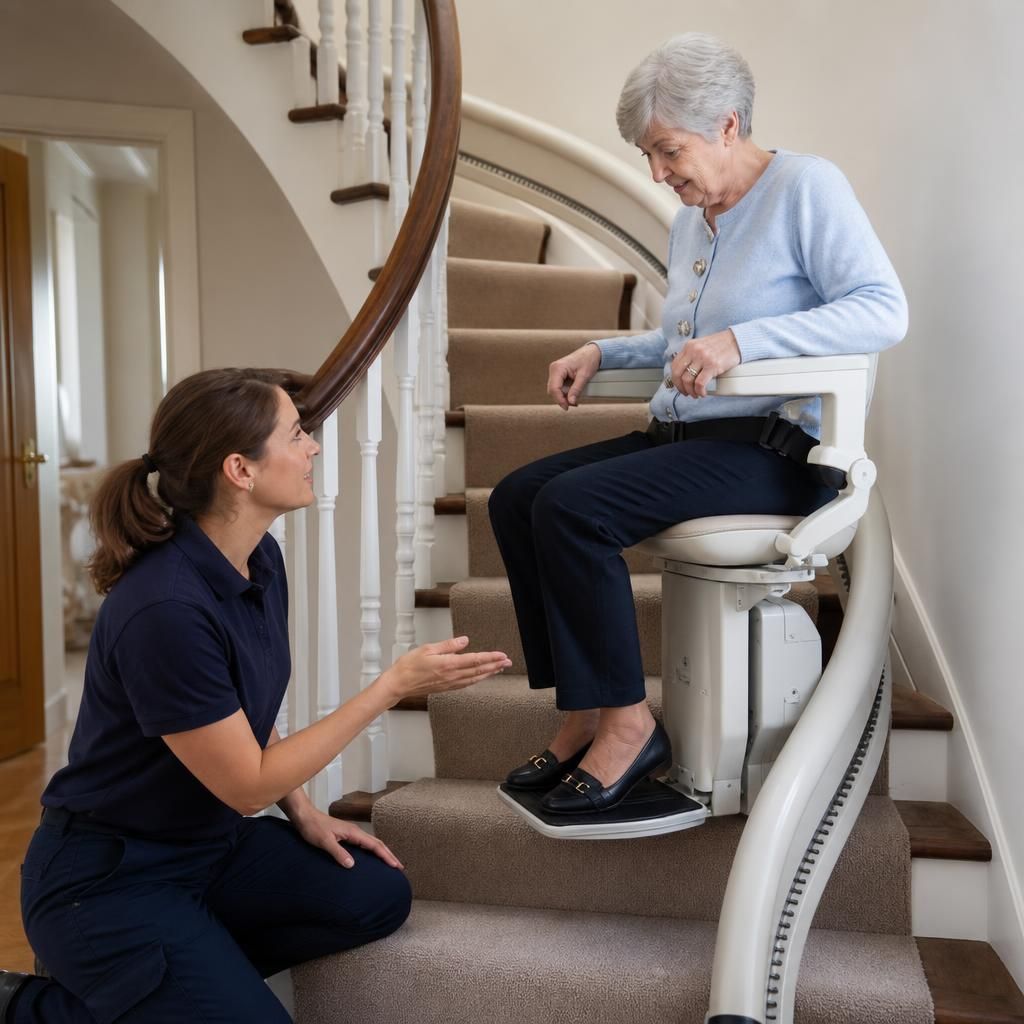
Arrange a curved stairlift assessment
Arrange a professional assessment of your curved staircase to confirm whether a reconditioned stairlift can be fitted safely and which rail, seat and parking options are suitable. We can explain the condition of the equipment, installation requirements, warranty and ongoing support before you decide.