
What factors should be considered when choosing a reconditioned stairlift for your home?
When choosing a reconditioned stairlift, consider the layout and length of your staircase, the user’s mobility needs and weight, the lift’s condition, safety testing, warranty, installation requirements and ongoing servicing. A professional assessment will confirm whether a particular reconditioned model is suitable for your home and can be installed safely.
A reconditioned stairlift is a previously used stairlift that has been inspected, serviced and prepared for installation in another home. Choosing the right one involves more than finding a suitable price: the lift must match the staircase, support the user safely, be in reliable condition and come with appropriate installation, warranty and aftercare. A professional home assessment is the best way to confirm whether a particular reconditioned model is suitable.
Assess the staircase and installation site
The layout of the staircase is one of the first factors to consider. A straight stairlift is designed for a staircase that runs in a single direction without intermediate bends or landings. A staircase with curves, turns or multiple flights generally requires a curved stairlift with a rail made to follow its individual shape. An existing rail from another property will not normally be suitable simply because it looks similar.
Check the available space at the top and bottom of the stairs, including whether the user can get on and off the seat safely. Doorways, corridors, radiators, bannisters and nearby furniture may affect the position of the rail or the choice of a parking point. The width and condition of the stairs are also relevant, particularly where the stairlift will need to leave enough room for other people to use the staircase.
External staircases require additional consideration. A stairlift intended for outdoor use needs suitable protection from weather and moisture, as well as a safe power supply and a practical place to park it. An indoor model should not be treated as an outdoor alternative without professional confirmation.
Match the stairlift to the user
The user’s mobility, balance, height, leg strength and ability to transfer onto the seat should guide the specification. Consider whether the user can sit upright, operate the controls and keep their feet in a safe position throughout the journey. If they have limited flexibility or difficulty bending their knees, a different seat design or powered option may be more appropriate.
Check the manufacturer’s stated weight capacity and ensure it accommodates the user comfortably, including clothing or any items they may carry. The seat, armrests, footrest and seat belt should provide adequate support without making transfers more difficult. Controls need to be reachable and simple to use. Call-and-send controls can be useful when more than one person uses the staircase or when the lift needs to be parked away from the user.
Think beyond the immediate need. A stairlift should remain practical if the user’s mobility changes. If a carer or another household member may use it, check that the design works safely for all intended users.
Find out what reconditioning has included
Ask for a clear explanation of the work carried out before the stairlift is offered for sale. Reconditioning may include cleaning, inspection, replacement of worn parts, battery checks, testing of safety systems and a functional test of the complete lift. The exact process can vary, so it is reasonable to ask which components have been checked or replaced and whether any parts remain from its previous installation.
Important areas include the drive mechanism, motor, batteries, charging system, rail, seat swivel, armrests, footrest, sensors, safety edges, controls and seat belt. The rail should be examined for damage or unsuitable modifications, especially if a straight stairlift is being considered for another staircase. A curved stairlift usually requires more careful assessment because its rail is shaped for a particular staircase and may have limited compatibility elsewhere.
Cosmetic marks are not necessarily a safety concern on a used stairlift, but damage, excessive movement, unusual noise or inconsistent operation should be investigated before purchase. Ask whether the lift has been tested under load and whether the installation includes a final safety check in the home.
Check safety and compliance
A reconditioned stairlift should have working safety features and be installed by a competent professional. These features commonly include a seat belt, obstruction sensors, braking or anti-runaway systems, swivel-seat locking, footrest protection and controls that stop the lift when released. The exact equipment depends on the model.
Ask for the available documentation, including the model details, service or inspection record and any relevant installation information. The installer should identify potential hazards at the property, explain how to use the lift and confirm that it operates correctly before leaving. Do not rely solely on a visual inspection or a demonstration at a showroom, since the staircase and installation conditions in your home may be different.
Understand the warranty and aftercare
Warranty cover can differ between suppliers and models. Before agreeing to buy, check how long the warranty lasts, which parts are included, whether labour and call-out charges are covered, and whether batteries are included. Confirm whether cover applies to the whole stairlift or only selected components.
Ask what happens if the stairlift develops a fault, including who to contact, the expected response arrangements and whether servicing is available after the warranty ends. A clear aftercare plan is particularly important for a user who depends on the lift every day. Find out whether routine servicing is recommended and whether replacement batteries, remote controls or other consumable parts are readily available.
Compare the complete cost
The advertised price may not represent the full cost of a reconditioned stairlift. Request an itemised quotation covering the lift, rail, survey, delivery, installation, electrical work if needed, removal of an existing lift and warranty. Curved installations may involve a bespoke rail or additional preparation, while an unusual staircase can require extra work even when the stairlift itself is pre-owned.
Also consider likely future costs. Older equipment may require batteries or other parts sooner than a newer reconditioned unit. A lower initial price is not necessarily better value if the lift has limited warranty protection or is difficult to service.
Use a professional assessment
A home assessment should consider the staircase, the user and the property together. The assessor can recommend the appropriate type of lift, identify access or electrical issues, measure clearances and explain where the lift will park. This is especially important for curved, narrow, split-level or outdoor staircases.
During the assessment, explain how the staircase is used, whether other people need to pass the lift and any difficulties the user has with standing, sitting or transferring. Ask the assessor to demonstrate the controls and explain charging, parking, emergency procedures and what to do if the lift stops.
Be cautious when buying privately
A private seller may be able to provide useful details about the stairlift’s history, but the buyer must take greater care over compatibility, condition, removal and installation. A stairlift removed from another home may not fit yours, and transporting or storing it can introduce damage. Safety systems may also be difficult to verify without specialist equipment.
Before committing to a private purchase, arrange an assessment by a qualified stairlift installer and obtain a separate quotation for safe removal, transport, installation, testing and any necessary parts. Do not assume that a working demonstration in the seller’s home proves that the lift is suitable for your staircase.
In practical terms, the strongest choice is a reconditioned stairlift with a suitable design for the staircase, an appropriate seat and weight capacity, documented inspection and testing, reliable batteries and safety systems, professional installation, clear warranty terms and accessible aftercare. If any of these points cannot be confirmed, ask for further information or consider an alternative model before making a decision.
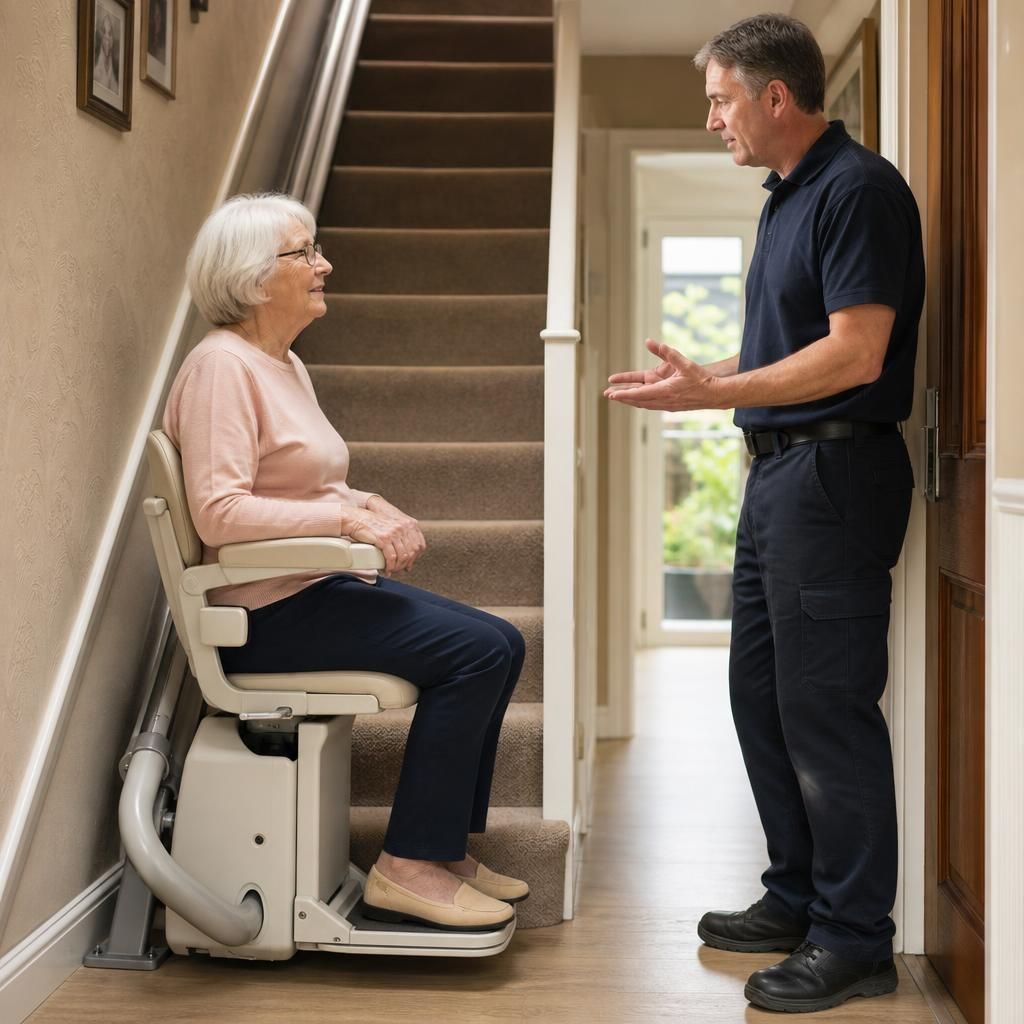
A professional home assessment confirms whether a reconditioned stairlift is suitable for both the staircase and the person using it. The assessor checks the shape, width and condition of the stairs, available space at the top and bottom, nearby doors or furniture, and any electrical requirements.
The assessment also considers the user’s height, mobility, balance, weight and ability to transfer safely onto the seat. This helps determine the most suitable seat, controls, weight capacity and parking position. It is particularly important for curved, narrow, split-level or outdoor staircases, where a pre-owned lift may not be compatible without further checks.
Arrange Your Reconditioned Stairlift Assessment
Arrange a professional assessment to confirm which reconditioned stairlift is suitable for your staircase, home and mobility needs. Independent Stairlifts can explain your options and provide a clear quotation for installation and aftercare.