
What factors should I consider when selecting a company to buy my second-hand stairlift?
When choosing a company to buy a second-hand stairlift from, check that it assesses the lift and your staircase properly, explains its condition and suitability, and completes safety checks, professional fitting and testing. Also confirm what is included in the price, the warranty or aftercare available, and whether the company can provide reliable support if the stairlift needs adjustment or repair.
The right company for a second-hand stairlift should do more than supply a pre-owned unit. It should assess your staircase and mobility needs, explain the stairlift’s condition and suitability, complete appropriate safety checks, install and test it professionally, and provide clear aftercare. Before you agree to buy, compare the company’s assessment process, installation standards, warranty, servicing arrangements, parts availability and total price.
Check whether the company assesses your staircase properly
A stairlift is not suitable simply because it is the correct model or appears to fit the available space. Straight, curved and outdoor staircases each present different installation requirements. Curved stairlifts are generally made or adapted for a particular staircase, so the company should confirm that the rail is compatible with your layout rather than relying on a visual inspection or an unverified measurement.
A proper assessment should consider the staircase dimensions, landings, bends, doorways, available parking space and the position of the user when getting on and off the lift. It should also identify whether the stairlift could obstruct other people using the stairs or interfere with doors and walkways. If an assessment is not offered, or the company proposes to sell the lift without checking the installation site, treat this as a warning sign.
Ask how the stairlift has been checked and reconditioned
Second-hand stairlifts vary considerably in age, condition and previous use. Ask whether the company has inspected the motor, drive system, batteries, charging points, seat, armrests, footrest, sensors, controls, wiring and safety edges. The company should be able to explain which components have been tested, cleaned, replaced or refurbished.
It is also reasonable to ask for the model details, the approximate age of the stairlift and whether its previous use or storage could affect its condition. A lift that has been standing unused may still need attention, particularly if its batteries or electrical components have deteriorated. The explanation should be specific rather than limited to a general statement that the stairlift is in good condition.
Confirm that the model is suitable for the user
Suitability depends on more than the user’s ability to sit on the seat. Discuss weight capacity, seat width, swivel or powered-seat options, controls, transfer ability, footrest position and whether the user can operate the controls safely. Consider whether the person has restricted movement, reduced grip strength, visual impairment or difficulty bending their knees.
For outdoor installations, ask about protection from weather, the condition of the external rail and charging arrangements. For any installation, confirm that the user can get on and off the stairlift safely at the top and bottom of the stairs. A reputable assessment should focus on the individual’s needs as well as the equipment.
Check who will install and test it
Professional fitting is important because an incorrectly positioned or secured stairlift can affect safe operation, access to the stairs and the condition of the property. Ask whether the installation is carried out by the company’s own trained installers or by a third party, and whether the installer will test the lift after fitting.
Testing should include the controls, charging system, seat and safety features, movement along the full rail, stopping positions and any alarms or sensors fitted to the model. The installer should demonstrate normal operation and explain what to do if the stairlift stops, displays a fault or loses power. You should receive operating information and know how to contact the company after installation.
Read the warranty and aftercare terms carefully
A second-hand stairlift may have different warranty terms from a new model. Establish what is covered, how long the cover lasts and whether it includes parts, labour, call-outs, batteries and adjustments. Check whether exclusions apply to normal wear, accidental damage, misuse or problems caused by changes to the property.
Ask how faults are reported, when support is available and whether servicing or future repairs can be arranged. It is particularly useful to confirm that the company can obtain compatible replacement parts for the model being offered. A low purchase price may be less helpful if support is limited or repairs are difficult to arrange.
Compare the complete cost, not just the advertised price
Request a written breakdown of what is included. The total cost may depend on the type of stairlift, the staircase, installation work, alterations, delivery, removal of an existing lift and any additional equipment. Clarify whether VAT applies to your circumstances and whether there are charges for assessment, installation, future call-outs or cancellation.
For a curved stairlift, confirm whether the quoted price includes the rail and any adjustments needed for your particular staircase. For a straight stairlift, check whether the rail length, charging points and installation are included. The cheapest initial quote is not necessarily the lowest overall cost if it provides less warranty cover or excludes essential work.
Look for clear information about ownership and removal
Find out whether you are buying the stairlift outright or entering into a rental, hire or other arrangement. If you own it, ask what happens if you move home or no longer need it. Some second-hand stairlifts have limited resale value because the rail is made for a specific staircase, particularly on curved installations.
Also ask whether the company will remove the stairlift in the future and whether the removal cost is included or charged separately. The company should explain what happens to any holes, fixings or minor marks left after removal and whether the stairlift can be adapted for another property.
Consider the company’s experience and accountability
Choose a provider that can explain its assessment, refurbishment, fitting and support processes in plain language. Check that you have a clear business address and reliable contact details, and read the terms before making payment. Written recommendations, quotations and warranty conditions make it easier to resolve misunderstandings.
Be cautious if you are pressured to make an immediate decision, asked to pay before the stairlift has been properly assessed, or given limited information about its age, condition or previous use. A responsible provider should allow you to ask questions and should tell you if a second-hand stairlift is not appropriate for your staircase or needs.
Questions to ask before agreeing to buy
- Has the stairlift and my staircase been assessed by a suitably trained person?
- Is this model suitable for the user’s mobility, weight, transfer ability and controls?
- Which parts have been inspected, tested or replaced?
- Is the stairlift second-hand, reconditioned or refurbished, and what does that description mean in this case?
- Who will install and test it?
- What exactly is included in the quoted price?
- What warranty and aftercare are provided, and who pays for parts or labour if a fault develops?
- Are compatible parts and batteries available for this model?
- What happens if the stairlift is unsuitable once assessed or cannot be installed as planned?
- How can it be removed later, and are there any removal or cancellation charges?
In practice, the best choice is the company that gives a clear assessment, matches the stairlift to the user and property, documents the condition of the equipment, installs it safely and remains available for support. Price is important, but it should be considered alongside suitability, installation quality, warranty protection and the likely cost of keeping the stairlift working.
A proper assessment is one of the most important checks when choosing a company for a second-hand stairlift. The company should assess both the stairlift and the intended installation site before confirming that the equipment is suitable.
The assessment should consider the staircase layout, landings, bends, doorways, available clearance and safe transfer points. It should also review the user’s weight capacity, mobility, ability to operate the controls and any need for features such as a swivel seat or powered footrest. For a curved stairlift, the rail must be confirmed as compatible with the particular staircase rather than assumed to fit.
Ask what has been inspected or replaced on the stairlift, including the batteries, drive system, controls, sensors and safety edges. A written explanation of the equipment’s condition, the proposed fitting work and what happens if it proves unsuitable will help you compare providers on safety and support, not just price.
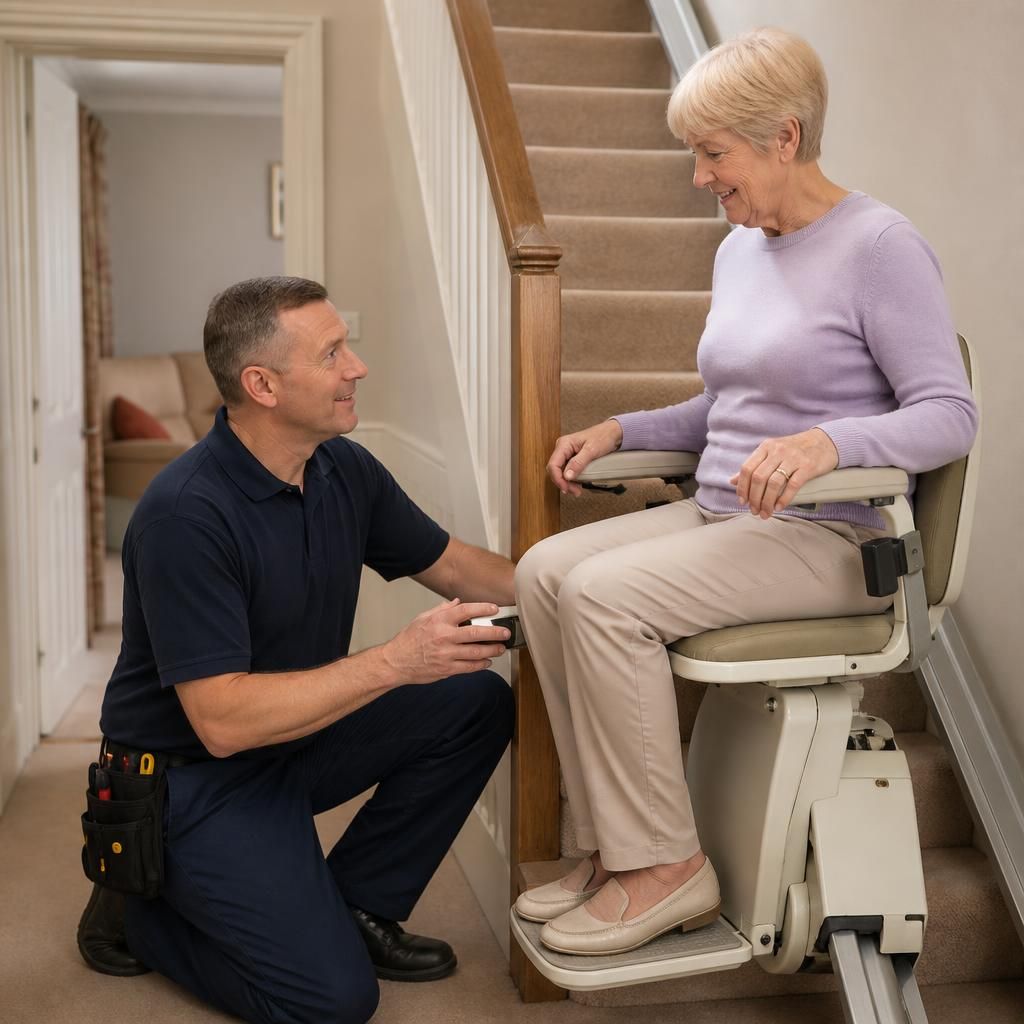
Discuss Your Second-Hand Stairlift Requirements With Our Team
Discuss your second-hand stairlift requirements with our team, including your staircase, mobility needs and preferred features. We can help you understand the available options and arrange a suitable assessment.