
How does the assessment process determine the market value of my stairlift?
The assessment determines your stairlift’s market value by considering its model, age, condition, current functionality, availability of replacement parts, and likely demand. The assessor also reviews the staircase and installation requirements to establish whether the lift can be safely removed, refurbished and resold.
The assessment determines your stairlift’s market value by establishing what it is likely to be worth as a used, removable and resalable product, rather than by referring to its original purchase price. The assessor considers the lift’s make and model, age, condition, operation, availability of parts, current demand and the practical requirements for removing and reinstalling it safely.
Identifying the stairlift
The assessment begins with the details of the stairlift itself. This normally includes the manufacturer, model, approximate age, specification and whether it is a straight or curved installation. A current model with supported components may have greater resale potential than an older model that is no longer produced or is difficult to maintain.
For a curved stairlift, the rail is made to suit the original staircase. Its value therefore depends not only on the lift and drive system, but also on whether the rail can be adapted for another property. A straight stairlift may be suitable for a wider range of homes, although the condition and design of its rail still need to be assessed.
Checking condition and functionality
The assessor checks the visible and mechanical condition of the stairlift, including the seat, armrests, footrest, covers, controls, batteries, charging equipment, carriage and rail. Signs of excessive wear, damage, corrosion, staining or missing components can reduce the offer because they may require repair, replacement or refurbishment.
The lift is also checked for safe operation where possible. This can include starting and stopping, movement along the rail, charging, controls, safety sensors, swivel or folding mechanisms and the operation of the seat belt. A stairlift that is working reliably and has been maintained is generally more straightforward to prepare for resale than one with faults or an uncertain service history.
A non-functioning stairlift can still be assessed, but its value is usually based on the condition of its recoverable parts and the likely cost of diagnosis, repair and testing. The assessment should make clear whether the valuation is for a working stairlift, a refurbishment project or parts.
Considering age, parts and future support
Age is relevant because batteries, electronic components and other replacement parts may become harder to source over time. The assessor considers whether the model can be serviced, whether compatible parts remain available and whether the lift can be tested to the required safety standard after removal and reinstallation.
Age alone does not determine the value. A well-maintained older stairlift with good parts availability may be more useful than a newer lift that is damaged, incomplete or unsuitable for common stair configurations. Conversely, an obsolete model may have limited market value even if it was expensive when new.
Assessing demand and resale suitability
Market value reflects likely demand. A lift that can be refurbished and installed in another home with relatively little modification may have stronger resale potential. The assessor considers the type of property and staircase for which the lift could be suitable, the availability of matching equipment and whether the specification meets the needs of prospective users.
This is why the valuation of a used stairlift is not simply a calculation based on its original price. The offer must reflect what the equipment is worth in its present condition and how practical it is to recover, prepare and resell.
Reviewing the staircase and removal requirements
The visit also covers the installation environment. The assessor checks how the rail is fixed, where the charging point is positioned, how accessible the equipment is and whether there are any obstacles that could affect removal. For curved installations, the shape and construction of the rail are particularly important.
These checks help establish the work involved in removing the stairlift without causing avoidable damage to the equipment or property. They may also identify whether additional time, specialist handling or remedial work is needed. Removal considerations can therefore affect the final offer, as the value of the stairlift has to be assessed alongside the practical cost and complexity of recovering it.
Taking account of paperwork and history
Information about the purchase, installation, servicing and previous repairs can help support the assessment. If you have an instruction manual, service records, proof of ownership or details of recent battery replacement, keep these available for the visit. They may help confirm the model and demonstrate how the lift has been maintained.
Missing paperwork does not automatically prevent an assessment, but incomplete information may make it harder to verify the equipment’s history, specification or ownership. The assessor may need to rely more heavily on a physical inspection and operational tests.
How the final valuation is reached
After considering the equipment, condition, demand and removal requirements, the assessor forms a valuation based on its realistic second-hand market potential. The assessment may identify work needed before resale, such as cleaning, battery replacement, repairs, safety testing or the replacement of missing parts. Those requirements are considered when calculating the offer.
The resulting offer is therefore specific to the stairlift and the circumstances of its removal. It is not an automatic percentage of the original purchase price and may differ from informal valuations based only on the model or age.
To help the assessment run smoothly, provide clear access to the stairlift, mention any known faults and explain whether it has recently been used. Do not attempt to dismantle or disconnect the lift yourself. A complete inspection gives the most reliable indication of its market value and helps ensure that any removal arrangements are based on the actual condition of the equipment.
The assessment determines your stairlift’s market value by combining its condition with how practical it is to remove, refurbish and install elsewhere. The original purchase price is not used as a direct guide because a used stairlift must be valued according to its current resale potential.
The assessor checks the make, model, age, functionality, parts availability and visible condition. They also consider the staircase and installation, including whether the rail can be reused. A straight rail may suit more properties, while a curved rail is made for a particular staircase and may have more limited resale options. Any repairs, replacement parts, cleaning or safety testing needed before resale are reflected in the offer.
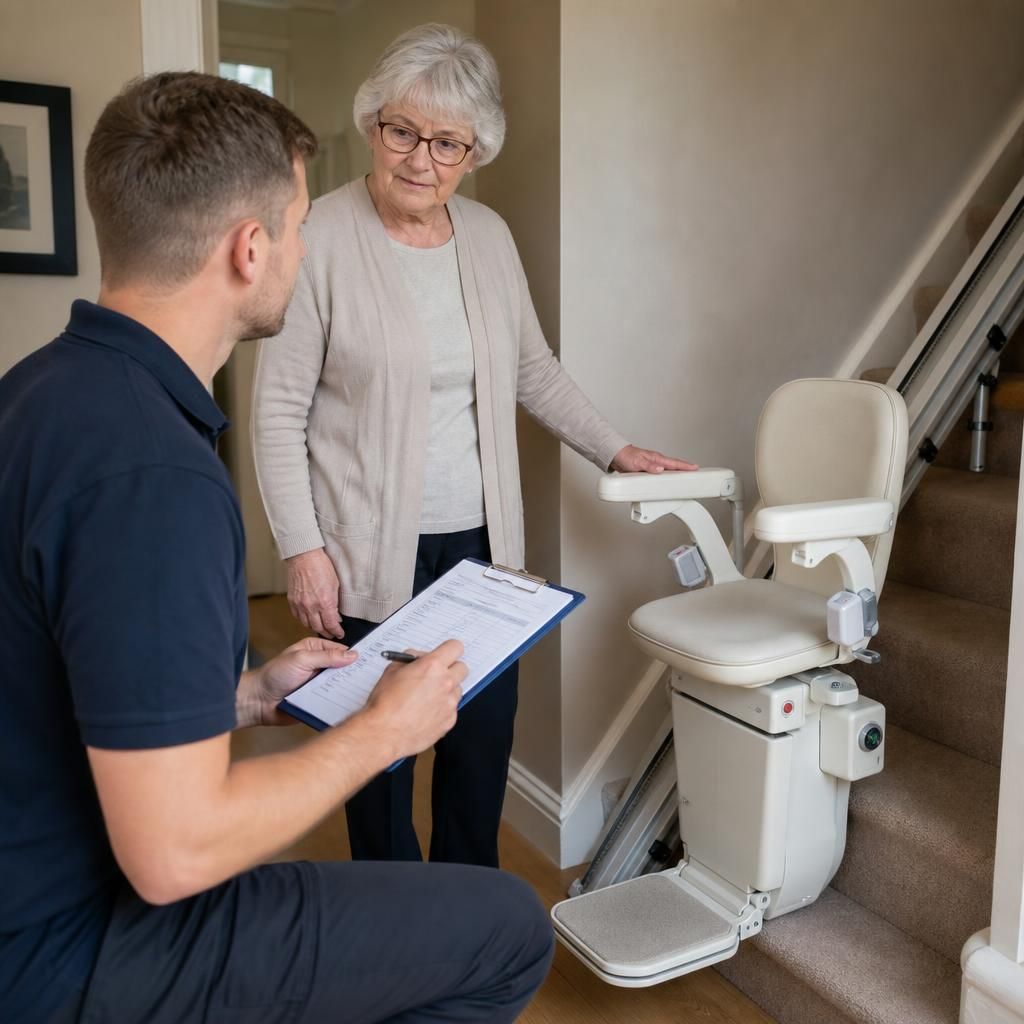
Arrange your stairlift assessment
Arrange your stairlift assessment with Independent Stairlifts so we can inspect its condition, functionality and removal requirements before providing a realistic market valuation.