
What specific assessments are conducted to ensure a used stairlift will seamlessly fit and operate safely on my staircase?
Before fitting a used stairlift, we assess the staircase dimensions and layout, including its width, length, bends, landings, clearances and fixing points, alongside the user’s access needs. We also check the lift’s condition, rail and seat compatibility, electrical supply, structural suitability and safety features to confirm it will fit correctly and operate reliably in your home.
A used stairlift is assessed against both the staircase and the person who will use it before installation. The assessment checks that the lift, rail, seat and controls are compatible with the property; that the staircase can safely support the installation; and that the completed system will provide suitable clearance, access and reliable operation.
Assessment of the staircase and surrounding space
An adviser or surveyor examines the full route from the bottom to the top of the stairs, rather than relying on standard measurements. This normally includes:
- the width of the staircase at different points;
- the total length and angle of the stairs;
- any bends, intermediate landings, half-landings or changes in direction;
- the shape and available space at the top and bottom of the rail;
- doorways, radiators, furniture, newel posts, handrails and other possible obstructions;
- clearance between the stairlift, walls and surrounding fixtures; and
- the position of suitable fixing points for the rail.
On a straight staircase, the survey confirms whether an existing rail is the correct length and configuration. On a curved staircase, the rail is checked in much greater detail because its curves, joins, gradients and parking positions are specific to the staircase where it was originally installed. A curved used stairlift will not necessarily transfer directly to another curved staircase, even where the two staircases look similar.
Checks on the user’s requirements
The assessment also considers how the stairlift will be used. Relevant points include the user’s height, weight, posture, balance, flexibility, transfer ability and whether they can operate the controls safely. The surveyor may discuss whether a standard seat, swivel seat, powered swivel function, hinged rail or alternative control arrangement is appropriate.
The user must be able to approach the seat, sit down, fasten the safety belt where fitted and leave the lift safely at the destination. The position of the controls, the direction of the swivel and the amount of space available for transferring on and off the seat are therefore checked as part of the overall suitability assessment. If more than one person may use the lift, their differing needs should be considered before a model is selected.
Inspection of the used stairlift itself
A used stairlift is inspected for signs of wear, damage or missing components. This can include the seat, armrests, footrest, swivel mechanism, safety belt, covers, sensors, controls, batteries, charger and drive system. Particular attention is given to parts that affect safe travel, stopping, transferring and positioning at the top or bottom of the stairs.
The rail is checked for damage, distortion, corrosion, worn fixings and compatibility with the proposed installation. Where the lift has been stored or removed from another property, its condition and completeness must be established before it is offered for fitting. A suitable used stairlift should be reconditioned or prepared in line with the installer’s inspection procedures, with defective or excessively worn parts repaired or replaced as necessary.
Compatibility and configuration checks
The survey confirms that the stairlift’s model, rail, seat configuration and controls work together and are suitable for the staircase. This includes checking the direction of travel, parking position, swivel arrangement, footrest design and any powered or manual features.
For a straight lift, the available rail length and the required overrun at either end are compared with the staircase. For a curved lift, the existing rail must match the route precisely or a suitable replacement or bespoke rail may be required. The assessment should also identify whether a hinged rail is needed to keep a doorway, passage or landing clear.
Structural and fixing-point assessment
Most stairlift rails are fixed to the stair treads or another suitable structural surface, but the condition and construction of the stairs still need to be assessed. The surveyor checks for loose, damaged or uneven treads, unsuitable edges, weak areas and obstructions beneath or beside the proposed fixing positions.
Where the staircase has unusual construction, limited tread depth, open sides, a narrow landing or other restrictions, the fixing method and rail position may need additional consideration. Any concern about the structure should be resolved before installation rather than discovered while the rail is being fitted.
Electrical and charging assessment
The survey includes the location of the charging points and whether the available electrical supply is suitable. A stairlift generally needs access to charging at its designated parking position or positions, depending on the model. The charger, batteries, wiring and connections are inspected for condition and compatibility, and the installation must not create a trip hazard or obstruct normal use of the stairs.
Safety and operational testing
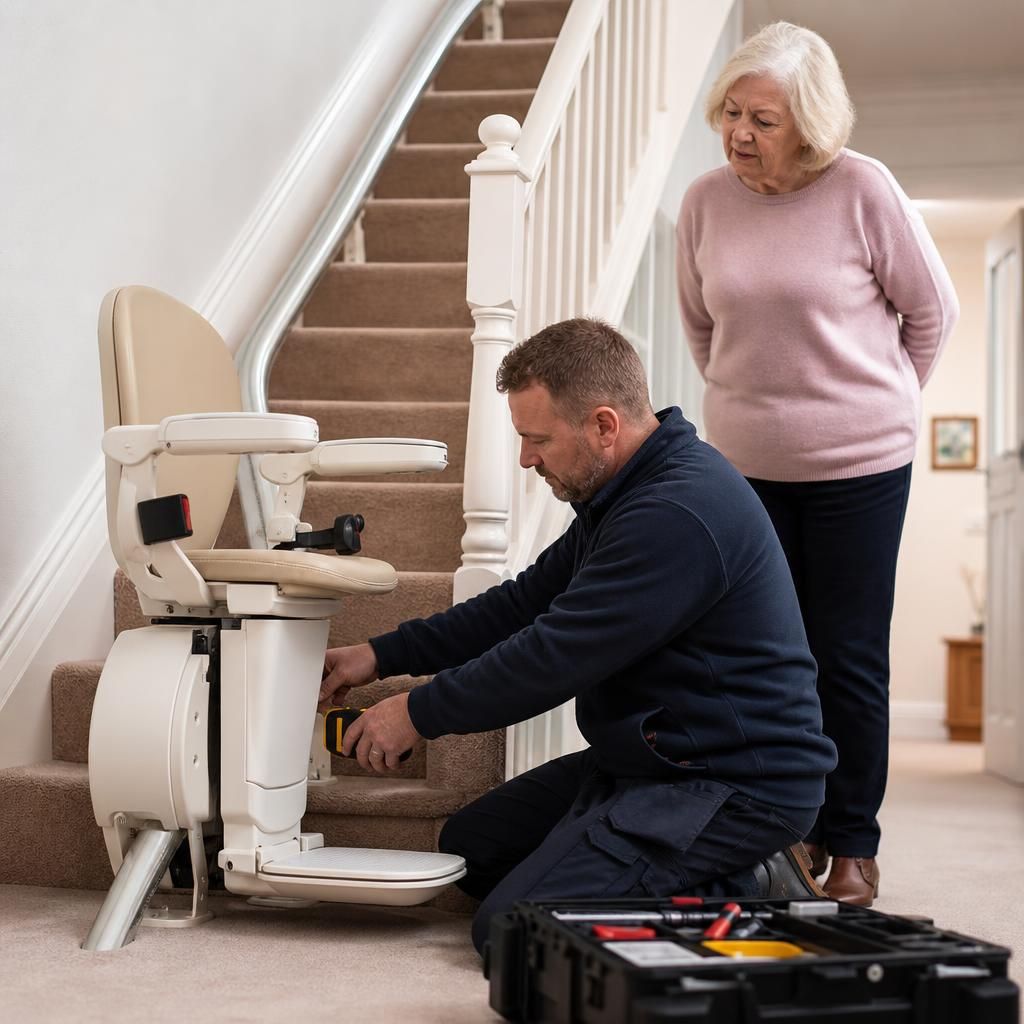
Before handover, the installed stairlift is operated through its complete route. The checks normally cover smooth starting and stopping, travel speed, charging, battery operation, the controls, swivel and safety features, and the response of sensors designed to stop the lift if an obstruction is detected.
The installer also checks that the seat locks correctly in its travel position, the footrest is secure, the safety belt operates as intended and the lift stops at the appropriate points. Clearances are reviewed with the lift moving and parked, including the space needed for the user to get on and off safely. Any unusual noise, vibration, hesitation or fault indication should be investigated before the installation is considered complete.
Assessment of the completed installation
Once fitted, the rail and fixings are checked for stability, the lift is tested under normal operating conditions and the user is shown how to use the controls, charging points and safety features. The installation should leave the staircase and nearby access routes as clear as reasonably possible, while retaining safe access for other household members.
The outcome of the assessment is not simply a decision about whether a used stairlift can be attached to the stairs. It establishes whether that particular lift and configuration are appropriate for the property and user. If the existing equipment cannot provide safe clearances, suitable transfers or reliable operation, the correct recommendation may be a different used model, a replacement rail, a bespoke solution or a new stairlift.
Before agreeing to installation, ask what has been inspected, which parts have been serviced or replaced, whether the rail is being reused or newly made, and what testing and aftercare are included. If the staircase, user’s mobility or equipment condition changes later, contact Independent Stairlifts so the lift can be reviewed rather than continuing to use it with a known fault or altered access requirement.
A used stairlift assessment confirms that the equipment, rail and staircase are compatible before fitting begins. It is not enough to check whether the lift moves; the survey must establish that it can travel safely, leave adequate clearance and allow the user to transfer on and off securely.
Particular attention is given to the rail route and the space around it. The surveyor checks stair width, bends, landings, doorways, handrails, radiators, fixing points and the available parking space at each end. On a curved staircase, the existing rail is assessed in detail because its curves and gradients are specific to the staircase for which it was made. A similar-looking staircase may still require a different rail or a bespoke solution.
The user’s requirements are assessed alongside the property. Seat height, swivel direction, controls, footrest position, safety belt, posture and ability to transfer are all considered. After fitting, the stairlift is run through its complete route so the installer can check stopping, charging, sensors, safety features, clearances and unusual noise or vibration before demonstrating its operation.
Arrange Your Used Stairlift Assessment
Arrange a used stairlift assessment with Independent Stairlifts to check that the equipment, rail and staircase are compatible before fitting begins. We will also consider the user’s access needs and explain any adjustments required for safe, reliable operation.