
What is the process for installing a second-hand stairlift on a curved staircase?
Installing a second-hand stairlift on a curved staircase begins with a detailed home survey to assess the existing rail, staircase layout and the lift’s compatibility. The stairlift is then checked and reconditioned where necessary, professionally fitted, and thoroughly tested for safe, reliable operation.
Installing a second-hand stairlift on a curved staircase involves a detailed survey, a compatibility assessment, professional preparation and fitting, followed by comprehensive safety testing. Unlike many straight stairlifts, a curved stairlift usually depends on a rail made specifically for the original staircase, so the existing lift cannot normally be transferred to a different curved staircase without checking the rail, carriage and control system carefully. In some cases, a suitable pre-owned stairlift can be adapted or matched with a new bespoke rail; in others, a different solution will be safer and more practical.
The process normally includes the following stages:
- Initial discussion and home survey: The installer reviews your mobility needs, the people who will use the stairlift and the layout of the staircase. The survey considers bends, intermediate landings, changes in gradient, narrow sections, headroom, available standing space and the position of the top and bottom landings. Doorways, radiators, bannisters and other nearby obstructions are also checked.
- Assessment of the second-hand stairlift: The model, age, condition and specification of the available stairlift are checked. Important components include the carriage, motor, batteries, charging equipment, controls, seat, safety sensors and track. Any service history or previous installation details can help establish how the equipment has been used and maintained.
- Checking the rail and staircase compatibility: A curved rail is generally designed around the original staircase rather than being a universal component. The installer therefore checks whether the existing rail matches your staircase dimensions and geometry. Measurements, photographs or previous fitting information alone may not be sufficient; an assessment at your home is normally needed before confirming suitability.
- Deciding whether a bespoke rail is required: If the used carriage and other components are suitable but the original rail is not, it may be possible to manufacture a new rail to fit your staircase. The installer will explain which parts can be reused and which need replacing. Reusing a carriage does not mean that the original curved rail can simply be shortened, reshaped or installed in a different position.
- Preparing and reconditioning the equipment: Before installation, the stairlift is inspected and serviced as necessary. This may include cleaning, checking mechanical movement, examining the drive system, testing the batteries and charger, replacing worn or unsuitable parts, and confirming that safety features operate correctly. Parts that do not meet the required condition should not be relied upon simply because the lift is second-hand.
- Planning the installation: The installation team confirms the rail route, charging points, parking positions and access requirements. The position of the seat and controls is considered so that the user can get on and off safely. If more than one person will use the stairlift, the assessment should take account of their different heights, weights, mobility and transfer needs.
- Fitting the rail and stairlift: The rail is securely fixed to the staircase or supporting structure in accordance with the approved design. The carriage, seat, footrest and controls are then fitted and adjusted. Installers take care to maintain usable access on the stairs and avoid interference with doors, landings or other household equipment.
- Testing under operating conditions: Once fitted, the stairlift is run repeatedly along the full route. The installer checks smooth travel through every curve, correct stopping at the landings, charging, braking, seat locking, swivel operation, footrest and armrests, obstruction sensors and emergency controls. The lift should also be checked in its intended parking positions, not only while travelling.
- Handover and user instruction: The user is shown how to operate the controls, call and send controls, seat swivel, safety belt, charging position and emergency stop. The installer should also explain what to do if the stairlift stops, how to keep the track clear and when to request servicing. Any relevant documentation, warranty or service arrangements should be confirmed at this stage.
A curved stairlift may not be suitable if the available equipment is substantially worn, its safety systems cannot be verified, the rail cannot be securely adapted, or the staircase has changed since the original installation. Building work, altered bannisters or changes to the landing can affect compatibility. A stairlift should never be installed by modifying the rail or bypassing a safety feature without an appropriate technical assessment.
The most important part of the process is the home survey. It establishes whether the second-hand equipment can be used safely, whether a new bespoke rail is needed and whether the proposed arrangement gives the user enough space to transfer and travel comfortably. Once these checks are complete, you can receive clear advice on the available options, expected preparation work and the cost of installation before any fitting is arranged.
Installing a second-hand stairlift on a curved staircase starts with a detailed home survey, because the existing curved rail is usually made for the staircase where it was first installed. The installer checks the bends, landings, gradients, clearances and parking positions, then assesses whether the available carriage and controls can be safely matched to your layout.
If the original rail is not compatible, the carriage may still be suitable with a new bespoke rail. The equipment is inspected, serviced where necessary and tested after fitting, including travel, braking, charging, safety sensors and seat functions. This confirms whether the reconditioned stairlift provides a safe and practical solution before installation is completed.
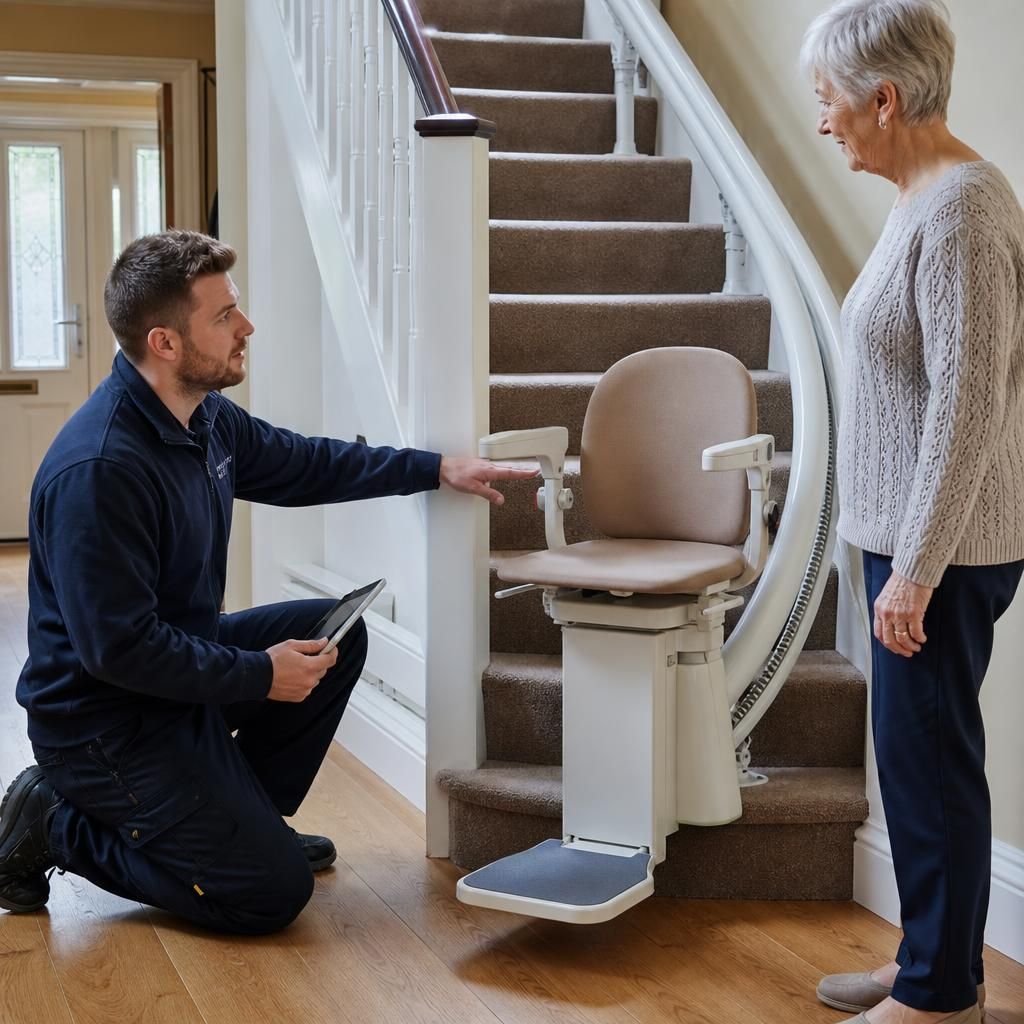
Arrange a curved stairlift assessment
Arrange a home assessment to confirm whether the second-hand stairlift, carriage and rail are suitable for your curved staircase. We can explain whether a bespoke rail or other adaptations are needed and provide a clear installation quotation.