
What bespoke solutions does Independent Stairlifts offer for homes with unusual or complex staircase configurations?
Independent Stairlifts provides bespoke solutions for complex staircases, including curved, split-level, narrow, steep and multi-flight layouts, following an individual home assessment. Options may include a made-to-measure curved rail, compact or hinged sections, powered swivel and folding seats, and suitable outdoor equipment where required, with the stairlift selected and installed to suit the staircase and the user’s mobility needs.
Independent Stairlifts offers individually assessed solutions for curved, split-level, narrow, steep, multi-flight and other non-standard staircases. The installation is designed around the staircase, available space and user’s mobility needs, rather than relying on a standard straight-rail stairlift. Depending on the layout, this may involve a made-to-measure curved rail, compact seating, powered adjustments, hinged rail sections or equipment suitable for an external staircase.
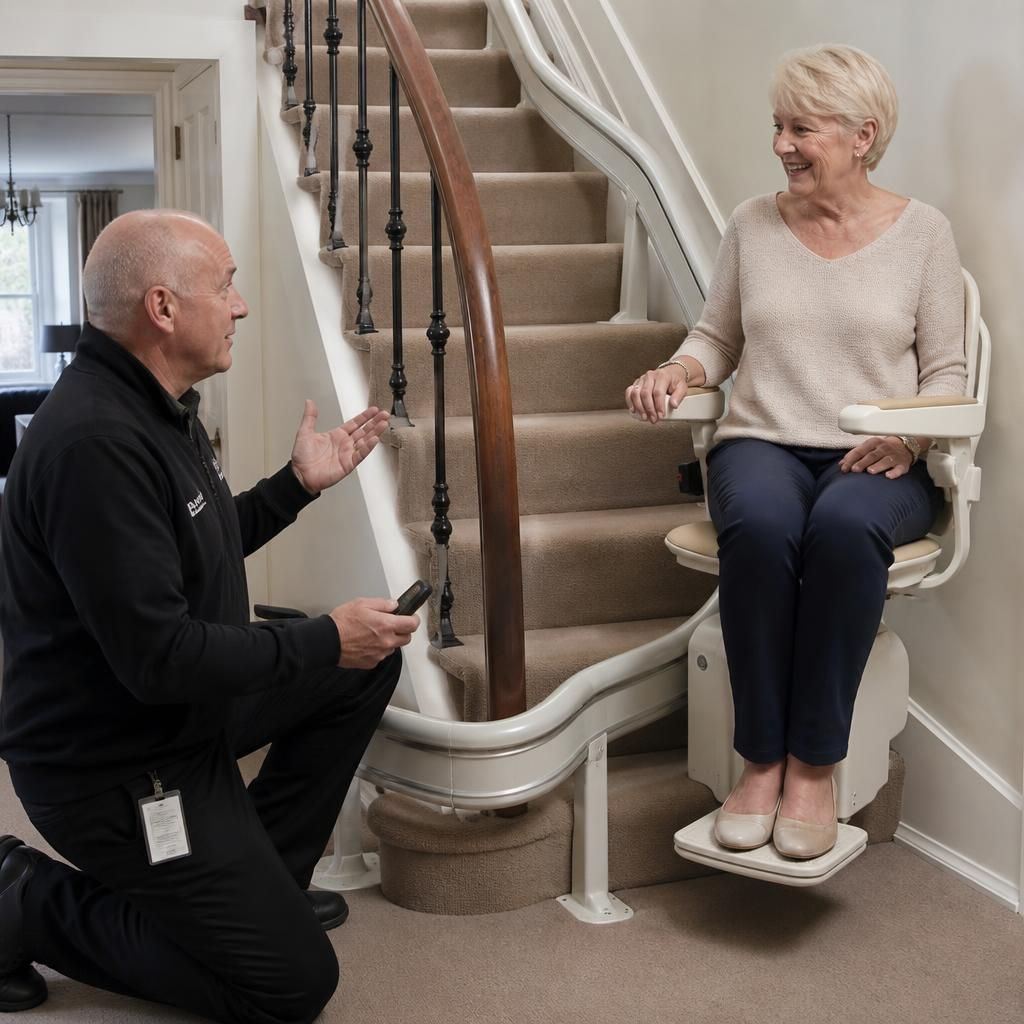
Each unusual staircase requires a home assessment. An adviser will examine the shape and gradient of the stairs, the position of landings, available headroom, doorways, radiators and other obstructions. They will also consider how the user approaches the stairlift, transfers onto the seat, operates the controls and gets on and off safely at the top and bottom. This assessment establishes whether a stairlift is appropriate and which configuration will provide the most practical access.
For a curved staircase, the rail is designed to follow the individual bends, landings and changes in direction. This can allow the stairlift to travel continuously around corners or between flights where a standard straight model would not be suitable. The position of the parked stairlift is also considered, since parking it away from a doorway or at the top or bottom of the stairs may help preserve access through the home.
Split-level and multi-flight staircases can be approached in different ways. A continuous curved system may be suitable where the flights are connected by landings and the user would benefit from remaining seated throughout the journey. In other homes, separate lifts or a different arrangement may be more appropriate. The decision depends on the staircase layout, available landing space, transfer requirements and whether the user can safely move between sections.
Narrow stairs may need a compact stairlift with a slim profile, folding arms, a folding footrest or a seat designed to reduce the space occupied when parked. A powered swivel seat can assist with turning towards the landing before getting off, while powered folding or hinged components can help keep a doorway, hallway or passage clear. These features do not remove the need to maintain safe clearance, so the proposed equipment must be checked against the actual dimensions of the staircase and surrounding areas.
Steep, uneven or unusually shaped stairs require particular attention to the rail angle, seat position and user stability. The installer will check that the stairlift can travel smoothly and that the user can remain correctly positioned during the journey. Options such as a powered swivel, suitable arm supports, a retractable or adjustable seat and an appropriate seat belt may be considered where they support safe and independent use. The chosen features should reflect the user’s abilities rather than being added without a clear practical reason.
Where the staircase includes a tight turn, a doorway, a radiator or an obstruction near the rail, a hinged or folding rail section may help preserve access when the stairlift is parked. The type of hinge and its operating method must suit the user. A manual section may be adequate for someone who can operate it safely, while a powered option may be preferable where reaching, bending or handling a rail would be difficult.
Independent Stairlifts can also advise on outdoor or partially exposed staircases. External installations require equipment and fixings suitable for the location, together with consideration of rain, temperature, drainage, electrical supply and secure parking. The assessment should also identify whether the route is fully external, sheltered or exposed only at certain points, as this can affect the specification and ongoing care required.
For customers considering a used or reconditioned stairlift, the staircase assessment is especially important. A previously used straight stairlift is not automatically suitable for a different staircase, and a curved rail is generally made to match the original staircase on which it was installed. Independent Stairlifts will need to check the rail, drive system, controls, seat and safety features, as well as whether the equipment can be installed safely in the proposed location. Where a suitable used option is not available, a new bespoke rail or another configuration may be the more appropriate solution.
The assessment also considers the home beyond the staircase. The installer may review the landing, entrance to each room, lighting, floor surfaces and the space needed to approach and leave the seat. If the stairlift is intended to support access to a bedroom, bathroom or living area, the route should be considered as a whole rather than focusing only on the rail.
Once the requirements are understood, Independent Stairlifts can explain the available configurations, likely limitations and any adaptations needed before installation. The final recommendation should make clear:
- which type of rail or stairlift is proposed and why it suits the staircase;
- where the stairlift will start, finish and park;
- which seat, swivel, folding or control features are included;
- how obstructions, narrow sections and landings will be managed;
- whether any electrical, structural or access preparation is required; and
- what servicing, user guidance and post-installation support will be provided.
A bespoke solution is therefore not simply a standard stairlift fitted to an unusual staircase. It is a combination of accurate measurement, suitable equipment, careful positioning and user-focused features. This approach helps ensure that a complex layout is assessed on its actual conditions and that the installed stairlift supports safe, practical movement between floors.
A bespoke stairlift solution begins with a detailed assessment of the staircase and the user’s access needs. This is particularly important where there are tight bends, intermediate landings, narrow sections, steep gradients or obstructions such as doorways and radiators. The assessment determines whether a made-to-measure curved rail, a compact stairlift, a hinged rail or another configuration is appropriate.
Independent Stairlifts also considers where the stairlift will park and how the user will approach, sit down, travel and leave the seat safely. Features such as a powered swivel seat, folding components or suitable controls may improve access, but only where they address a specific need. For a used or reconditioned stairlift, the equipment and rail must be checked against the proposed staircase; a curved rail made for another home will not normally provide a suitable fit without careful assessment and an appropriate bespoke solution.
Arrange a Bespoke Stairlift Assessment
Arrange a bespoke stairlift assessment with Independent Stairlifts to discuss your staircase layout, access requirements and the most suitable configuration for your home.