
What are the key factors to consider when choosing a reconditioned stairlift for my home environment?
When choosing a reconditioned stairlift, consider whether it suits your staircase and user requirements, as well as its safety condition, service history, controls, battery performance and available warranty or aftercare. A professional home assessment can confirm the lift will fit correctly, operate reliably and provide suitable value for your environment.
A reconditioned stairlift should be chosen by balancing the user’s mobility needs, the layout of the staircase, the condition of the equipment and the support available after installation. A suitable model is not simply the cheapest available: it must fit the stairs accurately, carry the user comfortably, operate safely and have been properly inspected and serviced before it is installed.
Start with the staircase and available space. The shape of the stairs determines which type of stairlift is appropriate. A straight stairlift is designed for a single, uninterrupted flight, while a curved stairlift may be needed for bends, landings, intermediate floors or more complex layouts. Outdoor stairs require equipment designed to withstand weather exposure rather than an indoor model placed outside.
Consider the width of the staircase, the position of doors and landings, the clearance at the top and bottom, and whether other people will still be able to use the stairs when the lift is parked. A professional assessment is important because small differences in the staircase, bannisters, skirting boards and available turning space can affect the installation. For a curved staircase, the rail normally needs to be matched to the route rather than treated as a standard interchangeable component.
Match the stairlift to the user’s physical requirements. The seat should provide a stable and comfortable position, with controls that the user can operate without excessive reaching or gripping. Check the seat height, width, armrest position, footrest arrangement and whether the user can transfer on and off the seat safely. Someone with restricted knee, hip or back movement may need a different seating position from someone whose main difficulty is balance.
Also consider whether the user can sit upright throughout the journey, use the seat belt correctly and turn safely at the top or bottom of the stairs. If more than one person may use the stairlift, the equipment must be suitable for the heaviest user and for the range of body sizes involved. Your installer should discuss the manufacturer’s stated weight limit and any relevant restrictions rather than relying on appearance alone.
Check how the reconditioning has been carried out. A reconditioned stairlift should have undergone more than a basic clean. Ask what has been inspected, which parts have been replaced, whether the batteries have been tested or renewed, and whether the lift has been function-tested before installation. Important areas include the drive system, gearbox, charging points, safety sensors, seat swivel, armrests, footrest, belt, controls and rail fixings.
Some cosmetic wear is normal on pre-owned equipment and does not necessarily affect operation. Mechanical wear, damaged safety components, unreliable controls, excessive movement or poor battery performance are more significant. The installer should be able to explain the condition of the particular stairlift being offered and identify any parts that have been renewed as part of the reconditioning process.
Give priority to safety features and correct operation. Safety systems commonly include a seat belt, obstruction sensors, braking or speed-control systems, secure swivel mechanisms and controls that stop the lift when released. The footrest and seat should lock securely, and the lift should stop promptly if an obstruction is detected. A professional installation should include checks that the rail, charging points and stairlift are secure and that the equipment operates correctly over the full route.
Do not assume that a stairlift is safe merely because it powers on. It should be assessed in the actual home, installed according to the manufacturer’s instructions and checked after fitting. Any concern about unusual noise, jolting, hesitation, movement in the seat or inconsistent stopping should be reported before the equipment is accepted for regular use.
Assess the batteries and charging arrangements. Batteries are wear items and can be particularly important in a used stairlift. Ask about their age and condition, how they have been tested and what symptoms might indicate that they need replacement. The lift should charge reliably at its designated charging points, including when parked at the position recommended by the installer.
Find out what happens if there is a power cut. Most domestic stairlifts use rechargeable batteries so that the lift can normally complete journeys when the mains supply is interrupted, but the available operation depends on the battery condition and the model. Keeping the lift correctly parked and charged is essential for dependable use.
Consider the controls and daily usability. Controls may be fitted to the armrest and may also be available through a remote handset. They should be easy for the user to see and operate, with buttons that do not require unnecessary force. If the user has limited dexterity, reduced vision or difficulty using one hand, this should be discussed during the assessment.
Where other household members use the stairs, remote controls can allow the stairlift to be sent to the required floor. However, the main priority is that the user can use the lift independently and safely. Ask for a demonstration and allow the user to practise starting, stopping, using the seat swivel, fastening the belt and parking the stairlift.
Compare the complete cost rather than only the purchase price. The quoted price should be considered alongside assessment, delivery, installation, removal of any existing equipment, replacement parts, batteries, warranty cover and future servicing. A lower initial price may not represent good value if the stairlift requires immediate repairs or has limited support.
Ask whether the quotation covers all work needed for the particular staircase and whether any additional electrical work or alterations are likely. For a curved stairlift, the rail and installation requirements can be more specific, so the price should be based on the assessed route rather than on a generic used-equipment price.
Check the warranty and aftercare arrangements. Confirm what the warranty covers, how long it lasts, whether parts and labour are included and how faults are reported. It is also useful to understand whether servicing, battery replacement and call-outs are available after the warranty period. A reconditioned stairlift should come with clear instructions for use, contact details for support and advice on routine care.
Ask what records are provided, such as details of the model, installation checks, servicing or parts replaced. These records can help with future maintenance and make it easier to identify the correct components if a repair is needed.
Check the installation method and effect on the home. Most stairlifts are fitted to the stairs rather than the wall, but the installer should confirm the fixing method during the survey. Discuss where the lift will park, whether it will obstruct a doorway or landing, and whether a powered or manually operated swivel seat, folding rail or other option would improve access.
In homes with narrow stairs, sharp turns, half-landings or unusual arrangements, a standard reconditioned model may not be suitable without modification. A bespoke assessment can establish whether the available equipment can follow the route safely or whether a different configuration is required.
Use the home assessment to make the final decision. The assessment should consider the staircase, the user, access to power, parking positions, transfer points and any household constraints. It should also identify risks such as loose flooring, poor lighting, obstacles on the stairs or difficulty approaching the seat. Take the opportunity to explain how the user currently manages the stairs, what assistance is available and whether their needs are likely to change.
Before agreeing to installation, ask to see or discuss the proposed stairlift, confirm that its specification suits the user, and obtain written details of the price, warranty and aftercare. The most appropriate reconditioned stairlift is one that has been professionally assessed, thoroughly checked, correctly fitted and supported by a clear maintenance and repair service.
Independent Stairlifts can assess the staircase and the intended user’s requirements before recommending a suitable reconditioned solution. This helps ensure that the equipment is compatible with the home environment, rather than selecting a model based only on its age or advertised price.
A professional home assessment is the most important step when choosing a reconditioned stairlift because it confirms that the equipment will fit the staircase, suit the user and operate safely in its intended position. The assessment should cover the stair width, bends, landings, doors, available clearance, parking points and access to charging.
It should also consider the user’s transfer ability, seating position, weight limit, controls, seat belt and any difficulty with balance, grip or vision. This helps identify whether a straight, curved or outdoor model is appropriate, and whether features such as a swivel seat or folding rail are needed. A reconditioned stairlift should only be selected once its condition, battery performance, safety systems, warranty and aftercare have been explained clearly.
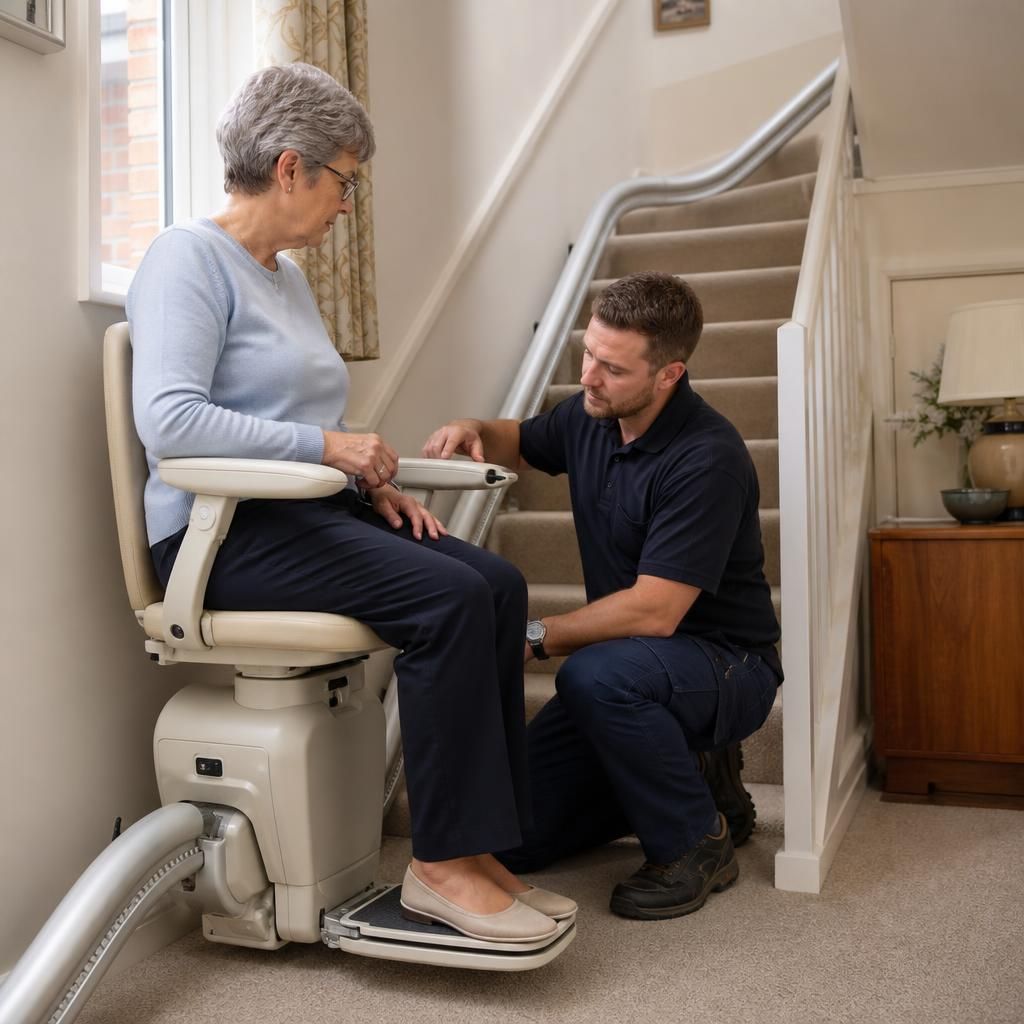
Arrange Your Reconditioned Stairlift Assessment
Arrange a home assessment with Independent Stairlifts to confirm which reconditioned stairlift fits your staircase, suits the user and meets your safety requirements. We can explain the available options, condition, warranty and aftercare before you decide.