
How can I ensure the used stairlift is safely installed in my home?
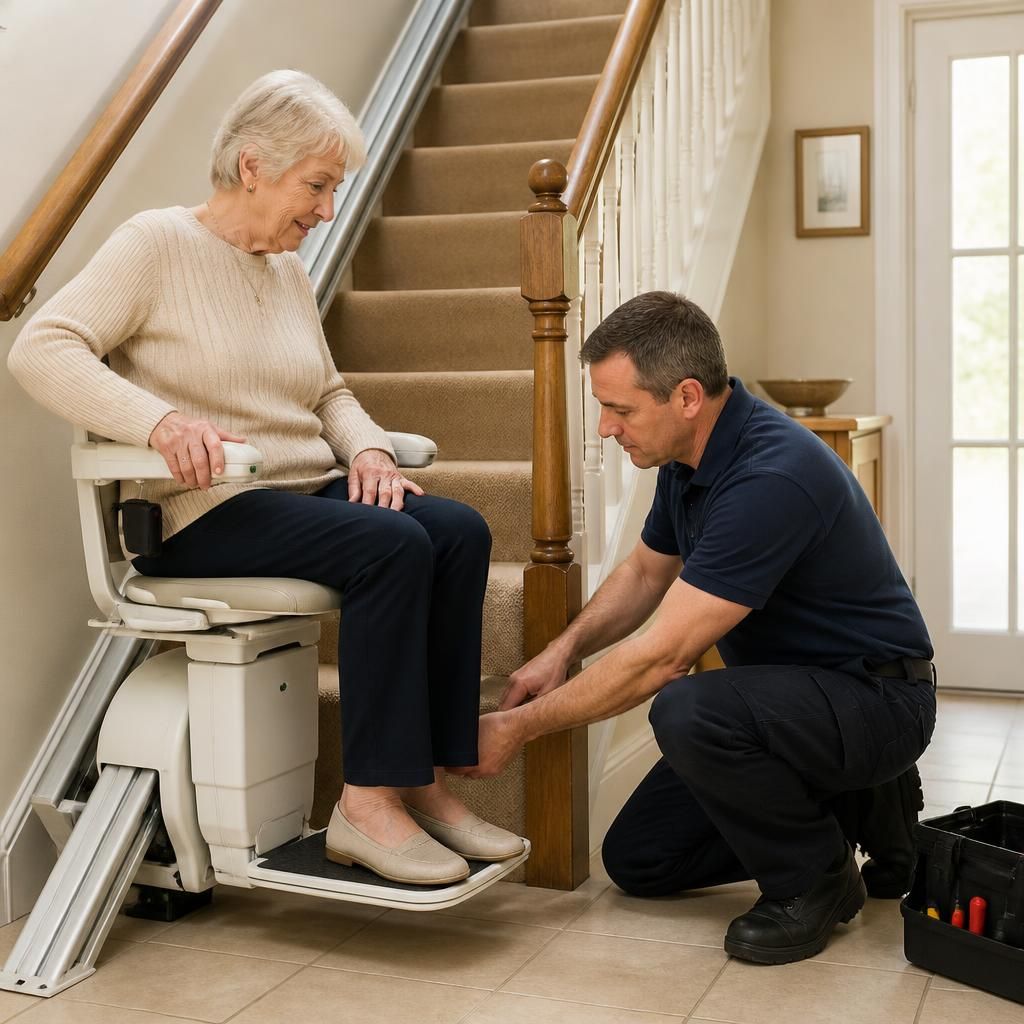
Ensure the used stairlift is inspected, professionally fitted and safety-tested by a qualified installer who assesses your staircase, the lift’s condition and its essential safety features. Independent Stairlifts can confirm that the equipment is suitable for your home, securely installed and supported with appropriate guidance and aftercare.
A used stairlift is safely installed when its condition and compatibility have been checked, it has been fitted securely by a competent stairlift installer, and all operating and safety features have been tested in your home. The assessment should cover both the equipment and your staircase, rather than assuming that a lift removed from another property will automatically be suitable for yours.
Use a professional installation service. Stairlift fitting is not a suitable do-it-yourself task. The installer needs to position and secure the rail correctly, connect the charging and electrical components safely, set the lift’s travel limits and confirm that it operates reliably on the staircase. Professional fitting also helps identify problems that may not be apparent from a visual inspection, such as worn drive components, incorrect rail alignment or insufficient clearance.
Have the staircase assessed before agreeing to the installation. The assessment should consider:
- the shape, length and width of the staircase;
- the position of landings, doorways and other access points;
- available clearance for the seat, footrest and any passenger using the stairs;
- the location of the charging point and whether the electrical supply is appropriate;
- the fixing surface and condition of the steps or floor structure;
- potential obstructions, including radiators, furniture, bannisters and doors; and
- whether the proposed seat, controls and transfer position are suitable for the user.
A straight stairlift rail may only be suitable for a staircase with a compatible straight layout. A curved or unusually configured staircase normally requires a rail designed to follow its particular bends, landings and changes in direction. Reusing a rail without checking its dimensions and configuration can create unsafe clearances or prevent the lift from reaching the required floors.
Check the used stairlift’s condition and history. Before installation, ask what inspection or refurbishment has been carried out and whether any worn parts have been replaced. Particular attention should be given to the battery condition, drive system, rail, seat swivel and locking mechanism, armrests, footrest, sensors, control switches and safety edges. The installer should also check that the equipment is complete and that compatible components are being used.
A used stairlift should not be treated as safe simply because it was working in a previous home. Components can deteriorate during storage, transportation or repeated use, and a lift may have been configured for a different staircase or user. If the equipment’s age, service history or condition cannot be established, ask for a clear explanation of the inspection and any limitations that apply.
Confirm the essential safety features. During installation and testing, the installer should verify that the stairlift:
- starts, stops and travels smoothly without unusual movement or noise;
- stops when an obstruction is detected by the safety sensors;
- has a secure seat, armrests, footrest and safety belt where fitted;
- locks correctly when the seat is swivelled or positioned for transfer;
- stops at the intended points at the top and bottom of the staircase;
- charges correctly when parked at the charging points; and
- continues to provide the appropriate warning sounds or indicators.
The rail and its fixings should be checked for stability, with no movement that could affect travel or clearance. The lift should be tested under normal operating conditions, including starting from its charging position, stopping at the landings and using the controls from the position in which you will normally travel. Any fault, unusual noise, jerky movement or error indication should be investigated before the installation is considered complete.
Ask for a proper handover. The installer should demonstrate how to use the controls, seat belt, swivel seat, footrest and any remote controls. You should also be shown how to park the lift, charge it, respond to an obstruction and use any manual lowering or emergency procedure that applies to the model. If more than one person will use the stairlift, each person should understand the instructions and be able to transfer on and off it safely.
Keep the operating instructions, installation or inspection records and details of the equipment supplied. You should also know who to contact if the lift stops working, displays a fault or needs servicing. Ask what warranty or cover applies to the used stairlift, what is excluded and whether batteries or other consumable components are covered separately.
Check the installation after the installer leaves. Keep the staircase clear of objects and watch for changes in operation during the first few journeys. Do not continue using the lift if it moves unpredictably, fails to stop at an obstruction, does not charge, makes a new grinding or knocking sound, or shows a fault warning. Switch it off as instructed and contact the installation or service team rather than attempting to adjust the rail or electrical components yourself.
Routine servicing and sensible use help maintain safety over time. Follow the manufacturer’s cleaning and charging instructions, keep the rail and sensors free from obstructions, and arrange inspection if the lift is used by someone whose mobility or seating requirements have changed. A professional review is also appropriate if the staircase is altered, furniture is moved close to the lift or the equipment has been unused for an extended period.
Independent Stairlifts can assess the staircase, check whether a reconditioned or used lift is an appropriate match, and arrange installation and guidance around the equipment supplied. The key safeguard is a documented suitability check followed by competent fitting, complete safety testing and clear aftercare support—not simply the fact that the stairlift has previously been used elsewhere.
A used stairlift is safely installed only after a competent installer has checked its condition, confirmed that it suits your staircase and tested every essential safety feature in your home. Previous use in another property does not guarantee that the rail, clearances or settings will be suitable for your staircase.
The installer should check the rail and fixings, seat and locking mechanism, drive system, batteries, controls, footrest and safety sensors. They should also confirm that the lift travels smoothly, stops correctly at the landings, detects obstructions and charges properly. Before the installation is completed, ask for a full demonstration and clear details of servicing, warranty cover and who to contact if a fault develops.
Arrange a used stairlift safety assessment
Arrange a used stairlift safety assessment with Independent Stairlifts to confirm that the equipment is in suitable condition and compatible with your staircase. We can advise on professional fitting, safety checks and ongoing support before installation.