
What pre-installation checks are carried out for reconditioned Stannah stairlifts to ensure suitability for my home?
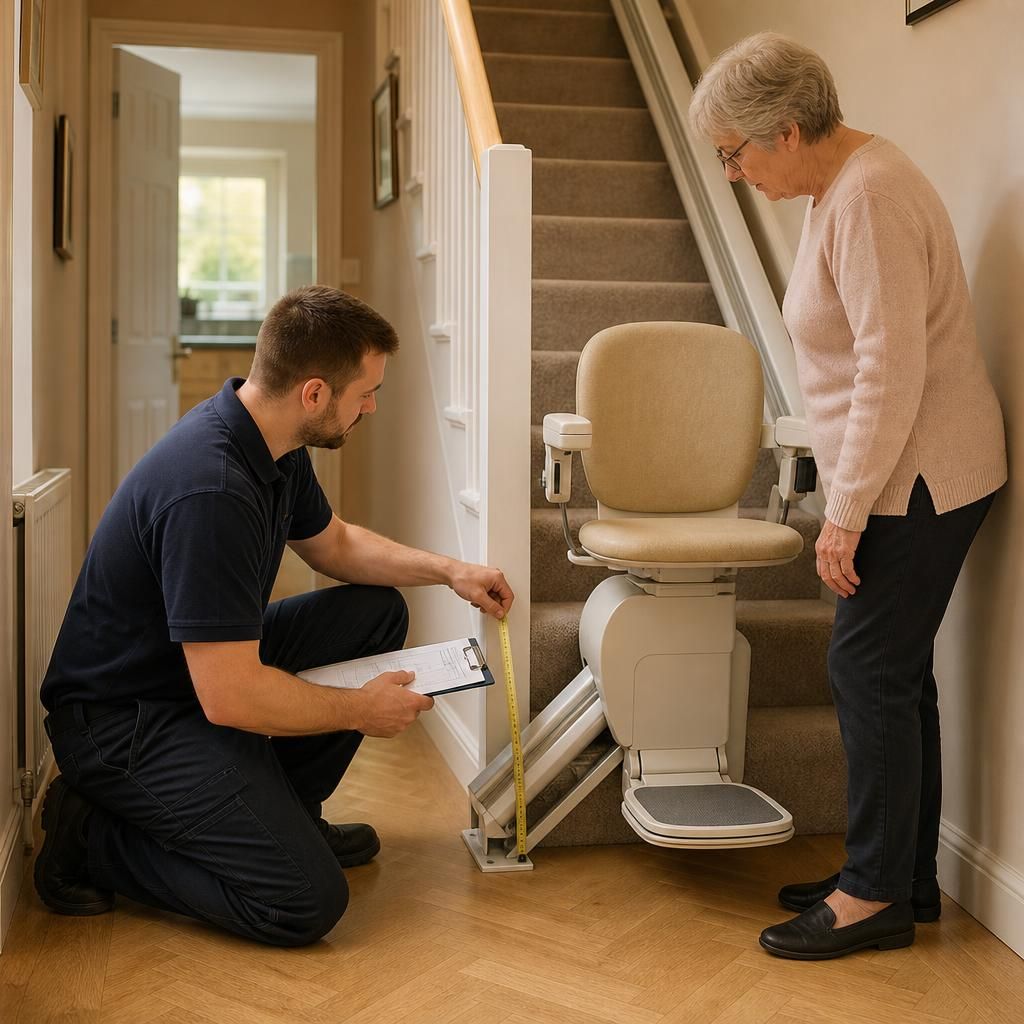
Before installation, we assess your staircase, access requirements and home layout, taking measurements and checking the stairs, landings, walls, power supply and clearances. The reconditioned Stannah stairlift is also inspected and safety-tested to confirm that its condition, track and controls are suitable for your staircase and intended use.
Before a reconditioned Stannah stairlift is installed, we carry out a home assessment and a separate inspection of the lift itself. These checks confirm that the stairlift is suitable for the staircase, can be installed safely, and is appropriate for the person who will use it. A reconditioned unit is not treated as suitable simply because it operated correctly in a previous home.
Assessment of the staircase and surrounding area
We inspect the complete route from the bottom to the top of the stairs, including any turns, intermediate landings, narrow sections and changes in gradient. Measurements are taken to establish whether the available space will accommodate the rail, seat, footrest and moving parts without creating an obstruction.
- The width and shape of each section of staircase are checked.
- Curves, bends, half-landings and unusual angles are assessed where applicable.
- The top and bottom landing areas are checked for safe entry and exit.
- Clearances from walls, doorways, radiators, bannisters and nearby furniture are considered.
- Potential hazards, such as low ceilings, opening doors or restricted headroom, are identified.
For a curved stairlift, the measurements and layout are particularly important because the rail is made or selected to follow the staircase. The condition and suitability of any existing or proposed rail are checked rather than assuming that a rail from another installation will fit your home.
Checks to the staircase and fixing points
The survey also considers the structure to which the stairlift will be fixed. We look for suitable fixing positions on the stairs and check for issues such as damaged treads, loose flooring, uneven surfaces or obstructions beneath the staircase. Stairlift rails are normally fixed to the stairs rather than the wall, but the exact method depends on the installation and the structure available.
Where there are concerns about the condition of the stairs, flooring or surrounding fittings, these are discussed before installation. The aim is to ensure that the rail can be securely installed without affecting the safe use of the staircase or access to adjoining areas.
Assessment of the user’s access requirements
A suitable stairlift must fit the user as well as the staircase. We discuss how the person will approach the lift, sit down, use the controls, travel on the stairs and get off at the destination. This includes considering mobility, balance, transfer ability and whether assistance from another person may be required.
We check that the seat, armrests, footrest, controls and seatbelt arrangement are appropriate for the intended user. The direction of travel, parking position and any powered or manual swivel feature are also considered where fitted. If more than one person may use the stairlift, their different requirements should be raised during the assessment.
Inspection of the reconditioned Stannah stairlift
The reconditioned stairlift is examined before it is allocated for installation. This includes checking the seat, arms, footrest, carriage, batteries, charging equipment, controls and safety components for signs of damage, excessive wear or deterioration. The rail and associated fittings are also reviewed for condition and compatibility with the proposed installation.
Electrical and operational checks are carried out to confirm that the stairlift starts, stops, charges and travels as expected. Safety features are tested, including the controls, seatbelt, obstruction sensors, limit controls and relevant stopping functions. Batteries and charging contacts are checked because reliable charging is essential for day-to-day use. Any component that does not meet the required condition is repaired or replaced before the stairlift is installed.
Testing is carried out in the context of the planned installation. A lift that performs correctly during a workshop inspection still needs to be checked against the dimensions, rail configuration and access arrangements of your home.
Power supply and installation planning
We identify the most suitable charging position and check the available electrical supply and cable route. The location must allow the stairlift to charge when parked without creating a trip hazard or restricting movement around the stairs. We also consider whether furniture, doors or other household activities could interfere with parking or charging.
The installation plan records practical details such as the intended direction of travel, parking points, cable position, access requirements for the installation team and any work needed to move or protect nearby items. If the stairlift cannot be installed safely without alteration to the proposed arrangement, this is explained before work begins.
Final suitability confirmation
Once the staircase, user requirements, electrical arrangements and reconditioned equipment have been reviewed together, we confirm whether the proposed Stannah stairlift is suitable. If a different configuration, component or type of stairlift would provide a safer or more practical solution, that will be discussed rather than proceeding with an unsuitable unit.
After installation, the stairlift is operated through its travel route and the relevant safety functions are checked again. We also confirm that the user can use the controls and get on and off safely. These pre-installation and final checks help ensure that the reconditioned Stannah stairlift is matched to your home and ready for dependable everyday use.
The staircase survey confirms that the reconditioned Stannah stairlift can be installed and used safely within your home. We measure the stairway, landings and available clearances, then check for bends, narrow sections, doorways, radiators, bannisters and other features that could affect the rail, seat or footrest.
We also inspect the proposed fixing points and consider how you will approach, sit on and leave the lift. This helps identify practical issues before installation, such as restricted headroom, an obstructed parking position or insufficient space at the top or bottom of the stairs. If the existing rail or proposed configuration is not suitable, we discuss an alternative rather than installing a lift that does not properly fit your home.
Arrange your pre-installation assessment
Arrange your pre-installation assessment so we can check your staircase, access requirements and reconditioned Stannah stairlift for a safe, suitable fit. We will explain any practical considerations and confirm the most appropriate installation plan for your home.