
What factors should be considered when deciding between a reconditioned Stannah stairlift and a second-hand option?
When choosing between a reconditioned Stannah stairlift and a second-hand option, compare its safety inspection, refurbishment work, suitability for your staircase, installation standard, warranty, aftercare and total cost. A professionally reconditioned lift normally provides greater assurance because it is assessed and prepared for installation, whereas a second-hand lift may have limited checks, support or warranty cover.
The main difference is the level of checking, preparation and support provided. A reconditioned Stannah stairlift has been inspected, tested and prepared for reinstallation by a specialist, while a second-hand lift is usually sold as a used item with its condition, compatibility and future support dependent on the seller. When comparing the two, consider safety, suitability for your staircase, installation quality, warranty protection, battery and component condition, aftercare and the total cost rather than the purchase price alone.
Safety inspection and refurbishment
A reconditioned stairlift should undergo a documented assessment before it is offered for installation. This normally includes checks of the drive system, rail, carriage, seat, swivel mechanism, armrests, footrest, controls, safety sensors, charging system, batteries, wiring, braking and securing points. Worn or unreliable components may be repaired or replaced, and the lift should be tested to confirm that it operates correctly under installation conditions.
With a second-hand lift, the extent of these checks may be unclear. It may have been removed from another property without a full inspection, or it may be sold in working condition without any meaningful refurbishment. A lift that moves on a demonstration does not necessarily have dependable batteries, effective safety sensors or a suitable braking system. Ask for a clear explanation of what has been inspected, what has been replaced and whether the work was completed by a suitably competent stairlift technician.
Suitability for your staircase and user
A stairlift must be matched to the staircase and to the person using it. A straight rail may be suitable only where the staircase has a consistent, unobstructed flight. Curved, narrow, multi-flight or split-level staircases require more detailed assessment, as the rail and travel path are designed around the individual layout. A rail from another home is unlikely to be suitable simply because the stairs appear similar.
The assessment should also consider the user’s height, weight, mobility, transfer ability, balance, grip and ability to operate the controls. Seat width, seat height, swivel action, footrest position, armrest design and the location of the controls can all affect safe use. Doorways, radiators, cupboards, landings and the position of the charging point must also be considered. For an outdoor installation, exposure to weather and the condition of the external staircase introduce additional requirements.
Installation standard
A professionally reconditioned lift is normally supplied with an installation assessment and fitted to the manufacturer’s requirements for the particular model. The installer should check that the rail is securely fixed, that the lift stops at the correct positions and that the user can get on and off safely. They should also demonstrate normal operation, charging, emergency procedures and any manual controls.
With a privately purchased second-hand lift, you may need to arrange transport, storage, removal of the existing equipment and installation separately. Some installers may not be able to take responsibility for a lift they have not inspected or supplied. This can create uncertainty about who is responsible if the lift does not fit, develops a fault or causes damage during fitting. Confirm in advance whether installation is included and whether the installer will support the equipment afterwards.
Age, model condition and availability of parts
Used stairlifts can vary considerably in age and condition. A lower purchase price may reflect worn batteries, an older control system, cosmetic damage or limited availability of replacement parts. Ask for the exact model information, service history and any known faults. It is also sensible to establish whether the batteries, handset, charger and other key components are original, recently replaced or simply untested.
Reconditioning does not make a lift new. You may notice marks from previous use, and an older model can have a shorter remaining service life than a new one. However, a reputable supplier should be able to explain the lift’s condition and identify any work carried out before installation. This makes the likely maintenance needs easier to assess.
Warranty and aftercare
Warranty cover is an important distinction. A reconditioned stairlift should be supplied with written terms explaining what is covered, how long the cover lasts, whether labour and replacement parts are included, and what exclusions apply. Check whether call-outs, batteries, accidental damage and faults caused by misuse are treated differently.
A second-hand lift may have no warranty, or any original cover may no longer apply to a new owner or a different installation. You may also have no dedicated aftercare contact if the lift was bought from a private seller. Before deciding, ask who will diagnose faults, supply parts and provide repairs after installation. Reliable aftercare can be more valuable than a small saving at the outset, particularly where the lift is an essential aid to moving around the home.
Total cost rather than advertised price
Compare the complete cost of each option. For a second-hand lift, include the purchase price, survey, transport, removal, storage, installation, replacement batteries, repairs and any alterations needed to make it suitable. If it cannot be fitted safely, the cost of replacing it may also need to be considered.
A reconditioned quotation should make clear what is included, such as the assessment, adapted or replacement rail where required, installation, testing, user demonstration, warranty and future support. The cheapest option is not necessarily the most cost-effective if it requires early repairs or leaves you responsible for arranging technical help.
Evidence and seller support
Before choosing a second-hand option, request the model and serial details, service history, instructions, details of the previous installation and evidence of any recent inspection. Be cautious if the seller cannot explain why the lift was removed, will not allow its condition to be assessed or offers no clear responsibility after the sale.
For a reconditioned lift, ask for a written summary of the checks completed and any parts replaced. The supplier should be willing to carry out a home assessment rather than relying only on photographs or measurements supplied by the customer. This is particularly important for curved staircases, restricted landings and homes where other people use the stairs.
Which option is usually more appropriate?
A professionally reconditioned Stannah stairlift is generally the safer and more predictable choice where you need confirmed compatibility, competent installation, warranty protection and an accessible aftercare service. A second-hand option may appear attractive when the model is inexpensive or already available, but it carries greater uncertainty unless its condition, history, suitability and installation arrangements can all be verified.
Independent Stairlifts can assess the staircase, discuss the user’s practical needs and explain the condition and cover available for a reconditioned option. If you are considering a second-hand lift, arrange an assessment before committing to purchase. This helps establish whether the equipment can be installed safely and whether the apparent saving remains worthwhile once all associated costs and support requirements are included.
The key difference between a reconditioned Stannah stairlift and a second-hand lift is the level of inspection, preparation and support provided before installation. A reconditioned lift should be assessed for safe operation, checked for compatibility with your staircase and supplied with clear warranty and aftercare terms. A second-hand lift may only have been removed from another property and sold without the same checks or technical support.
Before choosing, ask for the lift’s service history, details of any parts replaced and confirmation that installation is included. Also compare the complete cost, including transport, fitting, batteries and possible repairs. A professionally assessed reconditioned option can offer greater certainty that the lift is suitable for both your home and the person using it.
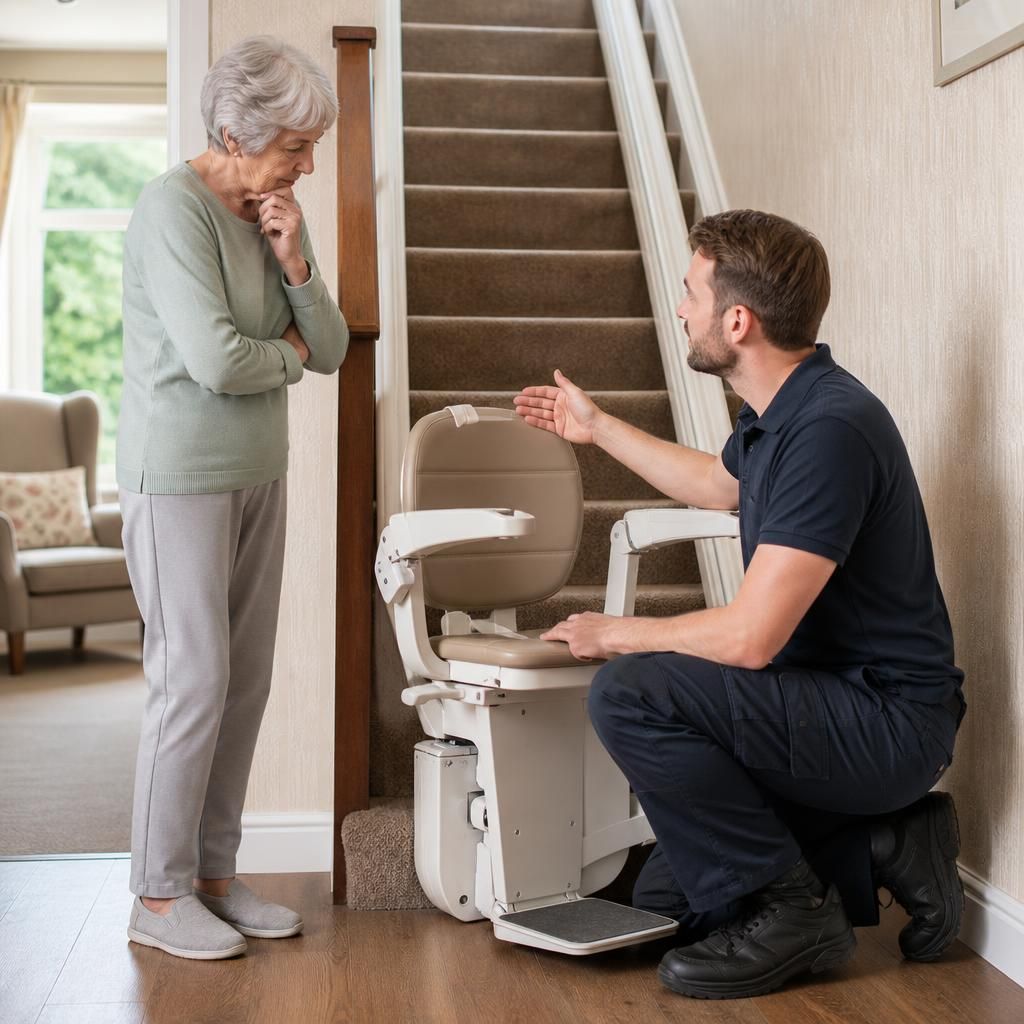
Arrange a home assessment for your stairlift options
Arrange a home assessment to compare reconditioned and second-hand stairlift options for your staircase and needs. Independent Stairlifts can explain suitability, installation, warranty and aftercare before you decide.