
Are reconditioned Stannah stairlifts compatible with all types of staircases, including more complex configurations?
Reconditioned Stannah stairlifts can suit many straight, curved, narrow and multi-level staircases, but they are not automatically compatible with every configuration. Complex stairs require a tailored survey to check the layout, rail design, lift model and whether suitable reconditioned components are available; a bespoke solution may be needed.
Reconditioned Stannah stairlifts can be suitable for many staircase layouts, including narrow, curved and multi-flight designs, but they are not automatically compatible with every configuration. Straight staircases are usually the simplest installation. Stairs with bends, intermediate landings, multiple flights, tight turns or unusual dimensions require a detailed survey to confirm that the lift, rail and parking position can be fitted safely.
The most important distinction is between the stairlift unit and its rail. A reconditioned Stannah lift may be suitable for use on different staircases, but a curved rail is generally made to follow the specific shape of an individual staircase. It cannot normally be transferred to another home simply because the lift model is compatible. For a complex staircase, a suitable rail may need to be manufactured or adapted for the property, subject to the availability of compatible parts and the design of the installation.
During the assessment, Independent Stairlifts will consider the full staircase rather than looking only at its width. This includes:
- Whether the staircase is straight, curved, split-level, open-tread, spiral or made up of several flights.
- The position and shape of landings, bends and changes in direction.
- The available width, headroom and clearance around doors, hallways, radiators and other obstructions.
- Where the stairlift can park without blocking access or creating a trip hazard.
- Whether the rail can be secured correctly to the stair treads and follow the staircase without interfering with normal use.
- Whether the proposed lift provides suitable access at the top and bottom of the stairs.
- The user’s mobility, weight, posture, transfer ability and preferred side of travel.
On a staircase with a single straight flight, a reconditioned straight stairlift may be appropriate if the rail length, fixing points and parking arrangements are suitable. A staircase with a bend or landing will normally require a curved stairlift rail. Where there are several flights, the design may include changes in direction and carefully planned parking areas. A split-level or unusually shaped staircase may also need a bespoke layout rather than a standard installation.
Narrow staircases do not automatically rule out a reconditioned Stannah stairlift. However, the available space must be checked with the seat, armrests, footrest and user in their travelling position. The stairlift should not make the stairs unusable for other household members, and the user must be able to get on and off safely. Folding components may help with clearance, but they do not remove the need for accurate measurements.
Some configurations are more difficult to accommodate. Very tight bends, spiral stairs, limited landing space, restricted headroom and stairs with unusual construction can affect the choice of lift and rail. In these situations, the surveyor may need to consider alternative parking positions, a different seat arrangement, a powered swivel or hinged rail, or another suitable accessibility solution. A reconditioned model should only be recommended where the completed installation meets the required safety and usability checks.
Availability is another consideration. Reconditioned stock changes over time, so the exact model, controls, seat configuration and compatible components may not always be available immediately. This does not mean that a complex staircase cannot be fitted, but it may affect the choice of model, the rail solution or the installation timescale. Independent Stairlifts can explain whether the available equipment is suitable or whether a different specification would be more appropriate.
A pre-installation survey is therefore essential. It should establish the staircase dimensions and condition, identify obstructions, assess electrical requirements, confirm fixing points and check the proposed route from the user’s normal position at the bottom to the intended exit at the top. The survey also provides an opportunity to discuss how the stairlift will be used, including whether the user needs to approach from a wheelchair, has difficulty bending a knee or requires additional support when transferring.
Reconditioning and installation should be treated as separate checks. The stairlift unit must be inspected, serviced and tested, while the rail and its fixings must be confirmed as appropriate for the particular staircase. Once installed, the system should be tested through its full travel, including stops, controls, safety edges, seat functions, charging arrangements and any powered or hinged components. The user should also receive clear guidance on operation and safe use.
In summary, a reconditioned Stannah stairlift may work well on a complex staircase, but compatibility depends on the property, the selected model, the rail design, the available components and the user’s needs. It should not be assessed from photographs or a general description alone. A tailored home survey will confirm whether a reconditioned solution is suitable, whether a bespoke rail or additional feature is needed, and whether another stairlift arrangement would provide safer access.
Reconditioned Stannah stairlifts can be suitable for complex staircases, but compatibility depends mainly on the rail design and the layout of the individual staircase. The lift unit may be reconditioned and suitable for reuse, while a curved rail normally needs to be made or configured specifically for the bends, landings and parking points in your home.
A pre-installation survey checks clearances, fixing points, headroom, obstructions and safe access at the top and bottom of the stairs. It also considers whether features such as a powered swivel seat, hinged rail or alternative parking position are needed. This ensures that the proposed reconditioned stairlift is suitable for both the staircase and the person using it, rather than relying on the lift model alone.
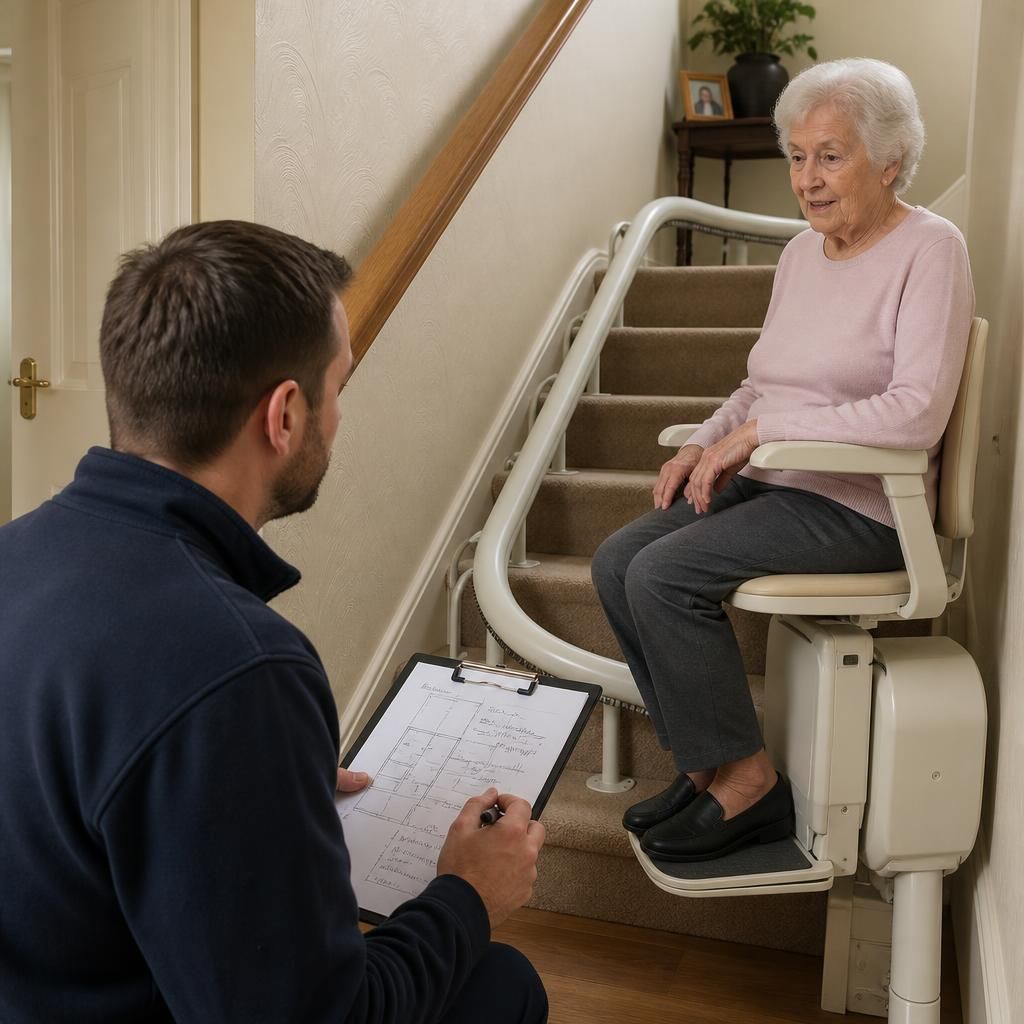
Arrange a tailored survey for your staircase
Arrange a tailored home survey to confirm whether a reconditioned Stannah stairlift is suitable for your staircase, including any bends, landings or access restrictions. Independent Stairlifts will assess the layout, rail requirements and your needs before recommending an appropriate solution.