
What maintenance is required for refurbished and reconditioned stairlifts after purchase?
Both refurbished and reconditioned stairlifts require routine cleaning, battery and safety checks, and professional servicing in line with the manufacturer’s guidance and your service agreement. Keep the rail and seat area clear, report unusual noises, jerky movement or charging problems promptly, and arrange inspections if the stairlift is used heavily or its performance changes.
Refurbished and reconditioned stairlifts need regular user checks, appropriate cleaning, battery care and professional servicing after purchase. The maintenance routine is usually similar for both types: follow the manufacturer’s instructions and service agreement, keep the stairlift and charging points clear, and report changes in operation before they become safety or reliability problems.
Follow the service and warranty requirements
Keep the installation paperwork, user manual, warranty details and any service records together. These documents identify the correct maintenance schedule, battery type, approved cleaning methods and reporting procedure for your model. Some warranties or service agreements require servicing by a suitably qualified technician, so check the terms before arranging work independently.
A reconditioned stairlift may have undergone more extensive inspection, testing and replacement of worn parts before installation, while a refurbished stairlift may have received a more limited preparation. This difference affects its condition at the point of sale, but it does not remove the need for ongoing maintenance. Both remain used mobility equipment with mechanical, electrical and battery-operated components.
Carry out simple checks regularly
The user or a family member can make basic visual and operational checks without removing covers or attempting repairs. Check that:
- the stairlift starts, stops and travels smoothly;
- the seat, armrests, footrest and safety belt remain secure;
- the swivel seat or powered swivel mechanism locks correctly, where fitted;
- the footrest sensors and other safety controls respond as expected;
- the rail, carriage and footrest are free from bags, clothing, toys and other obstructions;
- the charging point is not blocked and the stairlift returns to it correctly, if it has automatic charging;
- there are no unusual noises, smells, vibration, jerky movement or visible damage; and
- the lift’s display, warning light or audible alert is not indicating a fault.
Test the safety belt and controls as described in the manual rather than forcing them. If a check produces an unexpected result, stop using the stairlift if necessary and contact the installer or service provider.
Keep the stairlift clean and dry
Wipe the seat, armrests, controls and footrest with a soft, slightly damp cloth and a suitable mild cleaner. Do not pour or spray liquid directly onto the controls, motor, batteries or charging equipment. Avoid abrasive products, solvents and excessive moisture, as these can damage surfaces, switches or electrical components.
Keep the rail and surrounding steps clear. Dust and ordinary household dirt can be removed from accessible surfaces, but do not apply grease, oil or other lubricant to the rail unless the manufacturer specifically instructs you to do so. Incorrect lubrication can attract dirt or affect the carriage and braking system. Do not dismantle covers to clean internal parts.
Pay particular attention to the batteries
Most stairlifts use rechargeable batteries and need to be left on their charging points when not in use, according to the manufacturer’s instructions. A stairlift that is regularly left away from its charging position may not recharge properly, particularly if it is only used occasionally.
Signs that the batteries may need attention include slower travel, reduced operating time, repeated low-battery warnings, difficulty starting or a lift that stops before reaching the end of the rail. Batteries are consumable parts, so replacement may eventually be necessary even when the rest of the stairlift is working correctly. Battery replacement should be carried out using the correct specification and by a competent person. Do not open, modify or attempt to recharge a damaged battery.
Arrange professional servicing
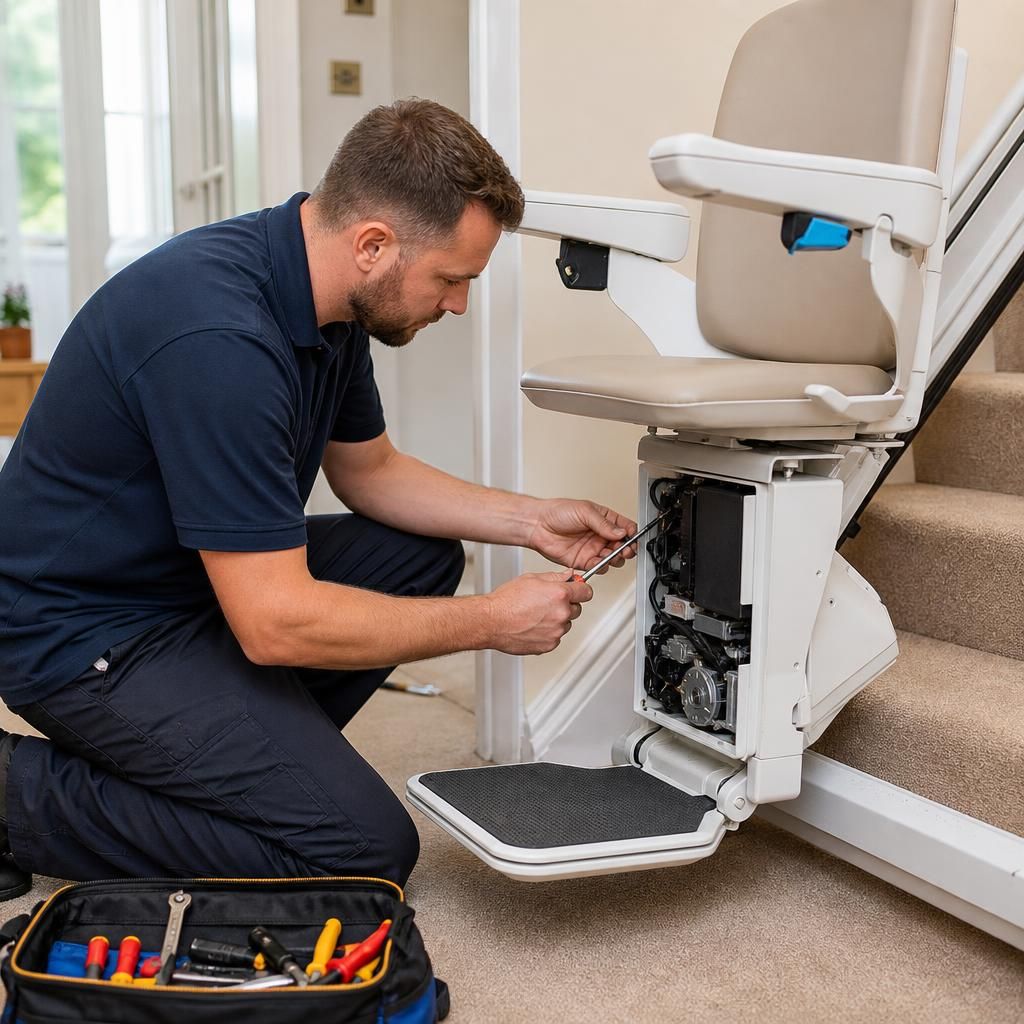
A qualified stairlift engineer should inspect and service the equipment in line with the manufacturer’s guidance and the terms of your service agreement. A service may include checks of the drive system, rail, carriage, brakes, safety sensors, seat mechanisms, controls, charging system, batteries and electrical connections. The engineer can also identify wear that may not be visible during everyday use.
Servicing intervals depend on the make, model, age, condition and level of use. A stairlift used several times a day, shared by more than one person or installed in a demanding environment may need closer monitoring than one used occasionally. Arrange an additional inspection if the user’s mobility needs change, the lift is moved to a different position, or the equipment has been unused for an extended period.
Keep a record of servicing, battery changes, repairs and any faults reported. This helps the engineer assess recurring problems and provides useful evidence if a warranty or service agreement query arises.
Report faults promptly
Stop and seek advice if the stairlift develops jerky movement, unusual sounds, a burning smell, repeated error messages, unreliable controls, failure to charge or difficulty locking the seat or belt. Do not continue using a lift that appears unsafe, and do not bypass a safety switch or repeatedly reset a fault without professional guidance.
Minor issues can sometimes result from an obstruction, an incorrectly positioned seat or a charging problem, but internal electrical and mechanical faults require proper diagnosis. Do not remove the motor or battery covers, alter wiring, adjust the rail or attempt to repair the braking system yourself. Unauthorised work may create a safety risk and could affect warranty cover.
Consider the installation environment
Moisture, condensation, dust, pet hair, temperature changes and heavy household traffic can affect maintenance needs. Outdoor stairlifts require particular attention to weather protection, covers, drainage, corrosion and the condition of exposed electrical connections. Keep indoor and outdoor equipment within the operating conditions specified by the manufacturer and report rust, water ingress or damaged covers promptly.
If the stairlift is in a property undergoing building work, protect it from dust and do not allow materials to rest against the rail or controls. After decorating, flooring work or other alterations near the staircase, check that the rail and travel path remain unobstructed and ask for an inspection if the installation may have been disturbed.
Maintenance responsibilities after purchase
Routine cleaning, keeping the charging point accessible, carrying out simple visual checks and reporting faults are normally the owner’s responsibilities. Technical servicing, safety testing, battery replacement and repairs should be handled by an appropriately qualified stairlift engineer. Whether the equipment was sold as refurbished or reconditioned, the safest approach is to maintain it according to its specific model and documented condition rather than relying on its description alone.
If you are unsure whether a noise, warning light or charging behaviour is normal, contact Independent Stairlifts or the service provider named in your paperwork. Providing the stairlift model, the fault message and when the problem occurs will help the engineer give accurate advice and decide whether an inspection is required.
Professional servicing is the main maintenance requirement for a refurbished or reconditioned stairlift after purchase. A qualified stairlift engineer should inspect the drive system, rail, carriage, brakes, safety sensors, seat mechanisms, controls, charging system and batteries in line with the manufacturer’s guidance and your service agreement.
Do not assume that a reconditioned stairlift needs less servicing because it received more extensive preparation before installation. Both types contain used mechanical, electrical and battery components that can wear over time. Arrange an earlier inspection if the lift develops jerky movement, unusual noises, charging problems, warning messages or difficulty locking the seat or safety belt. Keep records of servicing, repairs and battery replacement, as these help with future fault diagnosis and warranty queries.
Arrange a stairlift maintenance check
Contact Independent Stairlifts to arrange a maintenance check by a qualified stairlift engineer, particularly if your refurbished or reconditioned stairlift shows any change in movement, charging or safety operation.