
What are the key factors to consider regarding the longevity and resale value of refurbished versus reconditioned stairlifts?
A reconditioned stairlift will generally offer stronger long-term value because it has been more extensively inspected, serviced and tested, while a refurbished model may involve more limited cosmetic or functional work. Longevity and resale value depend on the lift’s age, condition, parts availability, installation quality, service history and warranty—not its label alone.
A reconditioned stairlift will generally offer stronger long-term value because it has usually been more extensively inspected, serviced and tested, while a refurbished stairlift may have received more limited cosmetic or functional work. However, the label alone does not determine longevity or resale value. The lift’s age, condition, design, parts availability, installation quality, service history, warranty and suitability for the next staircase are all important.
It is also worth recognising that refurbished and reconditioned are not universally defined terms. Different suppliers may use them in slightly different ways. Ask what work has actually been completed rather than relying on the description. A properly reconditioned lift should have evidence of a systematic inspection, replacement of worn components where necessary, safety testing and confirmation that it is suitable for installation. A refurbished lift may have been cleaned, cosmetically improved and checked for basic operation, but the extent of servicing can vary.
Factors affecting the expected lifespan
- Age and previous use: A lift that has had frequent use over many years may have more wear in its motor, drive system, carriage, controls, charging equipment and seat mechanism. Age is not an automatic reason to reject a stairlift, but it should be considered alongside its service history and current condition.
- Quality of the reconditioning or refurbishment: Inspection should cover the electrical system, safety sensors, braking system, drive components, batteries, charging points, seat, armrests, footrest and controls. Replacing a visibly worn part is not the same as checking why it has worn or confirming that related components remain reliable.
- Parts availability: A stairlift is more likely to remain serviceable when replacement batteries, chargers, control units and mechanical parts are still available. Older or discontinued models can become more difficult and expensive to maintain, even if they are working correctly at the time of installation.
- Installation quality: Correctly fitted rails, secure fixings, accurate alignment and appropriate adjustment of the carriage all affect performance and wear. The installation must also suit the staircase, user and home environment rather than being treated as a simple equipment swap.
- Operating conditions: Outdoor lifts are exposed to moisture, temperature changes and dirt, so their long-term condition depends heavily on protection and maintenance. Indoor lifts can also be affected by dust, damp, heavy use or storage conditions before installation.
- Maintenance: Batteries and moving parts require attention over time. Regular servicing can identify developing faults before they affect safety or lead to more extensive damage. Follow the servicing advice supplied with the lift and report unusual noises, jolting, slower movement or charging problems promptly.
In practical terms, a reconditioned stairlift may provide more predictable longevity when the supplier has carried out documented mechanical and electrical checks and replaced parts to an appropriate standard. A refurbished lift can still be a sound choice where it has been carefully assessed and is being offered with suitable aftercare. The difference is the level of work and assurance provided, not simply the wording used in the quotation.
How design affects resale value
Resale value is influenced strongly by whether the stairlift can be installed on another staircase. A straight stairlift is usually easier to transfer because its rail is designed for a straight flight and may suit another staircase with compatible dimensions. Even then, the rail, brackets and carriage need to be assessed before reuse, and a new installation should be carried out by a competent professional.
A curved stairlift is made around the bends, landings and measurements of the original staircase. Its carriage may be reusable, but the bespoke rail will often have limited value unless another staircase has a sufficiently similar layout. This can make a curved lift harder to resell as a complete system. Outdoor models have similar considerations because the receiving property must have a suitable external staircase and the equipment must still be in appropriate weather-resistant condition.
Other features can affect demand. A powered swivel seat, powered footrest, hinged rail or specific control arrangement may be valuable to a suitable user, but they do not necessarily increase the general resale market. The important question is whether the equipment meets the next user’s mobility requirements and fits their staircase safely.
What gives a stairlift better resale prospects
- A recognisable model that remains supported by the manufacturer or service provider.
- A clear record of installation, servicing, repairs and battery replacement.
- Evidence that safety checks were completed after reconditioning or refurbishment.
- A transferable warranty or clearly stated aftercare arrangements, where offered.
- Good cosmetic condition without damage to the seat, controls, covers or rail.
- A straight rail or a curved rail that has a realistic prospect of fitting another staircase.
- Complete accessories, including chargers, remote controls and user instructions.
- Professional removal and reinstallation arrangements, rather than an informal or untested transfer.
Even when a stairlift is well maintained, its resale price may be limited. Stairlifts are often purchased for a particular person and staircase, and removal, transport, assessment, adaptation and reinstallation all involve costs. A buyer may therefore value a reliable, documented lift but still deduct the cost of making it suitable for their home. Resale value should be viewed as a possible benefit, not a guaranteed return or a reason to select equipment that is less appropriate for the current user.
Questions to ask before choosing
- What does refurbished or reconditioned mean for this particular lift?
- Which components have been inspected, serviced or replaced?
- Has the lift been tested under load and checked for correct operation of its safety features?
- How old are the lift, batteries and charger, and are replacement parts still available?
- Will the warranty cover parts, labour and call-outs, and for how long?
- What servicing is recommended after installation?
- Is the rail new, previously used or made specifically for the current staircase?
- Could the lift realistically be removed and installed elsewhere if circumstances change?
- What documentation will be provided after installation?
A written quotation should separate the equipment, inspection, installation, warranty and ongoing service arrangements. It should also identify any limitations, such as a bespoke rail having little transfer value or a discontinued model having restricted parts support.
Making the decision
Choose a reconditioned stairlift when you want a more comprehensive preparation process and clearer evidence that the lift has been assessed for continued use. Choose a refurbished stairlift when its condition, testing, warranty and aftercare are clearly explained and the overall specification is suitable for the user and staircase. In both cases, prioritise safe operation, comfortable use, reliable support and available parts over a possible future resale price.
An individual assessment is the most reliable way to judge the likely service life and value of either option. It allows the lift, staircase and user’s requirements to be considered together, including whether a straight, curved or outdoor design is appropriate and whether the proposed equipment can be maintained over time.
Resale value depends more on whether a stairlift can be safely fitted elsewhere than on whether it is described as refurbished or reconditioned. A well-maintained lift with documented servicing may have limited transfer value if its rail or specification is unsuitable for another staircase.
Straight stairlifts generally have broader resale potential because the rail may suit another straight flight, subject to professional assessment. Curved stairlifts are manufactured for a particular staircase, so their bespoke rails often have little value elsewhere, although the carriage and features may remain useful. Outdoor models also require a suitable external staircase and continued protection from weather.
Keep the installation and service records, warranty details, user instructions and accessories. If the lift may later be moved, arrange professional removal and reinstallation rather than treating it as a simple equipment swap. The receiving staircase, lift condition, parts availability and cost of adaptation should all be checked before estimating its resale value.
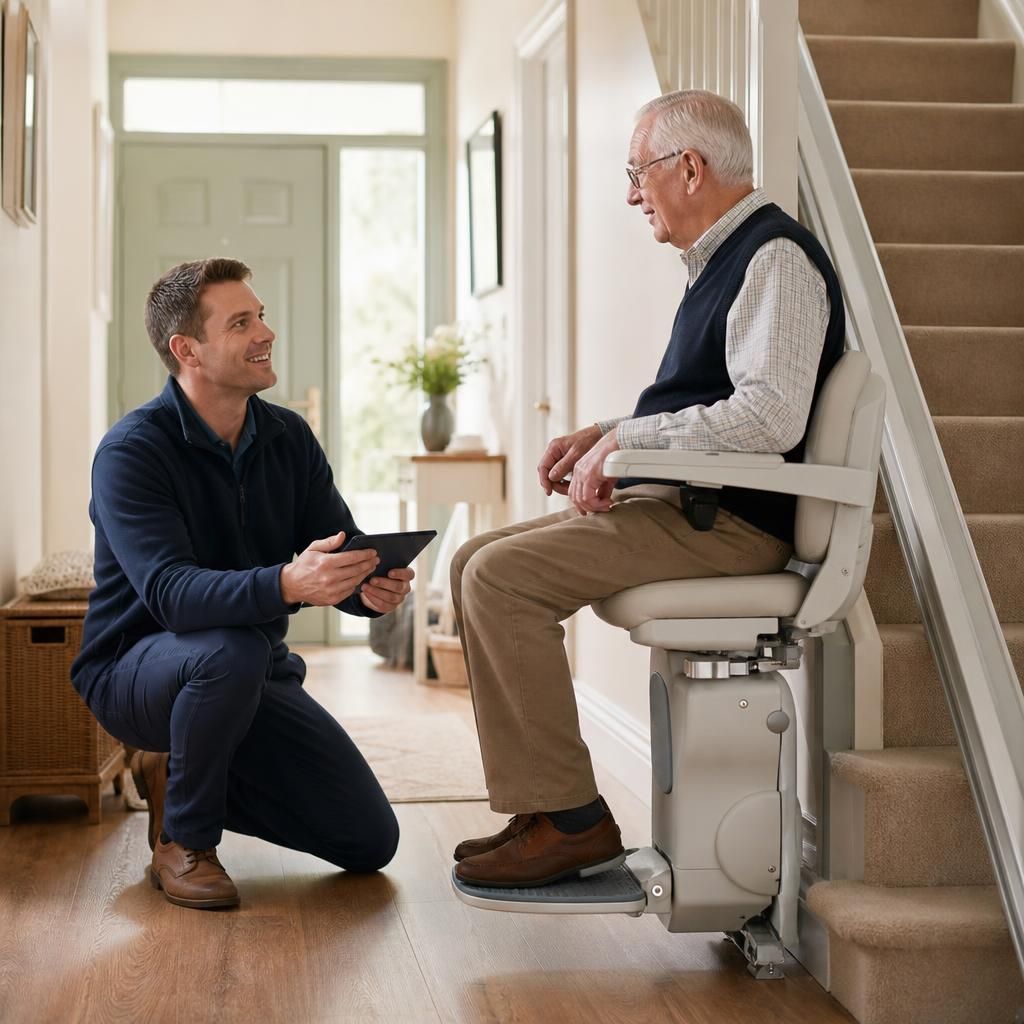
Discuss your refurbished or reconditioned stairlift options
Discuss your refurbished or reconditioned stairlift options with our team, including expected longevity, available parts, warranty cover and potential transfer value. We can help assess your staircase and recommend a suitable solution for your needs.