
How does the quality assurance process differ between refurbished and reconditioned stairlifts, and what impact does this have on their durability?
Refurbished stairlifts typically receive cleaning, inspection and basic remedial work, while reconditioned stairlifts undergo a more comprehensive programme of testing, servicing and replacement of worn components. As a result, a properly reconditioned lift will generally offer more consistent reliability and durability, although the quality of the inspection, parts used, installation and ongoing maintenance remains important.
Refurbished and reconditioned stairlifts can differ significantly in the extent of their quality assurance. A refurbished stairlift is usually cleaned, visually inspected and given basic remedial work, whereas a reconditioned stairlift should undergo a more comprehensive inspection, service, safety test and replacement of worn or unsuitable components. This additional work generally makes a properly reconditioned lift more reliable and durable, although the terminology is not formally standardised and the quality of the supplier’s process remains the deciding factor.
What quality assurance usually involves
Quality assurance is the process used to establish that a stairlift is safe, functional and suitable for installation before it is supplied. It should cover the lift itself, its electrical and mechanical systems, the condition of the rail, the batteries, the charging equipment and any controls. It should also include checks after installation, because a stairlift may perform differently once fitted to a particular staircase.
With a refurbished stairlift, the work may be limited to:
- Cleaning the seat, armrests, footrest, covers and rail.
- Checking for visible damage, corrosion or excessive wear.
- Testing basic operation and the main controls.
- Replacing parts that have clearly failed or are visibly damaged.
- Carrying out minor cosmetic repairs or adjustments.
This can produce a safe and usable stairlift, particularly where the underlying equipment is relatively new and has been well maintained. However, a basic refurbishment may not identify every component that is approaching the end of its serviceable life. A part can operate during a short inspection but still have limited remaining durability.
A reconditioning programme should be more methodical. The stairlift is assessed against its operating requirements, and key systems are serviced rather than simply checked for immediate failure. Depending on the model and its condition, this may include:
- Detailed inspection of the drive system, motor, gearbox, rollers and charging contacts.
- Testing of the seat swivel, locking mechanism, armrests, footrest and safety sensors.
- Inspection of the rail, fixings and moving parts for wear, looseness or damage.
- Testing the batteries, charger and electrical connections.
- Replacement of worn, degraded or unreliable components rather than retaining them until they fail.
- Adjustment, lubrication and servicing in line with the manufacturer’s instructions.
- Operational and safety testing before dispatch and after installation.
Not every component will necessarily be replaced during reconditioning. Replacing parts that are still within acceptable condition is not automatically better value or technically necessary. The important distinction is that the condition of each relevant component should be assessed and the decision documented, rather than relying only on cleaning and a short functional test.
How the difference affects durability
Durability depends on how long the stairlift can continue operating safely and consistently before it needs significant repair. A more thorough reconditioning process can improve durability by identifying wear before it becomes a breakdown, renewing consumable parts and correcting faults that could place additional strain on the drive system or electrical components.
For example, weak batteries may cause repeated charging problems and put extra demands on the charger. Worn rollers, poor alignment or damaged rail fixings can affect the smoothness of travel. A loose connection or deteriorating safety sensor may cause intermittent stopping. These issues may be missed by a superficial refurbishment but are more likely to be identified during a full service and test programme.
Refurbished equipment can still provide dependable service when it has been carefully selected, inspected and installed. Its durability is more variable because the term may cover anything from a basic clean-up to a substantial repair. The age of the stairlift, its previous usage, storage conditions and the availability of suitable replacement parts also influence how long it is likely to remain reliable.
Reconditioning does not make a stairlift new. Older equipment may still contain original parts that have experienced considerable use, and some models may no longer have comprehensive manufacturer support. Reconditioning improves the known condition of the lift at the time of sale; it cannot remove all uncertainty about its previous history or guarantee that a future component will not fail.
Why installation quality matters
Quality assurance continues when the stairlift is installed. The rail must be securely fixed to the staircase, the lift must travel correctly along its route and the charging points must work in their installed position. The installer should check clearances, access at the top and bottom of the stairs, seat operation, safety sensors and emergency controls. The customer should also receive an explanation of normal operation, charging and basic fault procedures.
A stairlift that has been thoroughly reconditioned can still suffer premature wear if it is poorly fitted, used on an unsuitable staircase or left with an alignment or charging issue. Conversely, a well-installed refurbished lift may perform satisfactorily if its condition was accurately assessed before installation. This is why the quality of the assessment and installation should be considered alongside the label applied to the lift.
How to assess the quality of the process
Because “refurbished” and “reconditioned” are used differently by different suppliers, ask what work was actually completed rather than relying on the description alone. Useful questions include:
- What components were inspected, serviced or replaced?
- Were the batteries tested under operating conditions, and are they included in the cover provided?
- Was the stairlift tested before removal, after preparation and following installation?
- Are service records or a written inspection checklist available?
- Are replacement parts genuine, compatible and suitable for the model?
- What warranty applies to parts, labour and batteries?
- What maintenance or servicing is recommended after installation?
A clear record of the work provides more useful assurance than the terminology alone. It should identify any replaced parts, outstanding limitations and the checks completed. A warranty can provide protection if a covered fault develops, but it is not proof that the lift has undergone a comprehensive reconditioning process. Check its exclusions, response arrangements and whether battery degradation or accidental damage is excluded.
Practical conclusion
For customers prioritising predictable performance and longer service between repairs, a reconditioned stairlift with documented testing and appropriate replacement of worn parts will generally be the stronger option. A refurbished stairlift may be suitable where its inspection has been thorough, its history is understood and its price reflects the remaining condition. In either case, durability is determined by the actual quality of the assessment, parts, installation and ongoing maintenance—not by the label alone.
The quality assurance record is often a better indication of a stairlift’s likely durability than the description “refurbished” or “reconditioned”. A refurbished lift may have been cleaned and function-tested, while a reconditioned lift should normally have received a more detailed inspection, servicing and replacement of worn components.
Before installation, ask which parts were checked or replaced, whether the batteries and charging system were tested, and whether the lift was safety-tested after fitting. These checks can identify issues such as worn rollers, weak batteries, loose connections or faulty safety sensors before they lead to unreliable operation. A well-documented process does not make an older stairlift equivalent to new equipment, but it gives you clearer evidence of its condition and can reduce the risk of avoidable repairs.
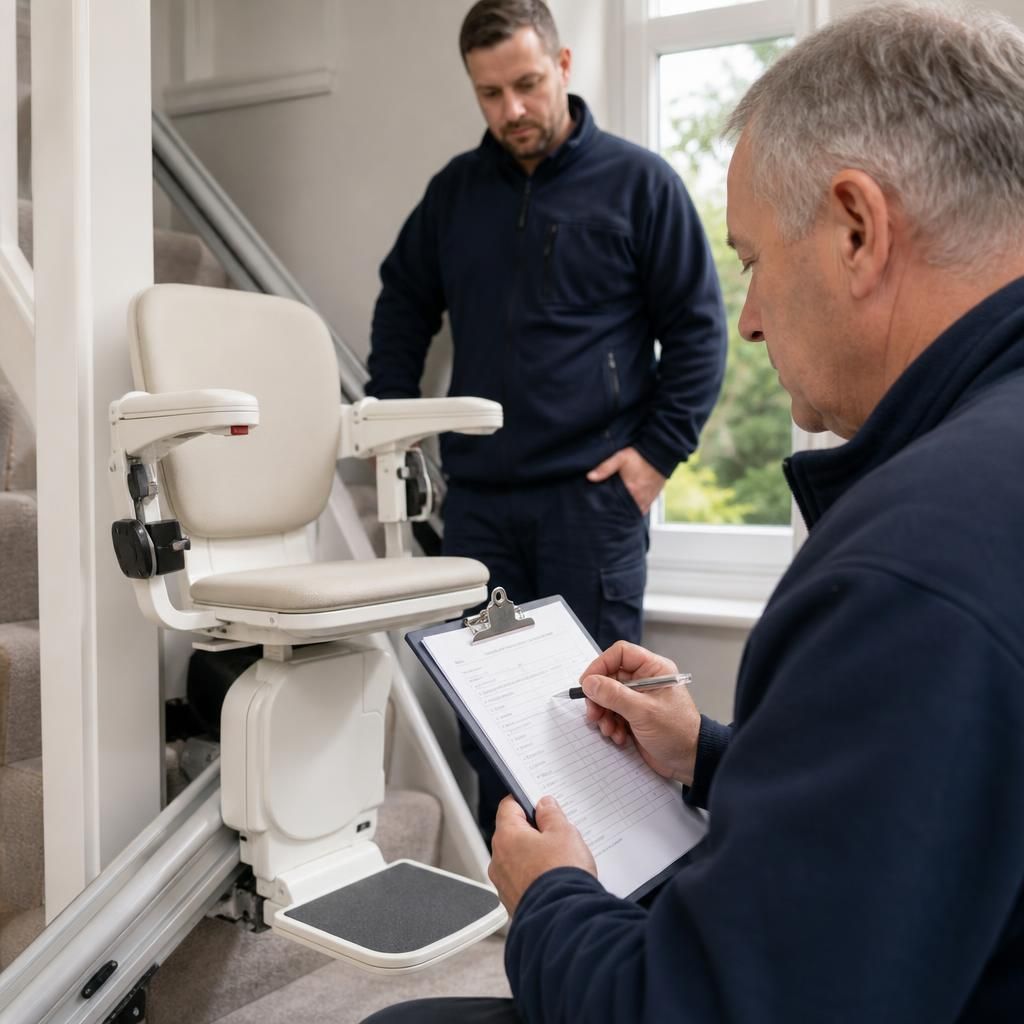
Ask us about refurbished and reconditioned stairlifts
Ask us to explain the inspection, servicing and warranty included with a refurbished or reconditioned stairlift before you decide. We can help assess which option is suitable for your staircase, mobility needs and expected use.