
What should I consider regarding maintenance and servicing of reconditioned stairlifts?
When maintaining a reconditioned stairlift, check the servicing schedule, warranty terms, availability of replacement parts and the installer’s process for safety inspections and repairs. Regular professional servicing, combined with keeping the track and seat mechanism clean and reporting unusual noises, movement or battery issues promptly, helps keep the stairlift safe and reliable.
Maintenance and servicing keep a reconditioned stairlift safe, dependable and suitable for daily use. The key points are to follow the manufacturer’s servicing recommendations, understand what the warranty covers, confirm that replacement parts remain available, and arrange inspections with a competent stairlift engineer. Reconditioned equipment should have been checked before installation, but it still contains used components that require routine monitoring and eventual replacement.
Check the servicing schedule
Your installation documents should state when the stairlift should be serviced and what checks are included. The correct interval depends on the model, its age, how frequently it is used, the weight it carries and whether it is installed indoors or outdoors. Many providers recommend servicing at least annually, but the manufacturer’s instructions and your installer’s advice should take priority.
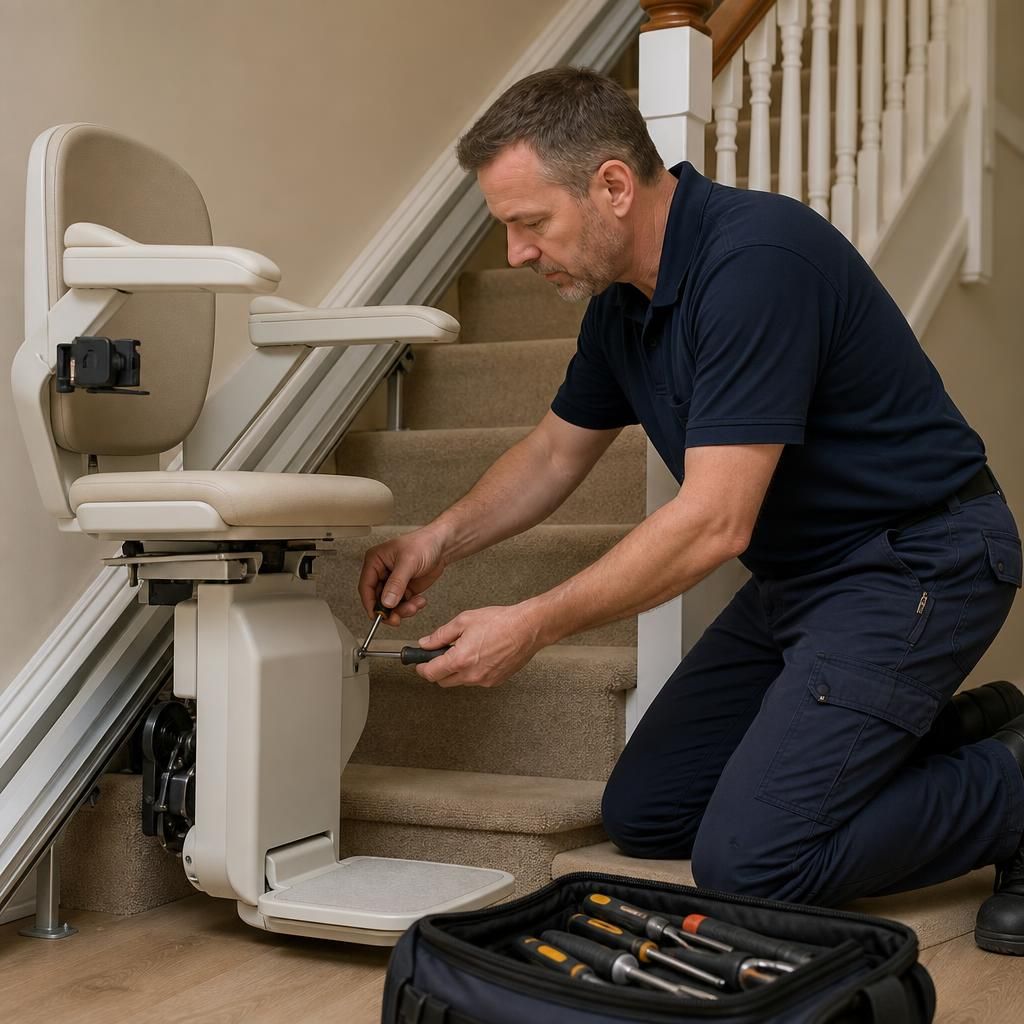
A service is more than a quick visual inspection. An engineer should assess the stairlift’s mechanical, electrical and safety systems, identify wear and explain whether any parts need attention. Keep a record of completed services, repairs and parts fitted. This helps establish the lift’s maintenance history and can be useful if you move home, transfer the stairlift or need to make a warranty claim.
Understand what a professional service includes
The precise checks vary between models, but a suitable service will normally include:
- Checking the seat, armrests, footrest, swivel mechanism and seat belt for damage or looseness.
- Testing the controls, remote controls, safety sensors, interlocks and emergency stop functions.
- Inspecting the rail, brackets, drive system, gears, rollers and other moving parts for wear, damage or obstruction.
- Checking the batteries, charger, charging points and electrical connections.
- Testing the stairlift’s stopping, starting and braking performance.
- Checking that the lift travels smoothly and that it stops correctly at the top and bottom of the stairs.
- Cleaning and lubricating components where the manufacturer permits it.
- Confirming that fixings and installation points remain secure.
Servicing should be carried out by an engineer who is trained to work on that model or system. Do not remove covers, adjust the drive mechanism or alter safety components yourself. Incorrect adjustments can create a hazard and may invalidate warranty protection.
Pay particular attention to the batteries
Battery condition is one of the most common causes of problems with stairlifts. A stairlift can usually continue to operate when connected to its charging point, even when its batteries are beginning to deteriorate. Signs of battery trouble include slower travel, reduced operating time, a lift that stops away from its charging position, repeated low-battery warnings or a charger that does not appear to work.
Leave the stairlift parked on its designated charging point when it is not in use, unless your model’s instructions say otherwise. Keep charging contacts clean and do not obstruct the charger or power supply. If the lift repeatedly reports a fault, do not keep resetting it or rely on it as a permanent solution. Contact us or your servicing provider so the batteries, charger and electrical system can be tested properly.
Batteries are consumable components and may need replacement during the life of a reconditioned stairlift. An engineer should confirm the correct specification rather than fitting an unsuitable battery. In some cases, batteries are replaced as a set to maintain balanced performance.
Keep the rail and surrounding area clear
Dust, pet hair, loose carpet fibres and objects left on the stairs can affect the rail, sensors or footrest. Wipe accessible surfaces with a soft, dry or slightly damp cloth, following the manufacturer’s cleaning instructions. Do not pour liquid onto the stairlift, use abrasive products or apply oil and grease unless the manufacturer specifically permits it. Some modern stairlift rails use materials or drive systems that do not need user-applied lubrication.
Keep the stairway clear of furniture, bags, toys and trailing cables. Check that curtains, clothing and other items cannot catch on the moving parts. Outdoor stairlifts also need protection from excessive moisture, debris and harsh weather, with their covers and charging equipment kept in good condition.
Know which symptoms require attention
Report unusual behaviour promptly rather than waiting for the next scheduled service. Contact a qualified engineer if you notice:
- Jerky, hesitant or unusually noisy movement.
- Unexpected stopping, repeated fault tones or warning lights.
- The seat, footrest or swivel mechanism becoming loose or difficult to operate.
- A seat belt, armrest or safety sensor that does not work correctly.
- Damage to the rail, brackets, wiring or casing.
- A burning smell, overheating, sparking or signs of water ingress.
- Reduced battery performance or failure to charge.
If the stairlift behaves unsafely, stop using it, keep the stairs clear and seek advice. Do not attempt to carry a passenger up or down the stairs while the lift is being repaired unless a suitable alternative has been arranged. In the event of smoke, burning or an electrical fault, switch off the power only if it is safe to do so and obtain professional assistance.
Check the warranty and service arrangements
Warranty terms for reconditioned stairlifts can differ from those for new equipment and may vary according to the provider, model and component. Before accepting installation, check the warranty period, whether it covers parts, labour and call-outs, and whether batteries or accidental damage are excluded. Confirm whether the warranty is transferable if the stairlift is moved or the property is sold.
It is also worth checking what happens after the warranty ends. Ask whether the original installer provides repairs, whether there is a service plan, how emergency call-outs are handled and whether engineers can obtain parts for the specific model. A lower initial purchase price is less useful if essential components are difficult to source or the servicing arrangements are unclear.
Consider the age and availability of components
A reconditioned stairlift should be assessed as a complete system, not just by the appearance of its seat or rail. The engineer should be able to explain the condition of key parts, including the batteries, drive unit, control systems, sensors and charging equipment. Older or discontinued models may still be reliable, but access to compatible batteries, circuit boards, remotes and mechanical parts should be considered.
Where a part is no longer available, a competent provider should explain the alternatives and any limitations before work is undertaken. Do not accept a repair that bypasses a safety feature or uses an incompatible component simply to return the lift to service.
Use the stairlift correctly between services
Follow the operating instructions, observe the stated user weight limit and use the seat belt where fitted. Avoid carrying items that can fall onto the stairs or interfere with controls. Do not allow children to play with the lift or remote controls. If the stairlift has been unused for a prolonged period, check its charging status and arrange advice if it does not start or operate normally.
Routine user checks do not replace professional servicing. They are intended to identify obvious problems early so that an engineer can investigate them before they affect safe operation.
For an existing reconditioned stairlift, the most useful next step is to review the installation paperwork and confirm the next recommended service date. If the paperwork is missing, the model is uncertain or the lift has developed a fault, provide the installer with the stairlift’s details and describe the symptoms. This allows the correct parts, tools and technical information to be considered before a visit.
Regular professional servicing is essential for a reconditioned stairlift because its batteries, drive system, sensors and other components have already been used. A trained engineer should inspect the complete lift, test its safety systems and identify wear before it develops into a failure.
Between services, keep the stairlift parked on its charging point when not in use and report slow movement, unusual noises, repeated warning tones, charging problems or unexpected stopping. Do not adjust the drive mechanism or safety controls yourself; incorrect repairs can create a hazard and may affect warranty cover.
Arrange your reconditioned stairlift service
If your reconditioned stairlift is due a service or showing signs of a fault, contact us to arrange an assessment by a qualified engineer and confirm the correct parts and support for your model.