
What refurbishment standards do you maintain for reconditioned stairlifts?
Our reconditioned stairlifts are inspected, cleaned, safety-tested and assessed for reliable operation before installation, with worn or unsuitable components replaced where necessary. Each lift is then professionally installed and checked in your home, with servicing guidance and warranty support provided.
Our refurbishment standard is based on a complete inspection, cleaning, safety check and operational assessment before a reconditioned stairlift is offered for installation. We replace or repair worn, damaged or unsuitable components where required, then test the lift again after installation in your home. A unit is not treated as ready for reuse simply because it powers up and moves along the rail.
Initial inspection and suitability assessment
We begin by checking the stairlift’s overall condition and identifying its model, configuration and previous use where this information is available. We assess the rail, carriage, seat, armrests, footrest, controls, sensors, charging equipment and batteries. We also consider whether the unit is suitable for your staircase, user requirements and intended installation position. A lift that cannot provide an appropriate fit, safe access or reliable operation is not selected merely because it is available.
Mechanical and electrical checks
The main mechanical and electrical systems are examined for signs of wear, impact damage, corrosion, contamination or deterioration. Particular attention is given to:
- the drive system, gearbox and movement along the rail;
- the rail, brackets and fixing points;
- seat swivelling, folding and locking mechanisms;
- armrests, footrest and safety sensors;
- joystick, remote controls and other user controls;
- charging points, wiring, connections and battery condition; and
- braking and other systems designed to stop or control the lift safely.
Components are cleaned, adjusted, repaired or replaced when their condition could affect safety, reliability or day-to-day use. Batteries and other consumable parts are assessed rather than assumed to be serviceable. Some visible marks or cosmetic signs of previous use may remain, but they should not be confused with faults that affect the lift’s function.
Cleaning and preparation
The stairlift is cleaned and prepared before installation. This includes the areas that are handled regularly, such as the seat, armrests, controls and footrest, as well as accessible parts of the rail and carriage. Cleaning also gives our installers an opportunity to identify damage, loose components or contamination that may not be obvious during a brief visual inspection.
Testing before installation
We operate the lift through its available functions and check that it starts, travels, stops and charges correctly. Safety features and controls are tested, including relevant sensors, switches, seat functions and remote controls. Any issue identified during this process is investigated before the stairlift is approved for installation. Where a fault cannot be resolved appropriately, the unit should not be supplied as a suitable reconditioned option.
Professional installation and checks in your home
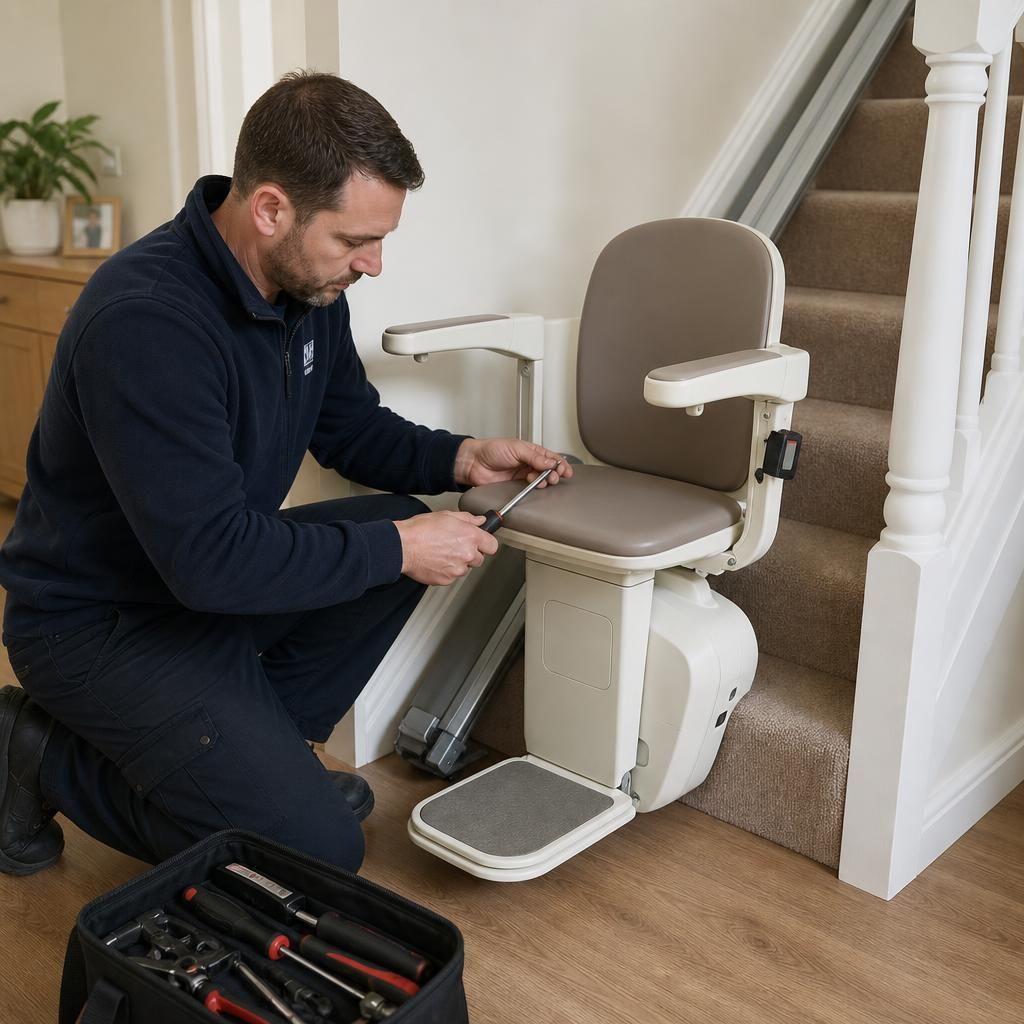
Refurbishment is only part of the standard. The installation must also be completed correctly for the individual staircase. Our installer checks the rail position, fixings, clearances, charging arrangements and access to the controls. The lift is then run on the actual staircase to confirm smooth travel, safe stopping and correct operation at the top and bottom. The installer also checks that the seat, footrest and controls are practical for the user, rather than relying solely on workshop testing.
If the staircase or the user’s needs differ from the original assessment, we address this before completing the installation. This is particularly important where there are narrow sections, unusual landings, doors, changes in floor level or a need for a powered swivel seat or other accessory.
Handover, records and aftercare
At handover, we explain the controls, charging routine, safety features and basic care requirements. We also provide information about warranty cover and how to report a fault or arrange servicing. Keeping the stairlift clean, charging it as instructed and reporting unusual noises, movement, error messages or reduced battery performance can help identify developing issues promptly.
Reconditioned equipment can have a different cosmetic history from a new stairlift, and the exact warranty and replacement-part arrangements depend on the unit supplied. The important standard is that its condition, safety and suitability are assessed transparently before you agree to the installation. If you would like clarification about a particular lift, ask us what work has been carried out, which parts have been replaced, what testing was completed and what support is included after installation.
Our refurbishment standard means a reconditioned stairlift must be inspected, tested and shown to be suitable before it is installed. We do not treat a lift as ready for reuse simply because it powers up and travels along the rail.
We check the drive system, rail, seat, footrest, controls, safety sensors, charging equipment and batteries for wear or damage. Parts are cleaned, adjusted, repaired or replaced where their condition could affect safe, reliable use. After installation, the lift is operated on your staircase to confirm smooth travel, safe stopping, correct clearances and practical access for the user. Any cosmetic marks from previous use are distinguished from faults that could affect performance.
Discuss Your Reconditioned Stairlift Options
Discuss your reconditioned stairlift options with our team to review your staircase, mobility needs and the refurbishment work included. We can explain the available warranty and aftercare before you decide.