
What factors should I consider when choosing a reconditioned stairlift provider?
When choosing a reconditioned stairlift provider, check the unit’s refurbishment and safety-testing process, the warranty offered, the installer’s experience, and the availability of servicing and repairs. A reliable provider should also carry out a proper assessment of your staircase, explain the total cost clearly, and recommend a suitable lift rather than simply supplying the cheapest available model.
The most important factors are the quality of the refurbishment, the safety checks completed, the suitability of the stairlift for your staircase, and the support provided after installation. A reconditioned stairlift should not simply be a previously used unit that has been cleaned and resold. The provider should inspect, test and service the lift, replace worn or unreliable components where necessary, and install it following a proper assessment of your home and mobility needs.
Start with the provider’s refurbishment process. Ask what happens to a stairlift before it is offered for sale. A thorough process should include a visual inspection, cleaning, electrical and mechanical testing, examination of the carriage, motor, batteries, controls, sensors, seat, armrests and safety systems. The provider should be able to explain which parts are routinely replaced and how faults are identified. Parts that appear acceptable externally may still be affected by wear, so a simple demonstration or cosmetic clean is not enough to establish condition.
It is also sensible to ask whether the provider can identify the make, model and age of the unit, and whether replacement parts and technical support remain available. Some older models may continue to operate well, but their long-term practicality can be affected if parts are difficult to source or the manufacturer no longer supports them. A reputable provider should explain any limitations rather than presenting every available lift as equally suitable.
Check how safety is assessed. The stairlift should be tested before installation and again as part of the installation and handover process. Important safety features include the seat belt, swivel or locking seat mechanism, obstruction sensors, braking system, controls, battery charging and the movement of the carriage along the rail. For a powered or folding model, the footrest, hinges and associated safety switches also need checking.
Ask whether the equipment and installation are assessed against the relevant current requirements for stairlifts, and whether the installer follows the manufacturer’s instructions. You should receive clear operating guidance and know what to do if the lift stops, displays a fault or needs to be isolated. Do not rely solely on the fact that a unit was previously installed in another home; its condition and suitability must be assessed in its new location.
Make sure the assessment covers your staircase and your routine. A proper survey should consider the staircase layout, available landing space, bends, narrow sections, doorways, radiators and any obstruction at the top or bottom. On a curved staircase, the rail is normally made to suit the individual route, so the provider should explain whether a reconditioned carriage, a new rail or a combination of existing and new components is appropriate.
The assessment should also consider how you will use the lift. Relevant points include your height, weight, sitting and standing ability, balance, preferred side of access, whether another person uses the stairs, and whether the lift needs to park in a particular position. Features such as a powered swivel seat, hinged rail, powered footrest or alternative controls may affect both suitability and cost. A responsible recommendation is based on safe use in your home, not simply on which model is currently in stock.
Read the warranty in full. Reconditioned stairlift warranties vary, so ask exactly what is covered and for how long. Check whether the warranty includes parts, labour, call-outs, batteries and the motor, and whether there are exclusions for accidental damage, misuse or issues caused by the electrical supply. Find out whether cover begins on installation, whether it can be extended, and what happens if a fault cannot be repaired promptly.
Also check whether the warranty applies to the whole installation or only to the stairlift components. A rail, charging point, remote control or powered accessory may have different terms. The warranty should be provided in writing, with a clear process for reporting faults and a telephone number or service route to use when support is needed.
Consider the installer’s experience and aftercare. Installation quality affects reliability and safety just as much as the condition of the lift. Ask whether the installation team is trained for the type of stairlift being supplied and whether the provider carries appropriate insurance. The installer should secure the rail correctly, check clearances, test the lift under operating conditions and leave the area safe and tidy.
After installation, you should receive instruction on charging, controls, safe seating, emergency stopping and basic fault indications. Ask what servicing is recommended and whether the provider can carry out repairs if the stairlift develops a problem. A low purchase price is less useful if routine servicing, parts or engineer visits are difficult to arrange. For an existing customer, it is worth confirming who will support the lift if your circumstances change or if the original installer is no longer available.
Compare the complete cost, not just the advertised price. Request a written quotation that separates the stairlift, survey, installation, adaptations, delivery, VAT where applicable, warranty and any optional features. For curved stairs, confirm whether the price includes the bespoke rail and whether removal of an existing lift is included. Ask about ongoing servicing, battery replacement and call-out charges before making a decision.
A reconditioned stairlift can offer good value, but the cheapest quotation may not provide the most appropriate equipment or the strongest aftercare. Compare like for like: the condition and age of the unit, the included safety work, the warranty, installation arrangements and future support. Be cautious if you are pressured to decide immediately, if the provider cannot explain what has been tested, or if important terms are only given verbally.
Finally, check the provider’s documentation and complaints process. You should receive a written quotation, warranty terms, operating instructions and details of the installed equipment. The provider should answer questions directly and record any agreed adaptations or requirements. Taking these steps helps you choose a reconditioned stairlift that is suitable for your staircase, properly checked and supported throughout its working life, rather than selecting a unit on price or appearance alone.
A reliable reconditioned stairlift provider should be able to explain, and document, how each unit is inspected, serviced and safety-tested before installation. Reconditioning should involve more than cleaning the lift or confirming that it runs. The provider should assess the carriage, motor, batteries, controls, seat, sensors, braking system and charging equipment, replacing worn or unreliable parts where necessary.
Ask which components have been checked or replaced, whether the make and model are still supported, and what testing is completed after installation in your home. The provider should also give you written warranty terms, operating instructions and a clear process for reporting faults. This information helps you judge the lift’s condition and future support rather than choosing solely on its appearance or advertised price.
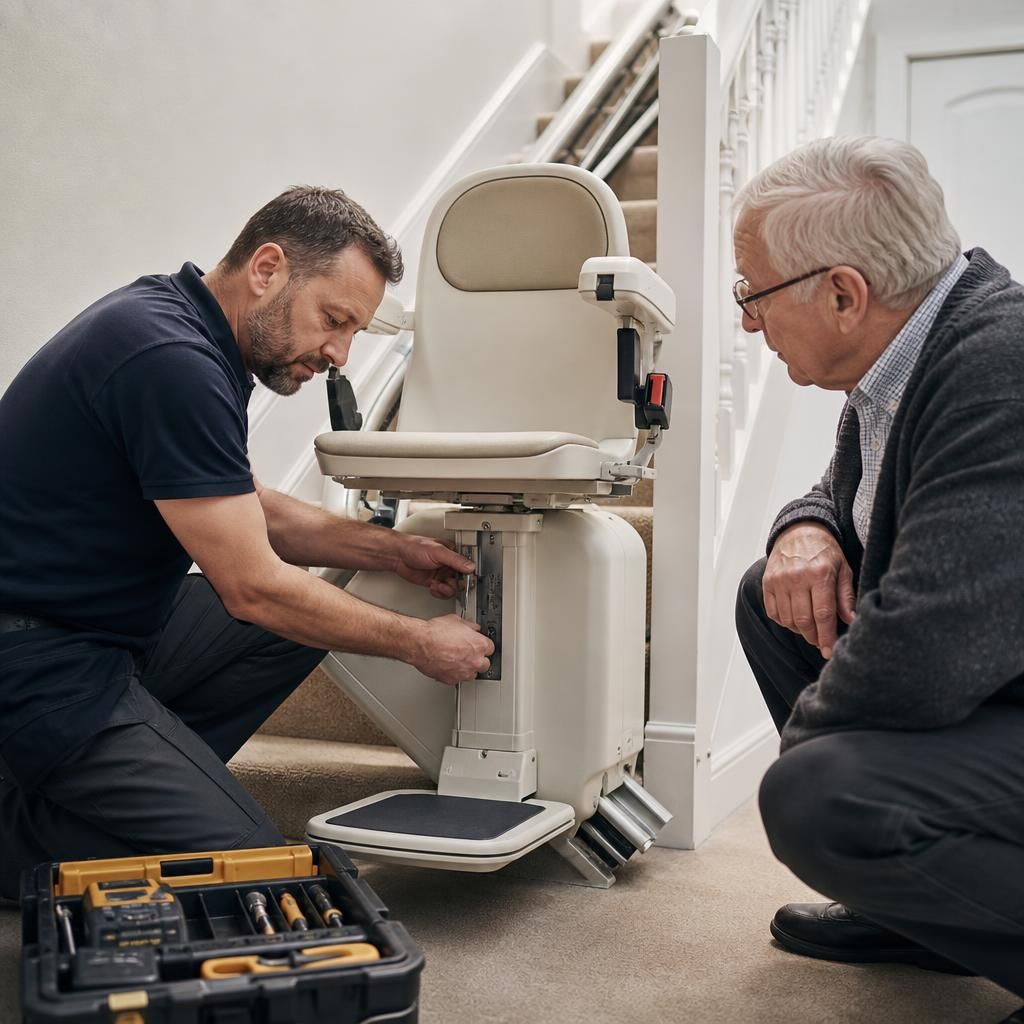
Get expert advice on choosing your reconditioned stairlift
Contact Independent Stairlifts for tailored advice on choosing a reconditioned stairlift, including its condition, suitability, warranty and installation requirements. We can assess your staircase and explain the available options and total costs clearly.