
Can reconditioned stairlifts be installed on curved stairs?
Yes, a reconditioned stairlift can be installed on curved stairs, provided the lift and rail system are suitable for the staircase and the user’s needs. Curved rails are normally made to measure, so a reconditioned unit may use refurbished components alongside a newly manufactured or adapted rail following a professional assessment.
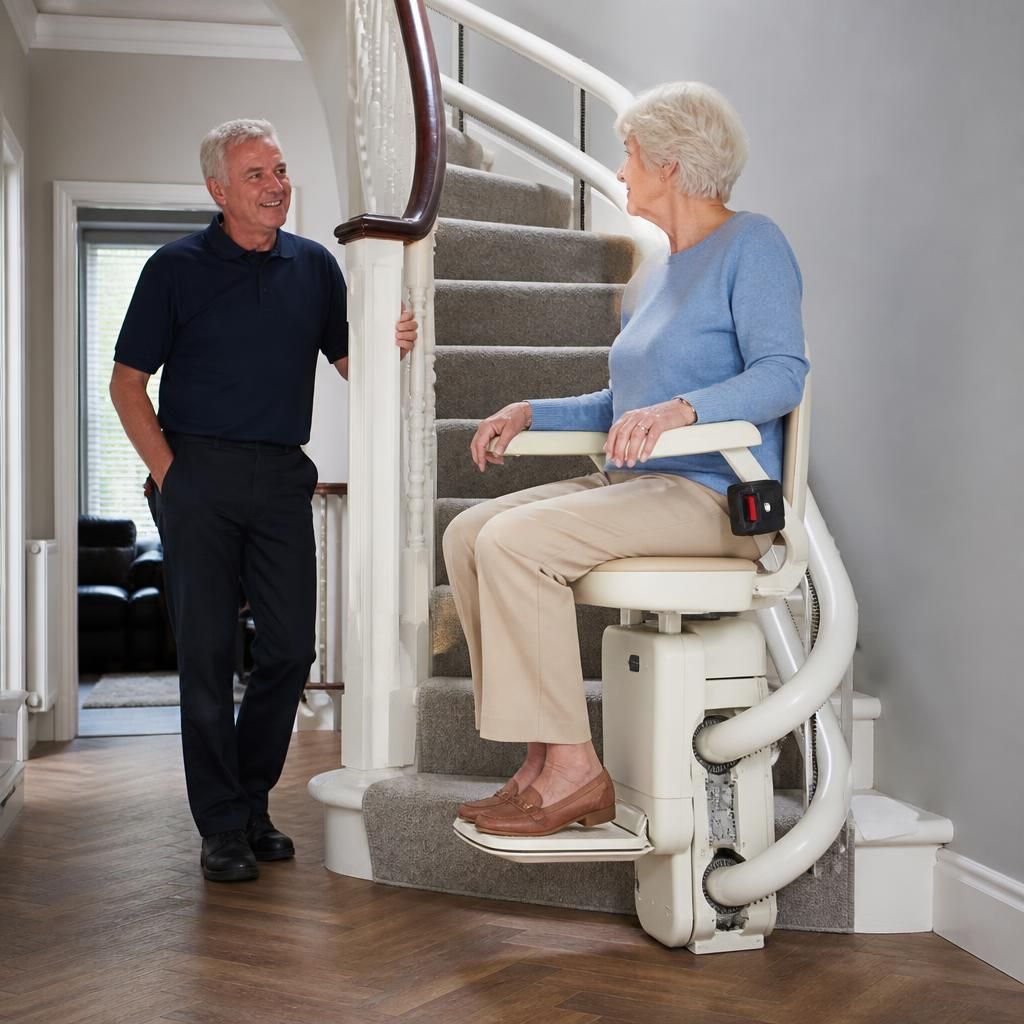
Yes. A reconditioned stairlift can be installed on a curved staircase, but the installation usually involves more than fitting a previously used lift to an existing rail. Curved stairlifts are designed around the individual staircase, so the rail may need to be newly manufactured or specifically adapted, while suitable reconditioned components such as the carriage, seat, batteries and controls are inspected and prepared for reuse.
Why curved installations are different
Unlike a straight stairlift, a curved model follows bends, landings, changes in gradient and sometimes several flights of stairs. Its rail must be accurately measured and manufactured to match the staircase. A rail from another property will rarely be a direct fit, even if the staircases appear similar. Small differences in width, pitch, curves, ceiling height and the position of doors or radiators can affect the design.
For this reason, a reconditioned curved stairlift is often a combination of refurbished equipment and a rail made or adapted for the current property. Reusing a suitable existing rail may be possible in limited circumstances, but this can only be confirmed after a detailed survey and technical assessment.
Which parts may be reconditioned?
The reusable parts depend on the model, its age, condition and compatibility with the proposed rail. They may include the seat, carriage, armrests, footrest, controls, charging equipment and batteries. Each component should be checked, cleaned, tested and replaced where necessary before installation. Parts that do not meet the required condition should not be used simply to reduce the purchase price.
The rail itself requires particular attention. A curved rail must be structurally sound, correctly aligned and suitable for the layout of the staircase. If an existing rail cannot be safely reused or altered, a new rail may be required. This does not mean the whole stairlift has to be new; it means that the part most closely tied to the shape of the staircase may need to be manufactured for that installation.
What is assessed before installation?
A proper assessment should consider both the staircase and the person using the stairlift. The surveyor will normally look at:
- the number and direction of the bends, turns and landings;
- the width of the stairs and available clearance;
- the position of doors, hallways, radiators and other obstructions;
- where the lift can start and finish safely;
- whether the user can transfer on and off the seat securely;
- the user’s height, weight, mobility and ability to operate the controls;
- whether a standard, swivel, perch or powered seat would be more appropriate; and
- the availability of suitable charging points and the condition of the electrical supply.
The assessment should also consider how the stairlift will be used by other people in the household. A design may need to leave sufficient walking space when parked, avoid obstructing a doorway or fold away neatly at the top or bottom of the stairs.
Can a reconditioned curved stairlift be as suitable as a new one?
It can be, provided the equipment is appropriate, professionally reconditioned and correctly installed. The key issue is not simply whether the lift has been used before. It is whether the complete installation is compatible with the staircase, reliable in operation and suitable for the user. A newer model that is unsuitable for the user or property is not necessarily a better choice than a properly assessed reconditioned model.
However, reconditioned availability is usually more limited than new equipment. The exact seat configuration, controls, weight capacity, rail design and replacement parts may not be available in every model. If the staircase is particularly complex or the user requires specialist features, a new curved stairlift may provide more choice.
What can affect the price?
The cost of a reconditioned curved stairlift is influenced by the complexity of the rail, the number of bends, the condition and availability of compatible components, the need for a new or adapted rail, installation requirements and any additional features. A curved stairlift is individually designed, so it should not be priced on the assumption that a used straight stairlift can simply be transferred to the property.
When comparing quotations, check whether the price includes the survey, rail, installation, removal of any existing equipment, testing, user instruction and warranty cover. It is also sensible to ask which parts are reconditioned and which are newly manufactured, rather than treating the equipment as either entirely new or entirely used.
Safety and aftercare
The stairlift should be installed by a suitably trained professional in accordance with the manufacturer’s instructions and applicable UK requirements. Installation includes securing and aligning the rail, checking travel and stopping positions, testing the safety systems and confirming that the lift charges correctly. The installer should demonstrate the controls and explain safe use, including how to park the lift and what to do if it stops away from a charging point.
Ask for clear information about the warranty, battery replacement, servicing and fault support before agreeing to the installation. Reconditioned equipment may have different warranty terms from new equipment, and some components may be covered separately. Regular servicing can help identify wear, battery deterioration or changes in the staircase environment before they affect reliable use.
The most practical next step
A free assessment is the reliable way to establish whether a reconditioned curved stairlift is suitable. The survey should confirm the rail design, the condition and compatibility of available equipment, the seating and control options, the installation requirements and the total cost. This approach avoids relying on photographs or assumptions about whether a stairlift from another property will fit.
In summary, reconditioned equipment can be a practical option for curved stairs, but the rail and the user’s requirements must be treated as part of one complete installation. A professional assessment will determine which components can be reused, whether a new curved rail is needed and whether the proposed stairlift provides safe, comfortable and dependable access throughout the home.
Reconditioned stairlifts can be installed on curved stairs, but the curved rail usually has to be made or adapted specifically for the staircase. Unlike a straight rail, it cannot normally be transferred from another property simply because the layout looks similar.
A professional survey checks the bends, landings, stair width, clearances and safe parking positions. Suitable reconditioned parts, such as the seat, carriage, controls and charging equipment, may then be matched with a new or adapted rail. Every component should be inspected and tested before installation, and any part that is not compatible or in suitable condition should be replaced.
This approach can provide a practical alternative to a completely new stairlift, while ensuring the finished installation suits both the staircase and the person using it. Your assessment should confirm which parts are reconditioned, whether the rail is new, what warranty is included and how servicing will be handled.
Book Your Free Reconditioned Curved Stairlift Assessment
Arrange your free assessment to confirm whether a reconditioned stairlift, suitable rail and seating configuration can be safely fitted to your curved staircase.