
What specific refurbishment processes are involved in ensuring a reconditioned stairlift meets high safety and performance standards?
A reconditioned stairlift is stripped down and inspected, with worn or faulty components replaced before the unit is cleaned, reassembled and function-tested. At installation, the lift, track, controls, charging system and safety features are checked on the customer’s staircase to confirm safe, reliable performance.
A reconditioned stairlift is prepared through a controlled inspection, repair, cleaning, reassembly and testing process before it is offered for installation. The aim is to confirm that the lift is mechanically sound, electrically safe and suitable for the intended staircase—not simply to make a previously used unit look presentable.
Initial assessment and identification
Each stairlift is assessed before refurbishment begins. The engineer records the model, configuration and condition of the main components, then considers whether the unit is suitable for another installation. This includes checking its previous service history where available and identifying any signs of impact, water damage, corrosion, overheating or unauthorised modification. Components that cannot be verified or that fall outside acceptable condition are not relied upon without further inspection or replacement.
Strip-down and detailed inspection
The lift is dismantled sufficiently to inspect parts that cannot be assessed reliably from the outside. The carriage, drive mechanism, motor, gearbox, electrical connections, batteries, sensors, controls, seat assembly and safety equipment are checked for wear, damage and correct operation. The rail is also inspected for distortion, damaged fixings, contamination and other issues that could affect smooth travel.
Particular attention is paid to parts that affect safe movement or stopping. Engineers look for excessive play, unusual resistance, worn drive components, loose connections and deterioration in cables or insulation. On a curved stairlift, the inspection also covers the bends, joints and any carriage-to-rail interaction specific to the customised track. Outdoor equipment requires additional checks for weather-related deterioration and corrosion.
Replacement of worn or faulty components
Parts are repaired or replaced where testing shows that they are worn, damaged or unsuitable for continued service. This may include batteries, switches, sensors, rollers, drive components, wiring, arm controls, safety edges, footrest parts or seat mechanisms, depending on the lift’s condition and design. Replacement is based on the manufacturer’s requirements, the engineer’s findings and the demands of the proposed installation; a reconditioned lift is not made safe merely by changing one visible component.
Safety-critical items receive particular scrutiny. The seat belt, swivel-lock mechanism, obstruction sensors, overspeed or braking arrangements, limit switches and controls must operate as intended. If a part cannot be tested satisfactorily, it should not be treated as serviceable until the issue has been resolved.
Cleaning and reassembly
After inspection and repair, the lift is cleaned to remove dust, grease and debris from the carriage, rail and accessible mechanisms. This is both a presentation and maintenance measure: contamination can interfere with sensors, controls and moving parts. The unit is then reassembled correctly, with fasteners, covers, connectors and protective components checked as they are refitted.
Lubrication is applied only where appropriate for the particular design. Excess lubricant can attract dirt or affect electrical and braking components, so servicing should follow the equipment’s technical requirements rather than a general-purpose approach.
Electrical and battery checks
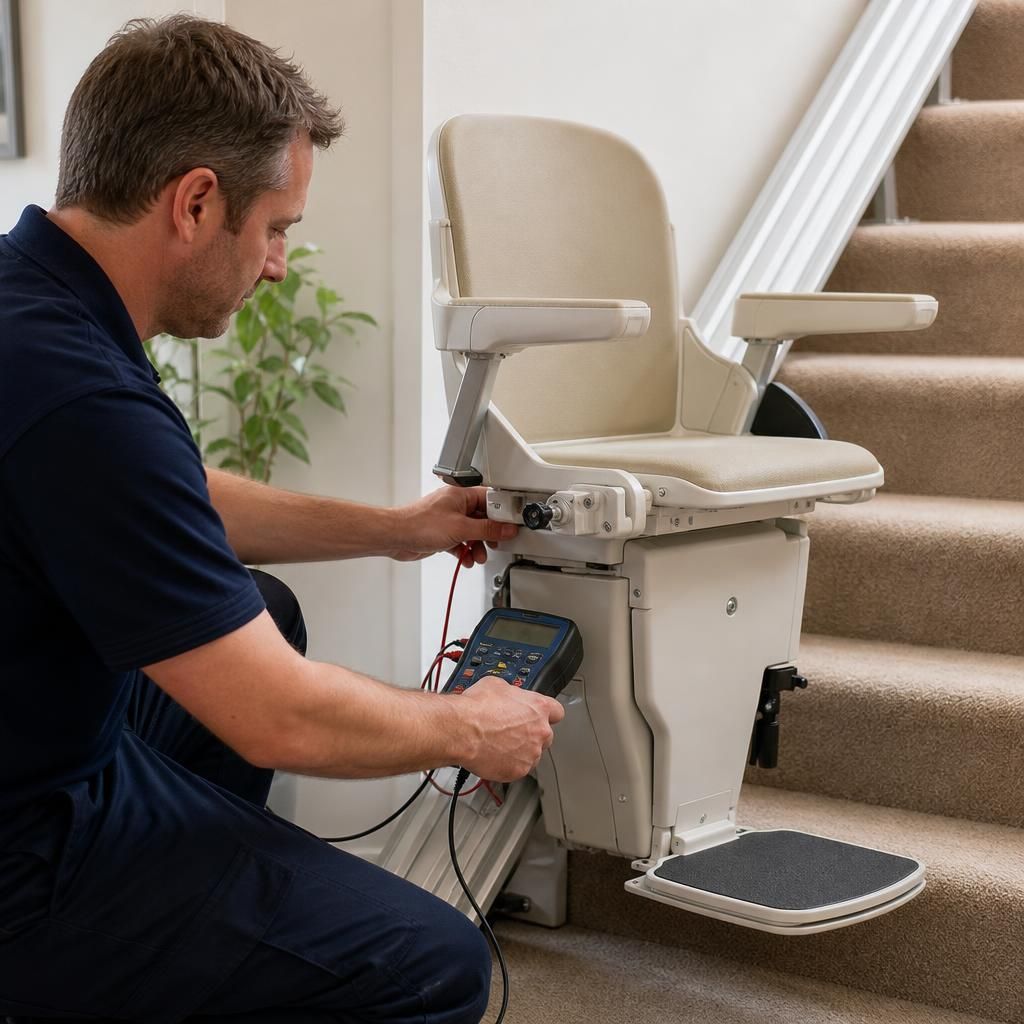
The charging system, batteries, wiring, connectors and control circuits are tested. Engineers check that the lift charges correctly when parked, responds to its controls and does not show faults or abnormal electrical behaviour. Batteries are consumable components, so their ability to hold charge and provide dependable operation is considered rather than assuming that a battery is suitable because it still powers the lift briefly.
Remote controls, call/send switches and onboard controls are checked for reliable response. Where the system includes diagnostic indicators or fault codes, these are reviewed and cleared only after the underlying cause has been addressed.
Functional and safety testing
The refurbished stairlift is run through its operating functions before installation. Testing normally includes:
- starting, stopping and travelling in both directions;
- smooth movement along the rail, including bends where applicable;
- controlled stopping at the top and bottom of the staircase;
- operation of the seat swivel and locking mechanism;
- use of the seat belt, arm controls and footrest;
- response to obstruction sensors and other safety edges;
- charging and parking behaviour; and
- operation of the remote controls and any relevant warning indicators.
These checks are intended to identify faults under normal operating conditions and to confirm that the safety features interrupt or prevent movement when they should. A lift that travels successfully but has a defective sensor, belt or swivel lock has not passed a complete safety assessment.
Assessment of the customer’s staircase
Refurbishment of the equipment is only part of the process. Before installation, the staircase is assessed for its shape, width, landings, access points, power supply and fixing requirements. The installer confirms that the rail and carriage configuration are appropriate for the property. A rail from another staircase cannot automatically be transferred to a different one, particularly where the staircase is curved; it may need to be modified, replaced or matched with a suitable track.
For outdoor installations, the assessment also considers exposure to rain, frost, dirt and temperature changes. The equipment must be positioned and protected in a way that supports safe use and appropriate charging in its intended environment.
Installation and commissioning checks
Once installed, the stairlift is tested again in its actual location. The engineer checks that the rail is securely fixed, the carriage runs smoothly, the lift stops at the correct positions and the charging points are accessible and functioning. Clearances from steps, walls, doors and landings are considered, as are the user’s ability to sit, swivel, fasten the belt and leave the lift safely.
The engineer also checks the emergency stop, sensors, controls and remote operation after installation, because a lift can behave differently on its final rail and staircase than it did during workshop testing. Any installation-specific adjustments are completed before handover.
Handover and ongoing checks
At handover, the user should be shown how to operate the stairlift, use the safety belt, park and charge it, respond to an obstruction and use the emergency controls. Important limitations and routine care requirements should also be explained. Installation and test records provide a reference for future servicing, fault diagnosis and warranty support.
Reconditioning reduces the risk associated with buying an uninspected used stairlift, but it does not remove the need for servicing. Batteries and other wear items will eventually require attention, and unusual noises, jerky travel, reduced charging, intermittent controls or changes in stopping should be reported promptly. A professional inspection and correctly completed installation are essential to maintaining safe performance throughout the lift’s service life.
Safety testing is a central part of stairlift refurbishment, confirming that the reconditioned unit operates reliably and that its protective features respond correctly before installation. Engineers check travel, stopping, charging and controls, while paying particular attention to the seat belt, swivel lock, obstruction sensors, footrest and emergency stop.
The lift is then tested again on the customer’s staircase. This confirms that the rail is secure, clearances are suitable and the carriage stops correctly at the required positions. Any fault found during workshop or installation checks must be resolved before handover, so a stairlift is assessed for safe performance rather than simply cleaned and resold.
Arrange a professional assessment for a reconditioned stairlift
Arrange a professional assessment to confirm which reconditioned stairlift and installation approach are suitable for your staircase. Our team can check the layout, access requirements and equipment condition before recommending the next step.