
What refurbishing process do reconditioned stairlifts undergo to ensure quality and safety?
Reconditioned stairlifts are professionally inspected, cleaned, serviced and safety-tested before installation. Worn or faulty components are replaced, and the completed lift is checked on the customer’s staircase to confirm reliable operation and safe performance.
A reconditioned stairlift is not simply a used lift that has been cleaned and resold. It should pass through a controlled inspection, refurbishment, testing and installation process before it is offered for use. The aim is to confirm that the stairlift is mechanically sound, electrically safe, suitable for the intended staircase and reliable in normal day-to-day operation.
Initial assessment and identification
When a stairlift is removed from a previous installation, it is assessed before a decision is made about whether it is suitable for refurbishment. The lift, rail, carriage, seat and controls are checked for damage, excessive wear, corrosion, signs of misuse and compatibility with available replacement parts. Its model and components are recorded so that servicing and future support can be based on the correct technical information.
A straight stairlift may be considered for another suitable straight staircase, subject to the rail and installation requirements. A curved stairlift is assessed more specifically because its rail has been made for a particular staircase. It may be adapted, reconfigured or retained for a comparable layout, but it cannot automatically be treated as suitable for every curved staircase. Outdoor stairlifts also require additional checks for weather exposure, moisture, corrosion protection and the condition of outdoor-rated components.
Cleaning and visual inspection
The stairlift is thoroughly cleaned to remove dust, dirt and residue from the seat, armrests, footrest, rail and carriage. Cleaning also makes it easier for a technician to identify cracks, loose covers, damaged trim, corrosion or other defects that may not be obvious when the lift is dirty.
External surfaces are inspected for damage that could affect safe use. The seat must rotate, fold or swivel as designed, where those features are fitted. Armrests should move correctly and latch securely, while the footrest should be stable and free from damage that could create a trip or foot-placement risk. Belts, buckles and other restraint components are checked for condition and correct operation.
Upholstery and cosmetic parts may be replaced where they are worn or unsuitable. Cosmetic refurbishment is useful, but appearance alone does not determine whether a stairlift is safe. The important checks concern the lift’s structure, controls, electrical system, drive mechanism and safety devices.
Mechanical servicing and replacement of worn parts
The carriage, drive system, wheels, rollers, gears, bearings, brakes and other moving parts are inspected in accordance with the equipment manufacturer’s servicing procedures. The rail is checked for damage, distortion, secure joints and correct alignment. Any part that is worn, damaged or outside the manufacturer’s acceptable condition is repaired or replaced rather than left in service.
Replacement parts should be compatible with the particular stairlift model and appropriate for the intended installation. Depending on the assessment, this can include batteries, control switches, covers, sensors, belts, charging components, rollers or other drive and safety parts. Lubrication is carried out where required, using the correct method and materials; applying unsuitable products can attract dirt or affect the operation of some components.
For a curved lift, the rail and carriage interface receives particular attention. The carriage must travel smoothly through bends, transitions and parking positions without abnormal movement, hesitation or contact with the staircase or surrounding fixtures.
Electrical and battery checks
The charging system, wiring, connections, hand controls, remote controls and isolation arrangements are examined for damage or poor connections. Batteries are checked because they are essential to dependable operation, especially where the lift needs to run during a temporary power interruption. Batteries that do not hold an appropriate charge or have reached the end of their serviceable condition should be replaced.
The stairlift is tested on and off its charging points, where applicable, to confirm that it charges correctly and responds as intended. Electrical safety checks are completed using suitable test equipment and the results are considered alongside the manufacturer’s requirements. A lift should not be passed for installation if an electrical fault, damaged cable or unreliable control remains unresolved.
Safety-device testing
A reconditioned stairlift should be tested to confirm that its safety features work correctly, not merely that it can travel up and down the stairs. Depending on the model, checks may include the seat belt or restraint, swivel-seat interlock, armrest and footrest sensors, obstruction sensors, overspeed or braking systems, limit switches, charging contacts and emergency stop functions.
Obstruction sensors are checked so that the lift stops or responds appropriately if an object is detected in its path. Interlocks should prevent travel when the seat is not in the correct position or when a safety condition has not been met. The lift should start, stop and park smoothly, with no unexpected movement, excessive noise or loss of control.
These checks are carried out in line with the relevant manufacturer’s instructions and applicable safety requirements. A technician should investigate any warning indicator, unusual sound, intermittent fault or inconsistent response rather than assuming that the issue will resolve itself in use.
Workshop testing and final quality checks
Once cleaning, repairs and part replacement are complete, the stairlift is operated repeatedly to assess its general performance. Technicians check travel speed, stopping, braking, charging, control response and the operation of the safety systems. A lift may also be checked under normal operating conditions with attention to the user’s position, footrest clearance and the movement of the seat.
The final inspection confirms that covers and fixings are secure, cables are protected, controls are labelled or understandable, and no part has been disturbed during servicing. Any relevant service records, technical notes or component details should be retained so that future maintenance can be carried out accurately.
Professional assessment of the customer’s staircase
Refurbishment does not end when the stairlift leaves the workshop. Before installation, the staircase and surrounding area are assessed to confirm that the refurbished model is appropriate. This includes checking the available width, landing and hallway clearances, doorways, steps, parking position, power supply and any features that could affect access.
For curved installations, the rail must match the staircase accurately and leave suitable clearance at bends, narrow sections and landings. For outdoor use, the installation must account for exposure to rain, temperature changes and surface conditions. A stairlift that is safe in one environment may require different components, protection or positioning in another.
Installation, commissioning and handover
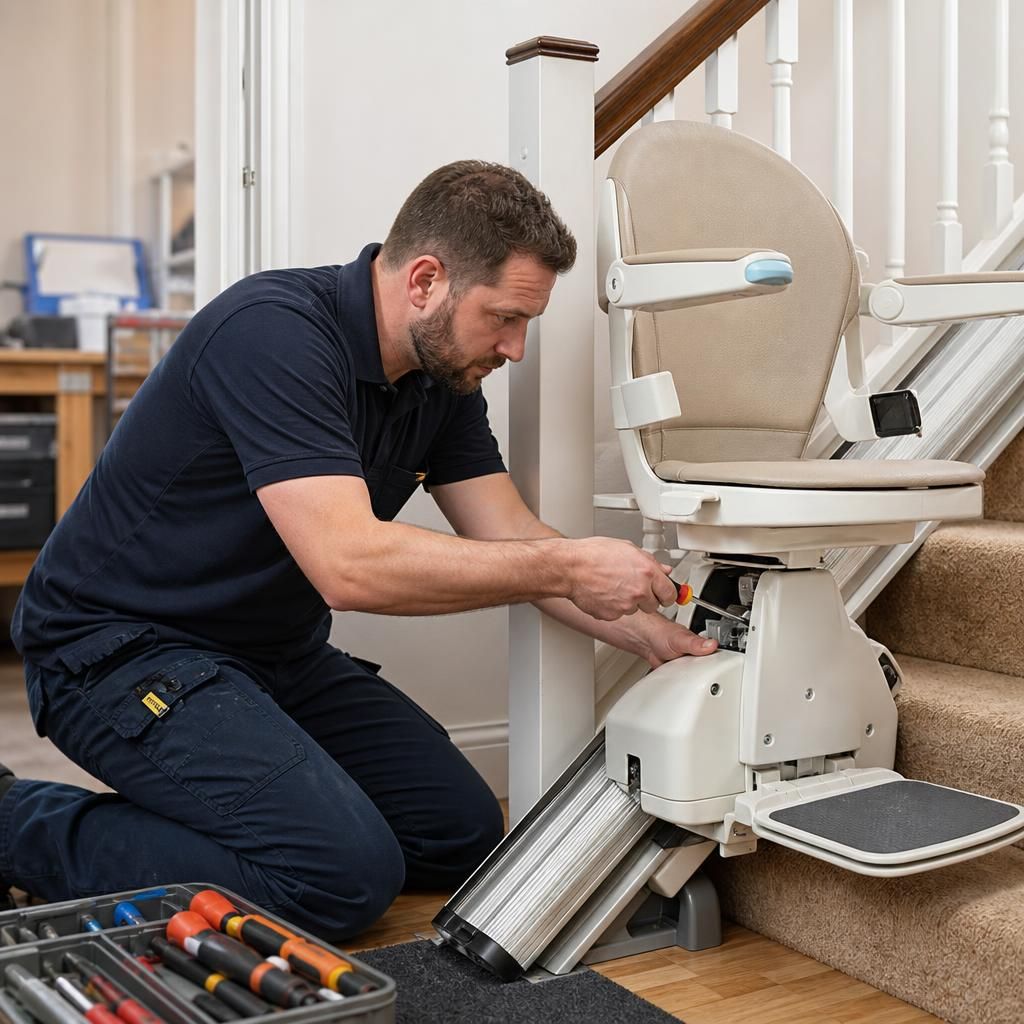
The lift is installed securely and then commissioned on the actual staircase. The installer checks rail fixings, travel, charging, parking, clearances and all accessible controls. Safety features are tested again after installation because movement, positioning or connection issues can only be identified reliably once the lift is fitted in its intended environment.
The user is shown how to operate the controls, use the seat and restraint, position the footrest, charge the lift, respond to an obstruction and use the emergency arrangements. Practical guidance should also cover keeping the stairs and rail clear, reporting unusual noises or faults, and arranging servicing when required.
Quality and safety therefore depend on the whole process: selecting a suitable unit, inspecting its history and condition, replacing defective parts, testing its mechanical and electrical systems, checking every safety device, and commissioning it correctly on the customer’s staircase. If your circumstances or staircase have changed since the original assessment, tell the installation team before fitting so that the proposed reconditioned stairlift can be reviewed rather than assumed to be suitable.
Professional commissioning after installation is a key part of making a reconditioned stairlift safe to use. Workshop testing confirms that the lift functions correctly, but fitting it on the customer’s staircase allows the installer to check the complete system in its actual surroundings.
The installer checks that the rail is securely fixed, the carriage travels smoothly, the seat and footrest have adequate clearance, and the lift parks and charges correctly. Safety devices, controls, braking and obstruction sensors are tested again after fitting. This is particularly important on curved or outdoor staircases, where the rail position, bends, surface conditions and surrounding space can affect operation.
During handover, the user is shown how to operate the lift, use the restraint, respond to an obstruction and report unusual noises or faults. These final checks and instructions help confirm that the refurbished stairlift is suitable for the staircase and understood by the person who will use it.
Arrange Your Reconditioned Stairlift Assessment
Arrange a reconditioned stairlift assessment so we can check your staircase, discuss your requirements and confirm whether a suitable refurbished model can be safely installed. Contact Independent Stairlifts to arrange your assessment.