
What factors should be considered when choosing between a new, reconditioned, or used stairlift?
Choosing between a new, reconditioned or used stairlift depends on your budget, staircase layout, required features, expected reliability, warranty and the level of installation and aftercare included. A professionally assessed reconditioned stairlift can offer a balance between cost and support, while a new model provides the widest choice of specifications and a used lift may suit simpler, budget-led requirements when its condition and installation are fully checked.
The right choice between a new, reconditioned or used stairlift depends on more than the purchase price. You should compare the lift’s condition, suitability for the staircase and user, safety checks, warranty, installation, future servicing and total cost. A new stairlift normally offers the widest choice and full manufacturer support; a professionally reconditioned stairlift can provide a practical balance between price and reassurance; and a used stairlift may be suitable only when its history, condition and installation have been properly verified.
New stairlifts are supplied with new or current components, subject to the model selected and the manufacturer’s specification. They usually offer the broadest range of seat styles, controls, finishes and optional features. This can be important where the user needs a particular seat position, powered swivel, adjustable armrests, extra support or controls that are easy to operate.
A new lift is also more likely to provide access to the latest design, software and safety features, together with the manufacturer’s standard warranty. It may be the most appropriate option where the staircase is unusual, the installation is outdoors, the user has specific postural or transfer needs, or long-term support and maximum choice are priorities. The main disadvantage is the higher initial cost, particularly for a bespoke curved rail or a specification with several additional features.
Reconditioned stairlifts are previously used lifts that have been removed, assessed, cleaned, serviced and tested before being offered for installation again. The exact refurbishment process varies, so it is sensible to ask what has been checked and which parts have been replaced. A proper assessment should include the drive system, batteries, charging equipment, safety sensors, controls, seat mechanism, carriage, rail and relevant electrical connections.
Reconditioning should also include functional testing and checks that the lift operates safely under the conditions expected in the home. The installer should confirm that the model is suitable for the staircase, that the rail can be installed securely and that the final installation complies with the applicable safety requirements. Written information about the warranty and aftercare should be provided, rather than relying only on a verbal description of the lift’s condition.
For many customers, a reconditioned stairlift offers a sensible compromise. It can reduce the upfront cost while still providing professional assessment, installation and ongoing support. However, the value depends on the quality of the refurbishment and the availability of replacement parts. A reconditioned lift should not be treated as equivalent to a private-sale used lift simply because both have been previously owned.
Used stairlifts can describe lifts sold privately, removed from another property or supplied without a full refurbishment service. Their condition and history may be difficult to establish. The lift could have been used heavily, stored incorrectly or removed without protecting important components. It may also be supplied without a meaningful warranty, installation service or access to technical support.
A low purchase price does not necessarily mean a used lift is the least expensive option overall. You may need to pay separately for transport, removal of an existing lift, alterations to the rail, installation, replacement batteries, repairs or an engineer’s inspection. Some models may also be discontinued, making parts or specialist support more difficult to obtain. A used lift should therefore be considered only when a competent stairlift professional has confirmed that it is suitable, safe and economically sensible to install.
Consider the staircase first. Straight staircases are generally easier to assess because the rail follows a single flight. Curved staircases require a rail made to follow the bends, landings and changes in direction. A reconditioned or used curved stairlift may not fit another property, even if the staircases appear similar, because the rail is normally made for the original layout. It may be possible to reuse some equipment, but this must be confirmed after a survey rather than assumed from photographs or measurements.
Outdoor installations need additional consideration. The stairlift must be designed for external conditions, including exposure to moisture, temperature changes and dirt, and the installation needs an appropriate location for charging and safe storage. A standard indoor model that has previously been used inside should not be treated as suitable for outdoor use without specific confirmation from the installer.
Match the lift to the user’s needs. Consider how the user transfers on and off the seat, whether they can operate a control safely, and whether they need support for their knees, hips, back or upper body. Check the seat height, weight capacity, armrest position, footrest design, seat belt and swivel arrangement. A lift that fits the staircase but is difficult for the user to access or control is not an appropriate choice.
Also consider who else uses the stairs. A folded seat and footrest can affect the remaining walking space, while a powered swivel or hinged rail may be useful where there is limited room at the top or bottom. Ask whether the controls can be fitted where they are accessible and whether additional call/send controls are needed for other household members.
Compare the complete cost, not just the advertised price. Request a clear explanation of what is included. This may cover the assessment, rail, seat and carriage, delivery, installation, removal of an old lift, electrical work, VAT where applicable, warranty and follow-up servicing. For a reconditioned or used lift, ask specifically whether batteries, chargers and worn components are included or treated as possible additional costs.
The cheapest option may be unsuitable if it requires extensive adaptation or is likely to need early repairs. Conversely, a new stairlift may offer features that are not necessary for the user’s circumstances. A professional assessment can identify whether a simpler specification will meet the need safely, or whether the staircase and user require a more specialised solution.
Check the warranty and aftercare carefully. Find out how long the warranty lasts, what it covers and whether it includes parts, labour, call-outs or batteries. Confirm any exclusions, such as accidental damage, misuse, water damage on outdoor equipment or faults caused by unauthorised alterations. Ask how to report a problem, whether emergency assistance is available and whether servicing can continue after the warranty expires.
Support is particularly important for a reconditioned or used lift because its previous operating history may be less certain. The supplier should be able to explain the lift’s condition, the work completed during refurbishment and the maintenance arrangements available after installation. Keep the service documentation and warranty details with the product information so they can be accessed if the lift needs attention.
Ask about safety and documentation. The installer should carry out a site assessment, explain any risks and provide operating guidance after fitting. The completed installation should be tested, and the user or carer should be shown how to use the controls, seat belt, swivel mechanism, charging system and emergency features. Do not buy a lift solely on the basis that it powers on; safe installation, correct adjustment and reliable safety devices are all essential.
In practical terms, choose a new stairlift when you need maximum specification choice, a bespoke solution or the latest available model. Choose a reconditioned stairlift when reducing the upfront cost matters but you still want a professionally assessed, installed and supported product. Consider a used stairlift only when its history and condition are clear and a qualified installer has confirmed its suitability, safety, warranty and total installed cost.
Before making a decision, arrange an assessment of the staircase and discuss the user’s mobility, transfer ability and expected length of use. Comparing like-for-like quotations that set out installation, warranty and aftercare will give you a more reliable basis for choosing than comparing lift prices alone.
The key difference between a reconditioned and a used stairlift is the level of checking, preparation and support provided before installation. A professionally reconditioned lift should be assessed, cleaned, serviced and safety-tested, with worn or defective components replaced where necessary. A used lift may be sold in its existing condition, with limited information about its operating history or remaining service life.
Before choosing a reconditioned or used model, confirm that the stairlift is suitable for the staircase and user, that essential components such as the batteries and safety sensors have been checked, and that installation is included. You should also receive clear warranty and aftercare information. The purchase price should be compared with the complete installed cost, including any repairs, replacement parts or additional servicing that may be required.
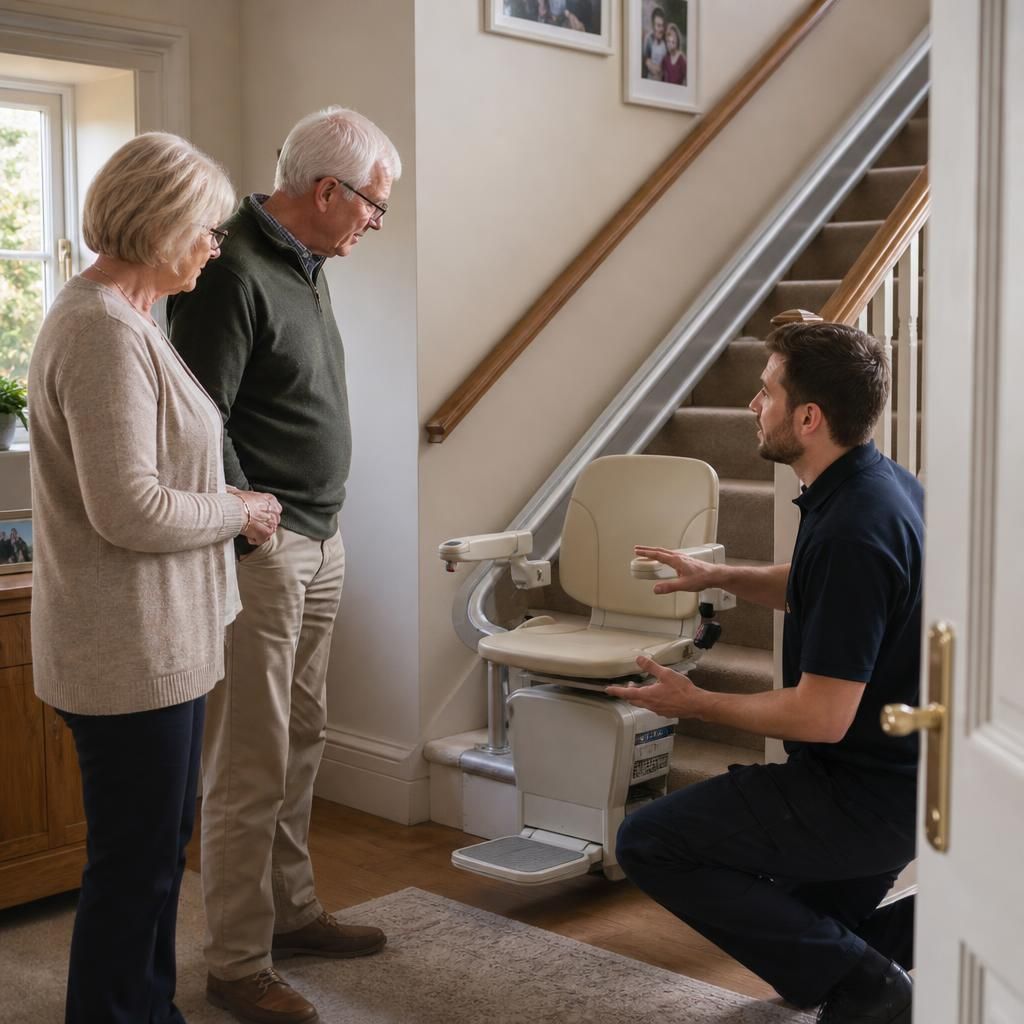
Discuss your new, reconditioned or used stairlift options
Discuss your new, reconditioned or used stairlift options with Independent Stairlifts, including your staircase, mobility requirements, total installed cost, warranty and aftercare.